Navigating US fintech regulations compliance: A guide to building compliant payment and lending solutions

US fintech regulations compliance means meeting four overlapping layers of obligations at once: federal supervision (CFPB, FinCEN, SEC, FTC), state licensing such as money transmitter licenses in 49 states, industry standards like PCI DSS for card data, and state privacy laws such as the CCPA. There is no single federal fintech license, so the exact mix depends on what your product does with money and data.
Compliance here is not just about avoiding fines. As payment infrastructure providers like Stripe note, it underpins customer trust and the durability of the product, and it reaches every stage of a financial product, from licensing and onboarding (KYC and AML) through data privacy, lending, and consumer protection.
In 2026–2027, US fintech compliance is being reshaped by a more fragmented mix of federal supervision, state privacy and AI rules, evolving open-banking expectations, and clearer scrutiny of digital assets. For payments and lending companies, the challenge is no longer only obtaining licenses and meeting baseline obligations, but building products that remain explainable, auditable, and adaptable as requirements change across jurisdictions.
This is a practical guide for fintech startups, incumbent banks, payment providers, and compliance professionals launching or scaling in the US. Based on our experience building solutions for fintechs, we'll break down the regulatory landscape, both federal and state, and the best practices for compliance by design.
Which US rules apply to your fintech?
Before mapping regulators, work out what your product actually does, because that is what pulls you into scope. Many founders assume they are unregulated until launch, but you are probably already regulated if you:
- hold, move, or store customer funds, or issue stored value
- store, process, or transmit payment card data
- extend credit, lend, or offer buy-now-pay-later
- issue, custody, or trade crypto tokens or stablecoins
- give investment advice or run automated portfolios
- use alternative data or automated decisioning in underwriting
- act as a technology vendor to a bank or a regulated fintech, since partner due diligence flows down to you
The table maps the most common fintech models to their primary regulators and the activity that brings each into scope:
| Fintech model | Primary regulators | What brings you into scope |
|---|---|---|
| Payments / money movement | FinCEN + state regulators | Moving money for others: money transmitter license (49 states) + FinCEN MSB registration |
| Lending / BNPL | CFPB, FTC, state regulators | Extending credit: state lender licenses + TILA, ECOA, and FCRA |
| Embedded finance / BaaS neobank | Sponsor bank + FinCEN | Funds and cards run through a partner bank, so its obligations become yours |
| Crypto / stablecoins | SEC, CFTC, FinCEN | Token or stablecoin activity: a securities review plus the GENIUS Act framework |
| Investment / robo-advisory | SEC + state securities regulators | Advising on or managing investments: investment-adviser registration |
| Card payments | PCI Security Standards Council + card networks | Storing, processing, or transmitting cardholder data: PCI DSS |
The unique complexity of the US regulatory landscape
The regulatory environment for fintech companies in the United States is unusually broad and fragmented. Unlike many other countries, the US financial regulation system is governed by a mosaic of federal and state regulatory authorities, each with their own laws, compliance requirements, and enforcement mechanisms. This makes for one of the most challenging and costly compliance regimes in the world for fintech companies, traditional financial institutions, and their technology partners.
At the core of this complexity is the country's dual banking system and federalist structure. Fintech companies operating nationwide must address federal regulations, which set the baseline for areas such as consumer protection, anti-money laundering (AML), and data privacy, plus a vast array of state-level laws and licensing obligations layered on top.
States hold significant regulatory power over non-bank financial activities. For example, money transmitter licensing must be obtained state-by-state, and lending activities are subject to each state's unique interest rate caps like usury laws and disclosure rules. Some states run particularly stringent regimes: California through the CCPA, and New York through the NYDFS Cybersecurity Regulation (23 NYCRR 500), which requires covered financial companies to run a formal cybersecurity program, designate a CISO, and report significant cyber events within 72 hours.
This patchwork gives rise to several distinctive challenges:
- Operational complexity and costs: Without a unified national licensing scheme, fintech companies must navigate dozens of application processes, ongoing reporting, audits, and changing local compliance requirements, greatly increasing time-to-market and cost of compliance.
- Regulatory overlap and ambiguity: Overlapping jurisdiction between federal and state laws, and among various federal agencies themselves, often leaves fintech companies uncertain about which laws apply and how to prioritize compliance efforts. For example we helped a client evaluate multiple Banking-as-a-Service (BaaS) providers from a technical standpoint. The overlapping US rules made this hard: the right partner has to fit on both technical capability and regulatory coverage, not just one of the two.
- Constant regulatory change: US regulators are continually updating rules to address emerging risks and technologies, requiring fintech firms to monitor the rules closely and adapt rapidly. As a result, they must implement changes into their products without delay, so maintenance services become essential in such cases.
What makes the 2026–2027 environment especially demanding is that compliance obligations now extend beyond traditional licensing and consumer protection into data governance, AI oversight, and operational evidence. Fintech teams increasingly need to document how product decisions are made, how consumer data is used, and how automated systems are monitored for risk, bias, and accuracy. In practice, this means regulatory readiness is becoming a continuous operational function rather than a one-time legal review.
In the US, then, compliance behaves less like a launch checklist and more like an ongoing product function, one that has to keep pace with both federal shifts and 50 sets of state rules.
Key federal regulatory bodies and their functions
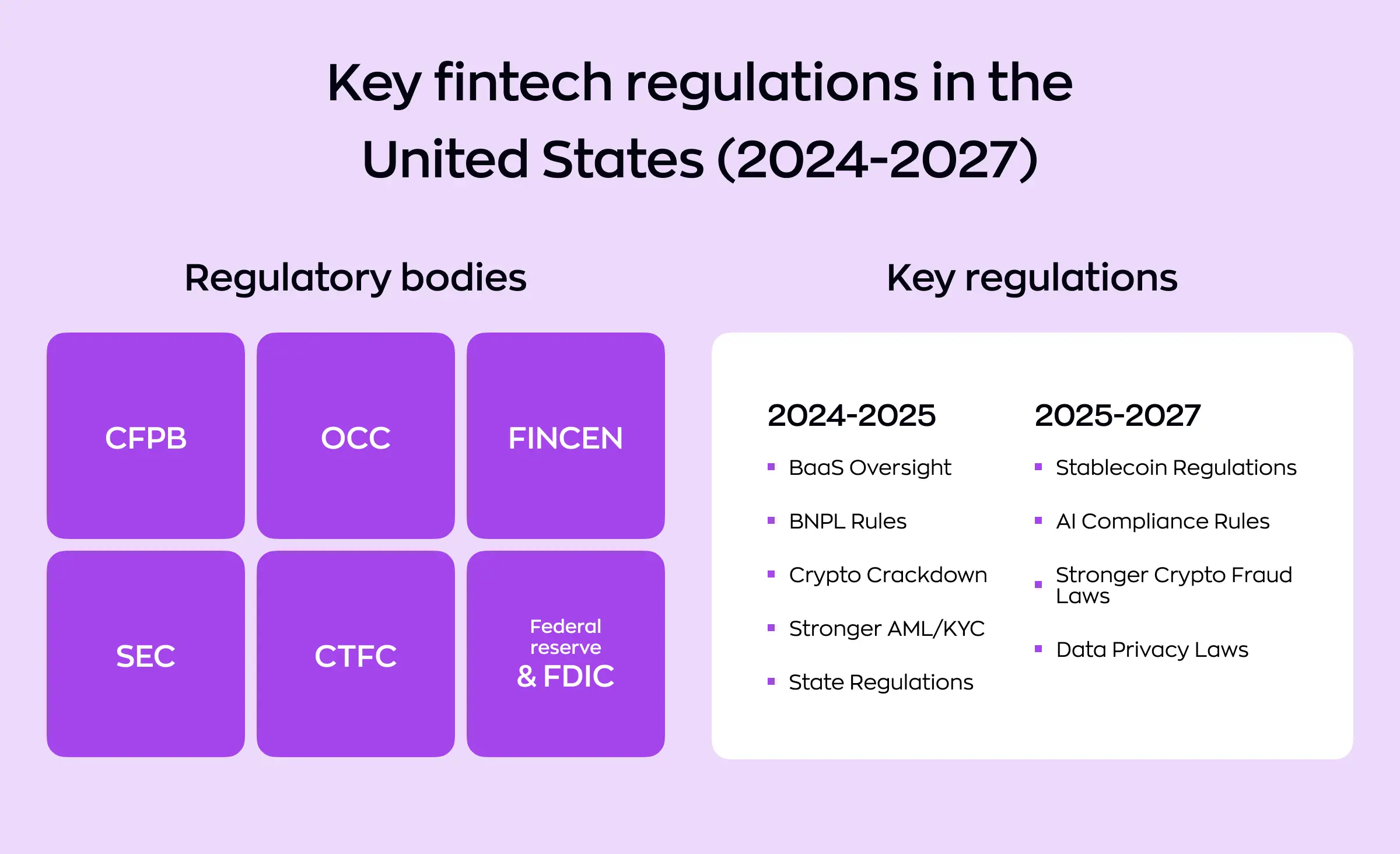
Fintech companies in the US answer to several federal regulators, each covering a different slice of financial activity and consumer protection. Which ones apply depends on what your product does, and the mix matters for both fintech startups and established financial institutions.
Consumer Financial Protection Bureau (CFPB)
Established in the aftermath of the 2008 financial crisis, the Consumer Financial Protection Bureau is dedicated to providing fair treatment of consumers by all entities offering financial products and services. Its authority covers a range of practices, including the monitoring and enforcement of UDAAP (Unfair, Deceptive, or Abusive Acts or Practices). Fintech compliance regulations such as Regulation E (governing electronic funds transfers) and Regulation Z (implementing the Truth in Lending Act) are enforced by the CFPB, making this agency central to consumer protection and disclosure standards for payments and lending solutions.
The CFPB's Personal Financial Data Rights rule (Section 1033) remains the main open-banking signal, but its status is unsettled. The rule was finalized in October 2024 with a first compliance date of April 1, 2026, yet a federal court has enjoined enforcement, and the Bureau opened a reconsideration in August 2025 that may revise or replace it. For payment providers, this means the technical direction (consumer-authorized data sharing, consent management, and account-access reliability) is not going away, even as the exact obligations shift. We advise clients to build these controls now, so the product can absorb the final rule when it lands, whatever form it takes.
Financial Crimes Enforcement Network (FinCEN)
Part of the US Department of the Treasury, FinCEN administers the Bank Secrecy Act (BSA) and oversees the implementation of anti-money laundering (AML) obligations, often aligning its guidance with international standards set by the Financial Action Task Force (FATF). Fintech companies facilitating payments, managing digital assets, or offering lending services, especially those using distributed ledger technology, must run a Customer Identification Program (CIP) under the USA PATRIOT Act to verify identities (KYC), screen customers and transactions against OFAC sanctions lists, monitor activity, and file Suspicious Activity Reports (SARs) when monitoring flags something unusual. Enforcement has grown in recent years, especially around digital assets and cross-border payments, where AML failures carry significant penalties. In 2024, TD Bank paid about $3 billion to resolve AML failures, including a record $1.3 billion FinCEN penalty, after program gaps let more than $600 million be laundered.
Office of the Comptroller of the Currency (OCC), Federal Deposit Insurance Corporation (FDIC), and Federal Reserve System
These agencies supervise and regulate traditional banks and, increasingly, fintech companies working in partnership with or as part of the federal banking system. The Federal Reserve oversees monetary policy and systemic financial stability; the FDIC insures bank deposits and provides sound risk management; and the OCC charters and oversees national banks. Partnering with federally regulated banks is a common path for fintech startups to access the financial system and offer insured deposit accounts or payment processing.
Securities and Exchange Commission (SEC)
The SEC regulates securities markets, investment products, and increasingly, digital assets that are classified as securities. Fintech firms launching investment platforms or dealing with certain cryptocurrencies must assess whether their offerings fall under SEC regulation, as unclear boundaries can lead to regulatory action and significant legal risk. Firms dealing with broker-dealer activities must also be aware of the rules enforced by the Financial Industry Regulatory Authority (FINRA), which oversees broker-dealers in the US.
For fintechs offering investment features, token-based products, or crypto-linked services, the SEC and CFTC's joint March 2026 interpretation made federal securities analysis more concrete. It sets out a token taxonomy: digital commodities, collectibles, and tools are not themselves securities; stablecoins may or may not be, depending on their characteristics; and digital securities are securities regardless of tokenization. Companies should assume that digital-asset offerings require a documented review of whether the product or token activity falls under securities laws, rather than treating crypto as a lightly regulated add-on. This matters most for platforms that combine payments, custody, or yield features with consumer-facing interfaces. Stablecoins now sit under a dedicated federal regime: the 2025 GENIUS Act (Guiding and Establishing National Innovation for U.S. Stablecoins Act), the first US framework for payment stablecoins, limits who may issue them to bank subsidiaries, OCC-supervised nonbanks, or state-chartered issuers under comparable rules.
Federal Trade Commission (FTC)
The FTC enforces consumer protection law and acts against unfair or deceptive practices, overseeing data privacy, advertising, and marketing across industries, including fintech. For fintechs specifically, it enforces the GLBA Safeguards Rule (the data-security duties covered below) and pursues deceptive fee or marketing claims, so clear disclosures and a documented security program are the practical baseline.
In practice, most consumer fintechs answer to the CFPB and FTC by default, add FinCEN the moment they move money or touch digital assets, and pull in the SEC only if they deal in investment or crypto products. Which of these apply comes down to whether you hold funds, move money, lend, or deal in securities.
One 2026 development cuts the other way. Executive Order 14405 (May 2026) orders federal financial regulators to review and roll back rules that unduly impede fintech innovation, and directs the Federal Reserve to study direct payment-system access for non-bank fintechs. It is a signal, not a rule change yet, but it means some federal barriers may ease over the next year.
State-level regulatory compliance and licensing
While federal compliance regulation shapes the overall framework for fintech companies operating in the United States, state-level requirements add another demanding layer of complexity. In practice, launching payment or lending solutions nationwide often means navigating more than fifty distinct regulatory systems, each with unique laws, licensing protocols, and consumer protection mandates.
Money Transmitter Licenses (MTLs)
Perhaps the most significant hurdle for many fintech startups and payment providers is the need to obtain Money Transmitter Licenses for each state where they intend to operate. As of 2026, 49 states require an MTL to move money on behalf of others (Montana is the only broad exception), and there is no single federal license that lets non-bank fintech companies, for example those offering embedded finance, cover all states at once. Each state regulator imposes its own licensing criteria, fees, bonding requirements, compliance checks, and periodic audits, with per-state surety-bond and fee requirements that can climb into the hundreds of thousands of dollars. Separately, money transmitters must register federally as a Money Services Business (MSB) with FinCEN, which ties them to Bank Secrecy Act and AML obligations from day one.
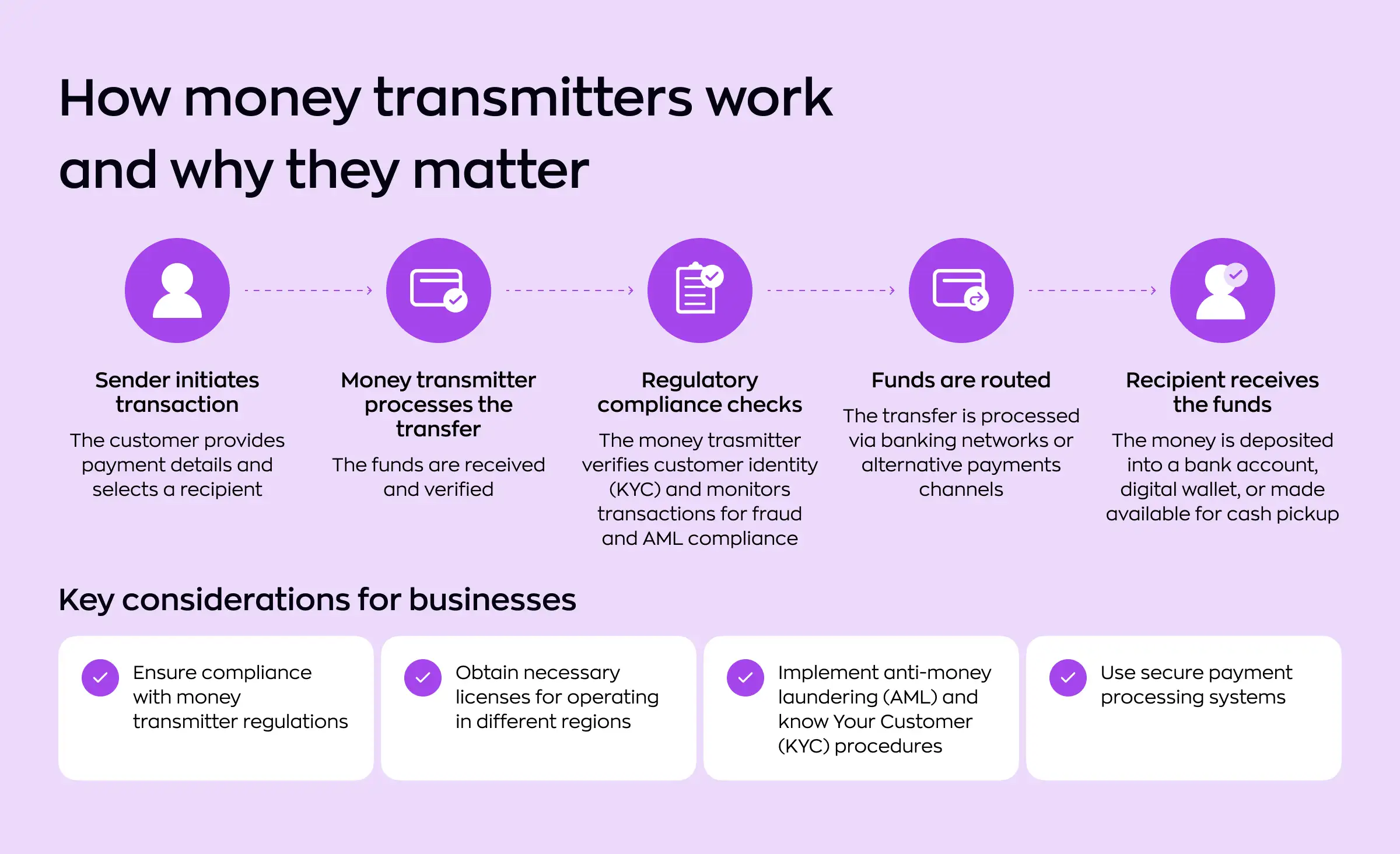
This fragmented licensing regime presents several challenges:
- Administrative and financial burden: The application process for MTLs can be lengthy and expensive, with costs mounting quickly for companies aiming for national coverage.
- Ongoing compliance obligations: Each state may require regular financial reporting, examinations, and updates, creating a heavy, ongoing compliance and operational load.
- Non-uniform regulatory expectations: States differ in how they define “money transmission,” and requirements can change with little notice, demanding continual regulatory monitoring.
Standardization is improving through the CSBS Model Money Transmission Modernization Act (MTMA) and the Multistate MSB Licensing Agreement, where one state's review of common requirements is accepted by the other participating states. Even so, money transmitter licensing remains fragmented and state-driven, with no single federal or unified state license available to non-bank providers.
Lending licenses and usury laws
A fintech business involved in credit products must also tackle state-by-state lending license requirements. These regulations go beyond initial registration: they cover everything from permissible interest rates and fees to underwriting disclosures, collection practices, and marketing communications.
Of particular note are usury laws, which cap allowable interest rates and fees, and these caps can vary widely from state to state. As a result, a fintech company may have to dynamically adjust its product features, borrower eligibility criteria, and even pricing models to maintain compliance across its footprint.
Beyond state usury caps, lending fintechs sit under a stack of federal statutes that dictate product behavior: the Truth in Lending Act (TILA) governs how you disclose the cost of credit, the Equal Credit Opportunity Act (ECOA) prohibits discrimination and requires adverse-action notices when you decline an applicant, and the Fair Credit Reporting Act (FCRA) sets rules for using credit data. These translate directly into product requirements (disclosure screens, decline-reason logic, and consent flows), not just legal paperwork. If you lend through a partner bank, the “true lender” question (who is legally the real lender, and therefore whose state usury caps apply) stays unsettled: the OCC's 2020 true-lender rule was repealed in 2021, so courts decide it case by case. Practically, keep per-state rate caps in data rather than hard-coded and document who actually underwrites, so a shift in the legal answer is cheap to absorb.
In 2026–2027, fintechs must also consider fair lending, model governance, and whether AI-assisted underwriting could create discrimination or disclosure risks. Where alternative data or automated decision-making is used, product teams should build controls that can explain outcomes, preserve audit trails, and support legal review across multiple states. Recognized references here are the NIST AI Risk Management Framework and ISO/IEC 42001, the certifiable AI-management standard.
Data privacy laws
State privacy regulation is now a major compliance issue for fintech companies in the US. Financial data already has a federal baseline: the Gramm-Leach-Bliley Act (GLBA), whose Privacy Rule and Safeguards Rule require financial institutions to disclose their data-sharing practices and protect nonpublic personal information, enforced by regulators including the FTC and CFPB. There is still no single federal law equivalent to the EU's GDPR, so several states have layered broad privacy statutes on top of that GLBA baseline, governing how personal data is collected, used, shared, and retained.
Key regulations
- California Consumer Privacy Act (CCPA) and its amendment through the California Privacy Rights Act (CPRA). These laws give California residents strong rights over their personal information and impose broad obligations on covered businesses.
- Virginia Consumer Data Protection Act (VCDPA). This law introduces requirements for data protection assessments, consumer rights handling, and limits on the use of sensitive data.
- Colorado Privacy Act (CPA). This law adds obligations around universal opt-out mechanisms, consumer rights, and processing of sensitive data.
- Connecticut Data Privacy Act (CTDPA). This law follows a similar model and reinforces the need for consistent rights-management and governance processes.
- Other states are also adopting privacy laws, which is steadily expanding the compliance patchwork.
Fintech companies are hit hardest because they process sensitive financial, identity, and behavioral data across exactly the workflows these laws police: onboarding, fraud and risk scoring, underwriting decisions, marketing personalization, and automated decision-making.
Main compliance challenges
- Fragmented requirements. State laws are similar, but not identical, so companies cannot rely on a single uniform workflow everywhere.
- Sensitive data controls. Fintechs must apply stricter handling rules to data such as precise geolocation, biometrics, financial account data, and other sensitive categories.
- Consumer rights handling. Companies need operational processes for access, deletion, correction, and opt-out requests.
- Vendor oversight. Privacy laws increasingly require tighter contracts and monitoring of service providers and processors.
- Risk assessments and documentation. Many laws require privacy impact or data protection assessments for higher-risk processing activities.
What has changed recently
In 2026, state privacy laws are shifting from notice-based obligations to active governance requirements. California's updated CCPA regulations phase in obligations for automated decision-making technology, cybersecurity audits, and risk assessments on staggered deadlines through 2030, while other state laws require privacy impact assessments for targeted advertising, data sales, profiling, and sensitive data processing. For fintechs, this means privacy must be built into onboarding, underwriting, fraud controls, personalization, and any workflow that uses automated or high-risk data processing.
For fintech companies handling sensitive financial data across multiple states, meeting the highest applicable state standard is often the most efficient strategy, though it raises the bar for compliance readiness.



Industry standards and self-regulation
Beyond what federal and state law require, US fintechs face a layer of industry standards. These are technically voluntary, but banking partners, card networks, and enterprise customers treat them as table stakes, so in practice they are mandatory to win partnerships and pass due diligence.
Payment Card Industry Data Security Standard (PCI DSS)
For any fintech company or financial institution involved in processing, storing, or transmitting payment card data, compliance with the Payment Card Industry Data Security Standard (PCI DSS) is mandatory. The standard maintained by the PCI Security Standards Council (founded by the major card networks) sets 12 core security requirements for protecting cardholder data. Non-compliance can lead to financial penalties, reputational damage, loss of payment processing privileges, and increased liability in the event of a breach.
- Continuous monitoring and implementation: PCI DSS is updated periodically to address evolving threats. Fintech businesses must demonstrate ongoing adherence through strong data encryption, regular vulnerability assessments, access controls, and security training.
- Integration with product design: Embedding PCI DSS controls during the earliest stages of development reduces retrofitting costs and supports security-by-design, a best practice for all digital financial product development.
We build PCI DSS-ready products rather than acting as a card processor ourselves. In practice that means running on infrastructure that already holds PCI DSS Level 1 attestation (Google Cloud or AWS) and adding the application-level controls the standard expects: encryption in transit and at rest, strict access control, and regular vulnerability testing throughout development and support. We embed these controls from the design stage, so clients can scope and pass their PCI audits without retrofitting.
General Data Protection Regulation (GDPR) and international self-regulation
While GDPR is a European compliance regulation, many US-based fintech companies opt to align with its high bar for data privacy, especially when servicing global or cross-border clients, much like they would observe guidelines from bodies such as the Financial Conduct Authority in the UK for market conduct. It also carries real teeth for any US fintech that touches EU data: fines can reach €20 million or 4% of global annual turnover. Adopting GDPR principles such as data minimization, explicit consent, and the right to erasure can future-proof operations and support international expansion.
Ronas IT applies global best practices based on GDPR principles (privacy by design, minimized data collection, and consent management) in all projects, even for US clients. Our solutions support key data subject rights and provide secure infrastructure, helping clients meet international standards for data privacy and security.
Security certifications: SOC 2, ISO 27001, and NIST CSF
Beyond PCI DSS, banking and BaaS partners usually expect a recognized security attestation before they connect you. The common ones are SOC 2 (an independent audit of your security, availability, and confidentiality controls), ISO/IEC 27001 (a certifiable information-security management standard), and the NIST Cybersecurity Framework (a widely used reference model for managing cyber risk). On the neobank project below, a SOC 2 attestation was the gate the banking deal required, and the architecture was built to those standards from day one.
The role of regtech and automated compliance solutions
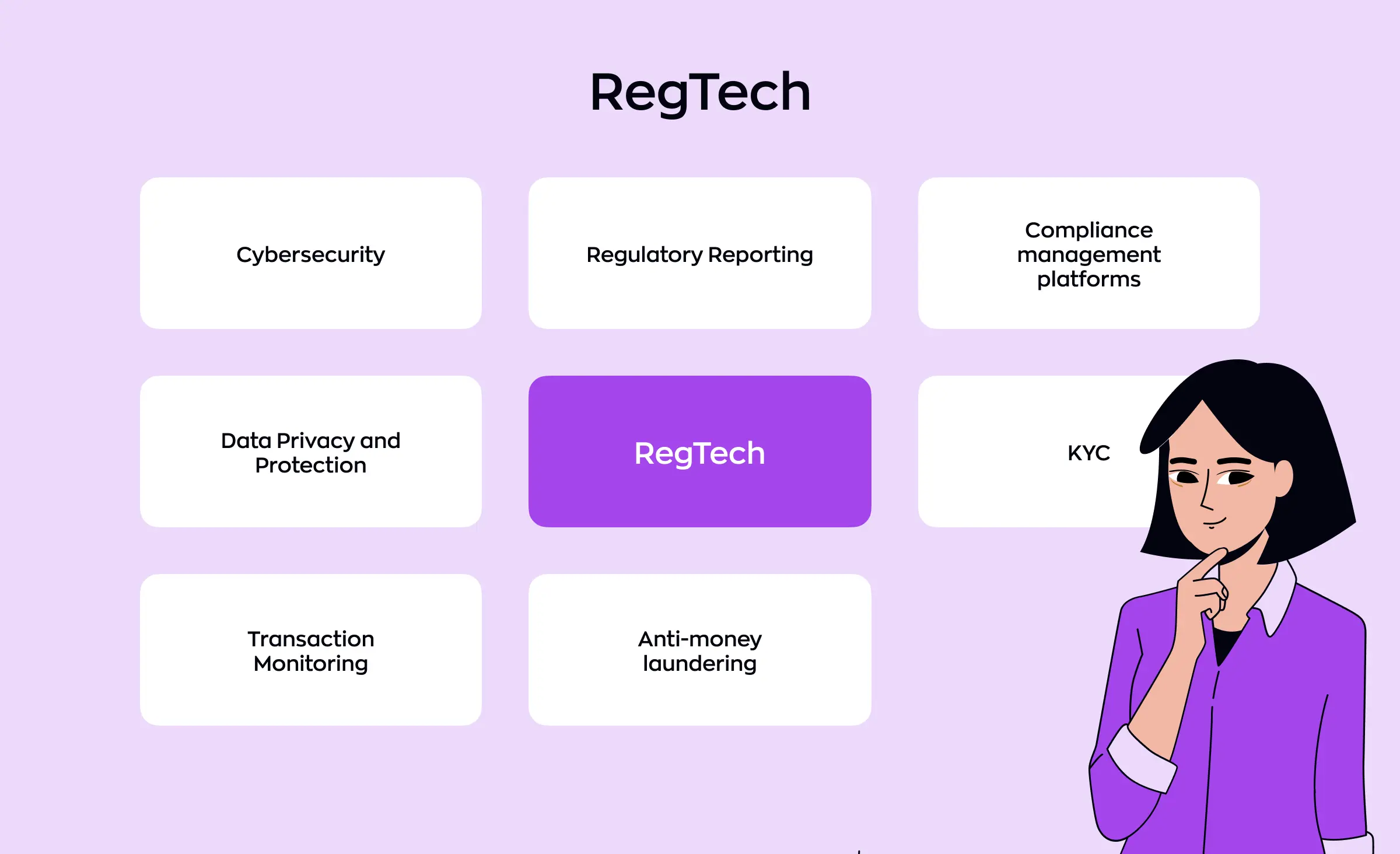
As regulatory complexity has grown, so has the fintech industry's adoption of regtech platforms, software that automates compliance workflows. Several US states also run a regulatory sandbox, among them Arizona (the first, in 2018), Utah, and Wyoming, letting fintechs test new products under temporary regulatory relief before taking on the full burden. In 2026–2027, firms are using automation not only for KYC and AML updates, but also for regulatory change tracking, evidence collection, AI governance documentation, and privacy risk management. For scaling fintechs, RegTech helps reduce manual workload while creating the auditability needed to respond quickly to state and federal compliance changes.
Beyond the bare minimum: Why self-regulation matters
Industry best practices, such as regular security audits, transparent incident response procedures, and proactive fraud detection, are increasingly expected by partners, customers, and regulators alike. For fintech companies seeking partnerships with banks or BaaS providers, a demonstrated security posture is often a prerequisite, and it doubles as a competitive advantage and a signal of trust in the US market.
Compliance by design: Building compliance-ready fintech products
“Compliance by design” means considering regulatory requirements, consumer protection, and risk management from the beginning of every project, rather than treating compliance as an afterthought. This lowers legal and operational risk and lets fintech companies iterate and scale without repeatedly reworking the product to fit US rules.
That is how we build fintech products. Security, data protection, and the ability to adapt to new regulations are treated as architecture decisions, not a legal review bolted on at the end, so the controls a US regulator or a banking partner expects are in the product from day one.
“We use the same security standards whether an app is a bank or not: least-privilege access, secrets locked to CI maintainers, admin surfaces behind a VPN, and proven cloud infrastructure underneath. For fintech we make those controls explicit and configurable, so when a rule changes we adjust a policy layer instead of rewriting the product.”
Evgeny Leonov, CTO at Ronas IT
Compliance by design also depends on a clear split of ownership:
- Legal counsel or a compliance officer decides what the rules require in your specific case.
- The engineering team turns each requirement into a concrete control in the architecture and code.
- The product manager keeps the roadmap in step with regulatory deadlines, so a required change ships on time rather than after a rule is already in force.
Integrating compliance requirements early
Embedding compliance early during system architecture, process design, and product specification means regulatory requirements such as KYC, AML, and consumer protection measures are built in from day one. In our experience, aligning technical and legal teams at the outset keeps fintech projects out of costly rewrites and last-minute fixes, while preserving flexibility to adapt to regulatory changes.
- Discovery phase: During discovery, this means capturing regulatory use cases early in user flows, data flows, and acceptance criteria so that KYC, AML, consent management, and consumer-protection rules are visible and prioritized before development begins.
- Architecture: At the architecture level, compliance-driven design typically leads to modular, event-driven, and policy-driven components, with clear boundaries between data domains, detailed audit trails, and strong access-control models.
- Tech-stack choice: When choosing the technology stack, this often favors platforms that support fine-grained logging, role-based access control, configurable workflows, and separation of duties, so regulatory rules can be updated through configuration rather than rewriting core code.
Automated KYC/AML workflows
Know Your Customer (KYC) and Anti-Money Laundering (AML) checks are among the heaviest compliance requirements for US fintechs, and by 2026 they are almost always automated. Identity verification, transaction monitoring, and sanctions screening run through specialist providers, often using AI algorithms to read documents, match faces, and flag suspicious activity in real time. These same identity checks also help satisfy the Red Flags Rule (under FACTA), which requires a written program to detect identity theft at onboarding. On our own projects we wire these in as dedicated services at onboarding rather than build them from scratch, which keeps verification consistent and lets us update the compliance logic as rules change.
Data architecture and security
Building a secure data architecture is essential for meeting both regulatory obligations (PCI DSS, CCPA, and voluntary GDPR standards) and industry partner expectations. Compliance-oriented systems address:
- Data minimization and encryption for both storage and in-transit communications
- Access controls and auditing to monitor activity and detect anomalies
- Least-privilege access and network isolation, with role-based access, network segmentation, and regular access reviews to limit unauthorized access and lateral movement
- Continuous monitoring and real-time threat detection to provide rapid response to emerging risks and compliance drift
- DevSecOps integration, embedding security practices and automated compliance checks throughout the entire custom software development lifecycle
- Site Reliability Engineering (SRE) practices focused on building resilient infrastructures, automating incident response, and maintaining service reliability at scale
- Disaster recovery and incident reporting with managed backups and replication (Cloud SQL / RDS) rather than hand-rolled scripts, to meet regulatory notification timelines and maintain consumer trust
These controls focus on meeting regulatory obligations. For the threat-modeling and defensive side, see our guide to cybersecurity in US fintech.
Our control matrix (excerpt)
The table below turns a subset of these practices into concrete controls, using the fintech project described later as a representative example. It maps each obligation to the control we implement and where that control lives. Infrastructure-level controls come from PCI DSS Level 1 cloud providers, while application-level controls are ours to build and prove.
| Obligation / standard | Control we implement | Where it lives |
|---|---|---|
| PCI DSS (cardholder data) | Encryption in transit and at rest; no long-term storage of raw sensitive data | Google Cloud / AWS (Level 1) + app layer |
| KYC / AML (FinCEN, BSA) | Automated identity verification and fraud screening via KYC providers, run at onboarding | Persona, Sardine + microservice |
| Least-privilege access | Fine-grained, role-based access; no team member has full project access | App layer + DevOps process |
| Secrets and admin surface | Access keys in CI environment variables (maintainers only); admin panels behind project VPN | GitLab CI + VPN |
| Data privacy (CCPA, GDPR-aligned) | Data minimization, consent management, and configurable export/deletion workflows | App layer |
| Auditability | Audit trails, real-time monitoring, and high automated test coverage on key modules | App layer + monitoring stack |
| Resilience and recovery | Managed backups and replication (Cloud SQL / RDS), not hand-rolled scripts | Cloud provider |
Auditing, monitoring, and reporting mechanisms
Regulators expect you to prove compliance, not just claim it. That means built-in audit trails, centralized reporting, and periodic internal and external assessments, so the evidence is already in place when the CFPB or a state regulator asks for it, and so gaps surface early instead of during an exam.
User transparency and disclosure
Clear, upfront communication with users matters for both legal compliance and customer experience. Since onboarding and disclosures happen entirely in-app, they must also meet the ESIGN Act's rules for valid electronic consent and signatures. UDAAP and other consumer protection laws require fintech companies to:
- Provide plain-language disclosures on terms, fees, and lending conditions
- Make sure users can easily access, correct, or delete their data (to meet emerging privacy regulations)
- Implement transparent dispute resolution and complaint mechanisms
What a compliance-by-design program includes
Concretely, that means automated logging of key decisions, structured consent capture, policy versioning, and model-risk review for any AI-driven workflow. Each obligation is mapped to a specific product feature early, wherever onboarding, lending, fraud detection, or personalization touches sensitive data, so ownership of it is clear and it can be updated in one place when the rule shifts.
The Ronas IT advantage: Expert guidance and reliable solutions
Navigating US fintech regulations takes regulatory analysis, deliberate planning, and hands-on engineering. At Ronas IT, we start each project by turning the rules that apply to you into concrete product and architecture requirements, working from the obligations your legal or compliance lead defines. We document those requirements with you from day one, so there are no surprises later.
Our development process is grounded in privacy and security by design. Whether we're building a mobile app, a web SaaS platform, or a complex banking solution, we collect only the necessary user data, incorporate automated consent management, and use secure infrastructure trusted by global enterprises like AWS, Google Cloud, Auth0, and GitLab. Using DevOps practices, we tightly control data access within our team, consistently encrypt sensitive information, and regularly conduct automated tests to identify and fix vulnerabilities before launch.
We don't just hand over code; we also help set up practical workflows for handling requests related to data privacy, such as exporting or deleting user information, tracking data processing, and staying on top of compliance routines. If you choose our ongoing support, we monitor your software for new risks and regulatory updates, adapting the solution to evolving requirements after deployment. As needed, our experts can step in as a virtual CTO, providing strategic technical leadership and guiding your product from idea to launch and beyond.
Case study: Development of a neobank app for credit score tracking
We were approached by a client aiming to launch a new neobank app targeting US consumers, a market where security, flexibility, and regulatory compliance all matter from day one. The solution needed to support onboarding, ongoing credit-building programs, and day-to-day payment functionality, all while protecting sensitive user data and meeting the highest standards for privacy and consumer transparency.
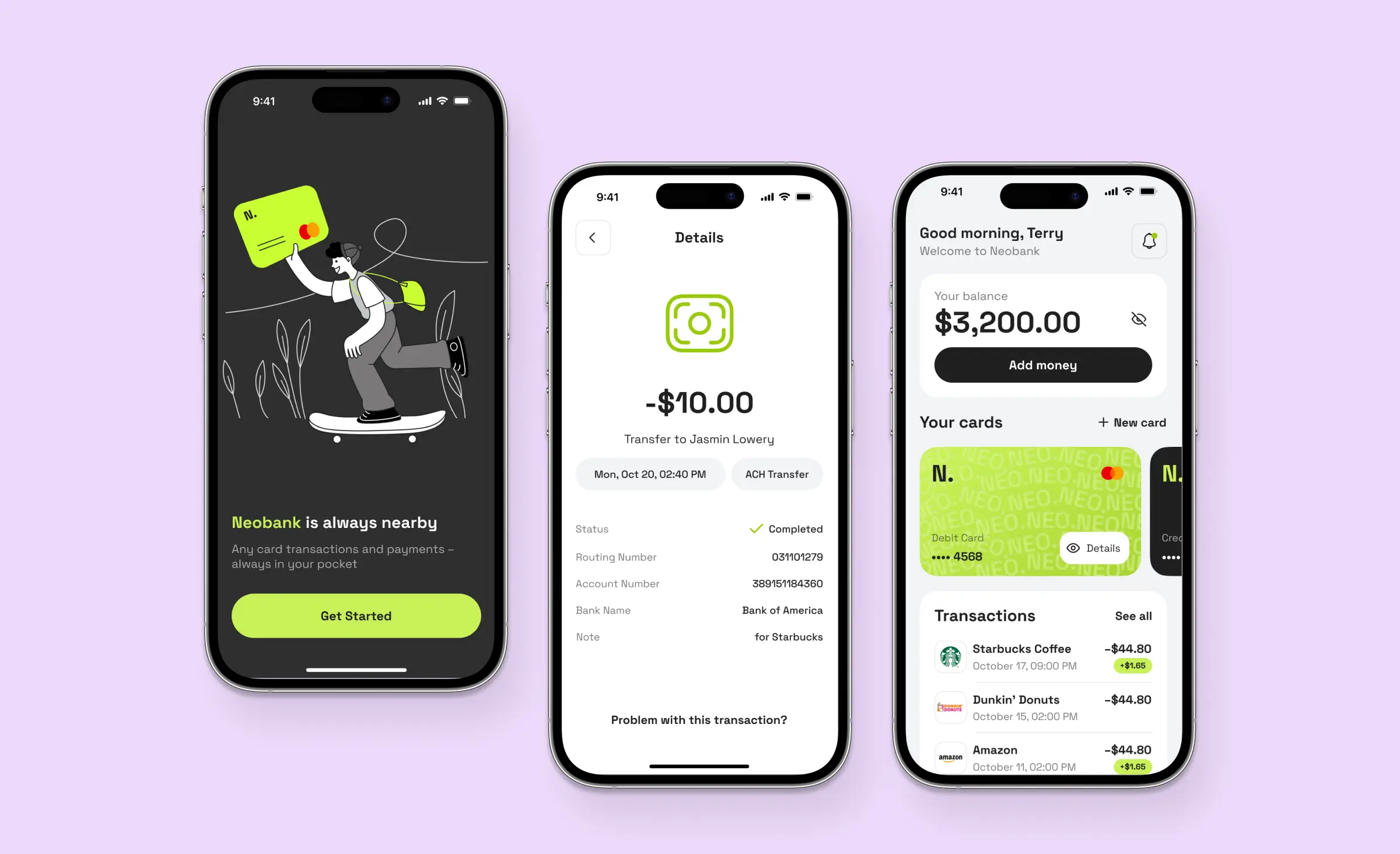
To meet these goals, Ronas IT designed a microservice architecture keeping financial and personal information strictly separated and accessible only on a need-to-know basis. Automated KYC and AML processes were integrated using trusted third-party solutions like Persona and Sardine, supporting real-time identity verification and fraud checks. Personal data was processed instantly for compliance but never stored long-term, which cut regulatory exposure and privacy risk.
The real engineering challenge was not any single integration but making them behave as one reliable flow. We unified eight external services (a BaaS gateway, authentication, KYC and fraud vendors, and account-linking and direct-deposit providers) with seven in-house microservices. To keep it maintainable, we split the backend into small single-responsibility services, so a change in one rarely ripples into the others. When a failure crossed the vendor boundary, the hard question was whose bug it was, ours or the provider's; request-level monitoring let us trace the whole chain end to end (our request, the provider's response, its webhook, and the resulting state on our side) until the broken step was obvious.
From a compliance perspective, SOC 2 was the certification the project required, and our team passed its part of that certification; PCI DSS and ISO/IEC 27001 were treated as design standards the architecture was built to satisfy. We helped the client evaluate Banking-as-a-Service providers on technical merit; they chose Bond as the gateway to US banks, so that deposit, payment, and card-issuance functionality met the required federal and state-level regulations.
Throughout closed beta and rollout, the app passed Apple's App Store review, which vets store policies rather than financial compliance. During the beta and store-launch period, 1,285 accounts were opened by verified users, and the modular architecture kept it adaptable to changes in US compliance requirements. The product was later removed from both app stores.
During the engagement, regular updates folded in new regulatory changes, security fixes, and user feedback, so the compliance posture stayed current as US requirements shifted.
Let's partner up
Our work on this neobank app is just one example. Across all regions, Ronas IT applies the same diligence whether providing GDPR compliance and accessibility for European fintech platforms, building systems around PCI DSS requirements for Australian payment providers, or designing a mobile banking product concept for the MENA region. For products that reach development, we build the agreed compliance controls into the architecture so the client can prepare for partner due diligence and regulator questions.
None of this is legal advice. Treat it as an engineering-side map of the terrain and confirm the specifics with qualified counsel or a compliance officer. If you are launching or scaling a fintech product in the US, a practical starting sequence is:
- Map your product to the federal regulators that apply: CFPB, FinCEN, SEC, and the FTC.
- List the states where you move money and need a money transmitter license, and register as a Money Services Business with FinCEN.
- Add PCI DSS scope if you touch card data, plus GLBA and the privacy laws of your users' states.
- Decide who owns compliance: legal counsel or a compliance officer defines what is required, and your build partner implements and maintains it.
- Build the matching controls into the architecture from day one, in a configurable policy layer you can update as rules change.
Frequently Asked Questions (FAQs)
What compliance does a US fintech company actually need?
There is no single fintech license to check off; what you need is driven by what your product does. If you move or hold money, money-transmitter licensing (49 states) and FinCEN AML rules apply. Handle card data and PCI DSS enters the picture; offer credit and federal lending laws like TILA and ECOA apply. Consumer-protection and state privacy rules sit on top, so the exact set is specific to your product, not a fixed checklist.
Do fintech startups need a money transmitter license?
If your product holds customer funds, moves money, or issues stored value, you almost certainly do. As of 2026, 49 states require a money transmitter license (Montana is the main exception), and each is a separate application with its own fee and surety-bond requirements that can climb into the hundreds of thousands of dollars. You must also register federally as a Money Services Business with FinCEN, which triggers AML obligations from day one.
Is PCI DSS compliance mandatory for fintech companies?
Yes, if you store, process, or transmit payment card data. PCI DSS is a set of 12 security requirements maintained by the PCI Security Standards Council (founded by the major card networks), and non-compliance can cost you card-processing privileges plus penalties. A common way to shrink the burden is to tokenize card data through a compliant processor so raw card numbers never touch your own systems, which narrows the scope you have to certify.
Does GDPR apply to a US-based fintech?
The US has no single federal privacy law like the EU's GDPR, but GDPR still applies to any US fintech that offers products to, or monitors the behavior of, people located in the EU, with penalties reaching €20 million or 4% of global annual turnover. Even for US-only products, following core GDPR practices, collecting less data, getting clear consent, and honoring deletion requests, is a practical way to also satisfy strict state laws like the CCPA.
What changed in US fintech compliance for 2026?
Three shifts stand out. Updated CCPA regulations took effect on January 1, 2026 and phase in new cybersecurity-audit, risk-assessment, and automated decision-making (ADMT) duties on staggered deadlines running from 2027 through 2030; those ADMT rules treat granting or denying lending as a “significant decision.” The SEC and CFTC issued a joint March 2026 crypto token taxonomy, and the CFPB's open-banking rule (Section 1033) is enjoined and under reconsideration, so its data-sharing obligations are in flux.
How much does it cost to build a compliant fintech product?
It depends on scope. At Ronas IT, a proof of concept or MVP runs from $8,000 to $25,000 and takes a few weeks, while a full compliant fintech platform (KYC/AML, encryption, access controls, audit trails) starts from $75,000 and about 3 months. Build cost is only part of it: state licensing and legal counsel run separately and can take months, so plan them in parallel. For a scoped number, tell us about your product.
How do you keep a fintech product compliant as regulations change?
Rules change after launch, so compliance logic (consent, disclosures, and state-specific limits) is kept as configuration rather than hard-coded, and audit trails plus monitoring flag drift early. Each obligation in our control matrix maps to a specific feature, so a change usually touches one place. With ongoing support, we watch for new state and federal rules and roll the changes in, usually within one release cycle.
Related posts





Related Services
MVP Development Services
Need to launch your startup quickly? Ronas IT offers urgent MVP development services, allowing you to get a fully-functional app in 4 to 12 weeks, depending on scope. Ideal for testing business ideas, presenting to investors, or entering the market swiftly. Benefit from our extensive experience and accelerated development process.
Fintech Software Development Services
We build secure, scalable fintech solutions like neobanks, trading, and investment platforms — tailored to your market and regulatory needs. Our team ensures robust KYC, compliance, and data privacy, delivering modern, user-friendly interfaces and flexible microservice architectures. From code audits to full-cycle development and ongoing support, we help you launch and manage high-performing fintech apps with confidence.
Custom Web App Development Services
Build secure, scalable web applications with Ronas IT’s custom web app development services. Our team covers the full cycle — from concept and UI/UX design to development, testing, and ongoing support — using leading tech like React and Laravel. With 200+ custom apps delivered across various industries, we ensure intuitive interfaces, smooth integration, and solutions tailored to your business goals.