Embedded finance in the USA: How non-financial companies can add banking features to their platforms

Embedded finance lets a non-financial company offer payments, lending, insurance, or even full banking inside its own product, without becoming a bank. In the US market, that convenience is how platforms boost revenue and earn loyalty: your users handle money right where they already are, in your mobile app, web app, or website, instead of leaving for a traditional bank.
This article explains what embedded finance is, how it fits the US market, and the key technical components and challenges involved in adding it to your product. We also cover embedded lending in detail, since it is the fastest way for a non-financial platform to offer credit without holding its own lending license.
What is embedded finance?
Embedded finance is the practice of integrating financial services into non-financial products, applications, and user experiences. It means digital platforms, such as online shops, marketplaces, or travel apps, can give users financial tools directly within their own ecosystem.
For example, an online store might include embedded payments at checkout so customers never have to leave the site, while travel apps can offer embedded insurance at the moment of booking. Retailers that provide “buy now, pay later” options illustrate embedded lending in action, as users can split purchases into installments instantly. Some platforms now also enable embedded investing, letting users access investment tools without switching apps.
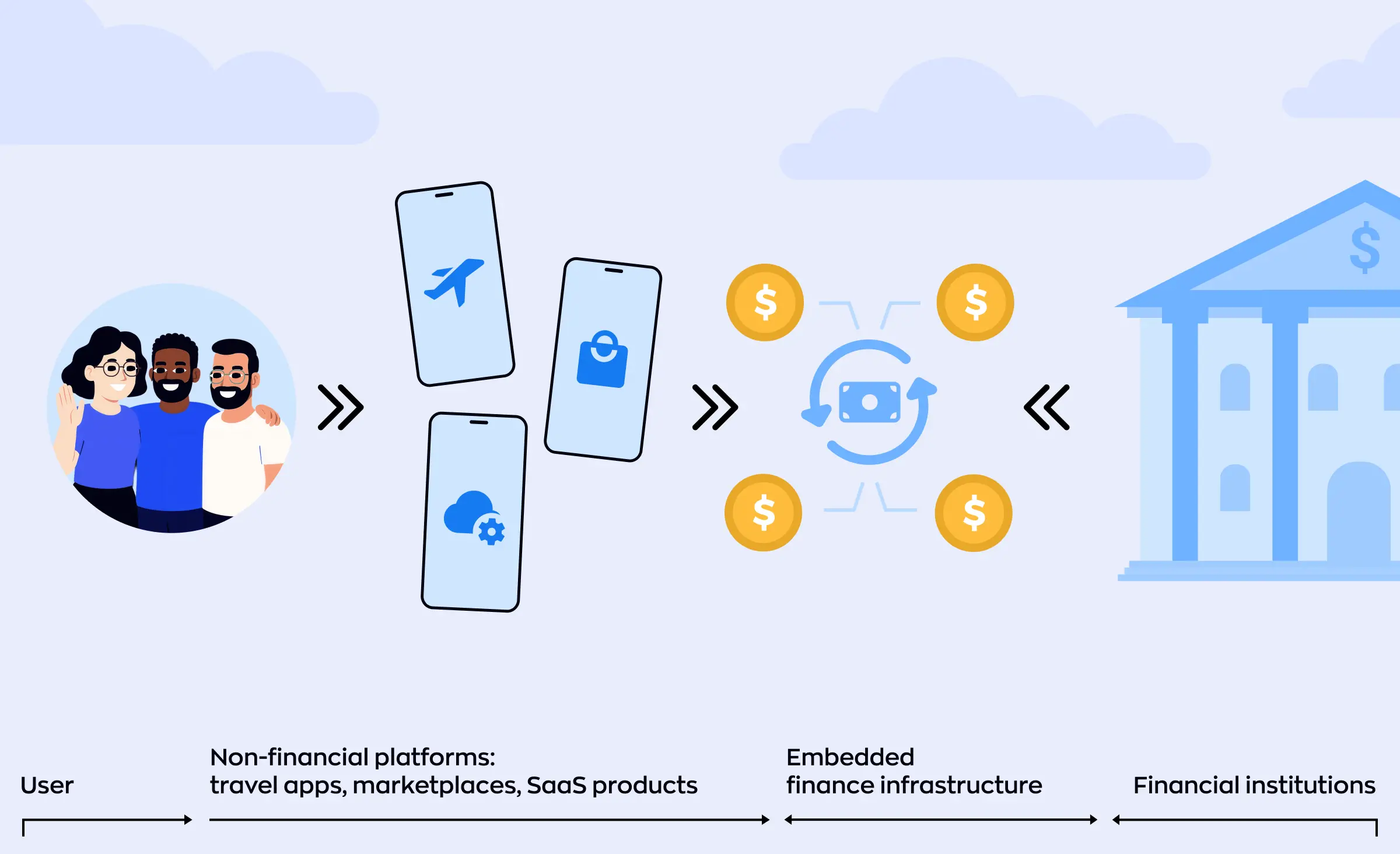
Users can open accounts, take out loans, and make payments or investments inside a single familiar app, without visiting a traditional bank.
Why do non-financial businesses add embedded finance?
For a non-financial business, embedded finance adds a new revenue stream and makes the core product more useful to the customers already using it. The main benefits break down five ways.
Unlock additional revenue
By offering embedded payments, embedded lending, or even embedded banking, businesses earn commissions, interest, or referral fees from their financial product offers. For example, when an e-commerce platform provides embedded financing for its sellers, it makes money from each loan in addition to typical transaction fees.
Build lasting loyalty
When customers can pay or borrow inside an app they already use, they have fewer reasons to go elsewhere. A business tool that builds in payment processing and instant payouts, for example, becomes where users handle money day to day, so they come back more often.
Gain insights from customer data
When non-financial platforms add financial tools, they get better data on customer financial behavior. For example, a SaaS provider that manages client subscriptions can track cash flow trends. This information helps them offer more personalized financial solutions, like tailored lending options or credit lines, based on real-time customer data.
Stand out from competitors
By adding financial services that others don’t offer, a platform can separate itself from the competition. For instance, a property management software that integrates embedded payments for rent collection is far more appealing than one that just lists properties.
Provide access for underserved users
Many consumers and small businesses, especially those in underserved areas, have trouble working with traditional banks or getting loans. A platform for gig workers, for example, can offer basic banking services or micro-lending through an embedded finance platform, reaching people often ignored by financial institutions.
The embedded finance phenomenon in the USA
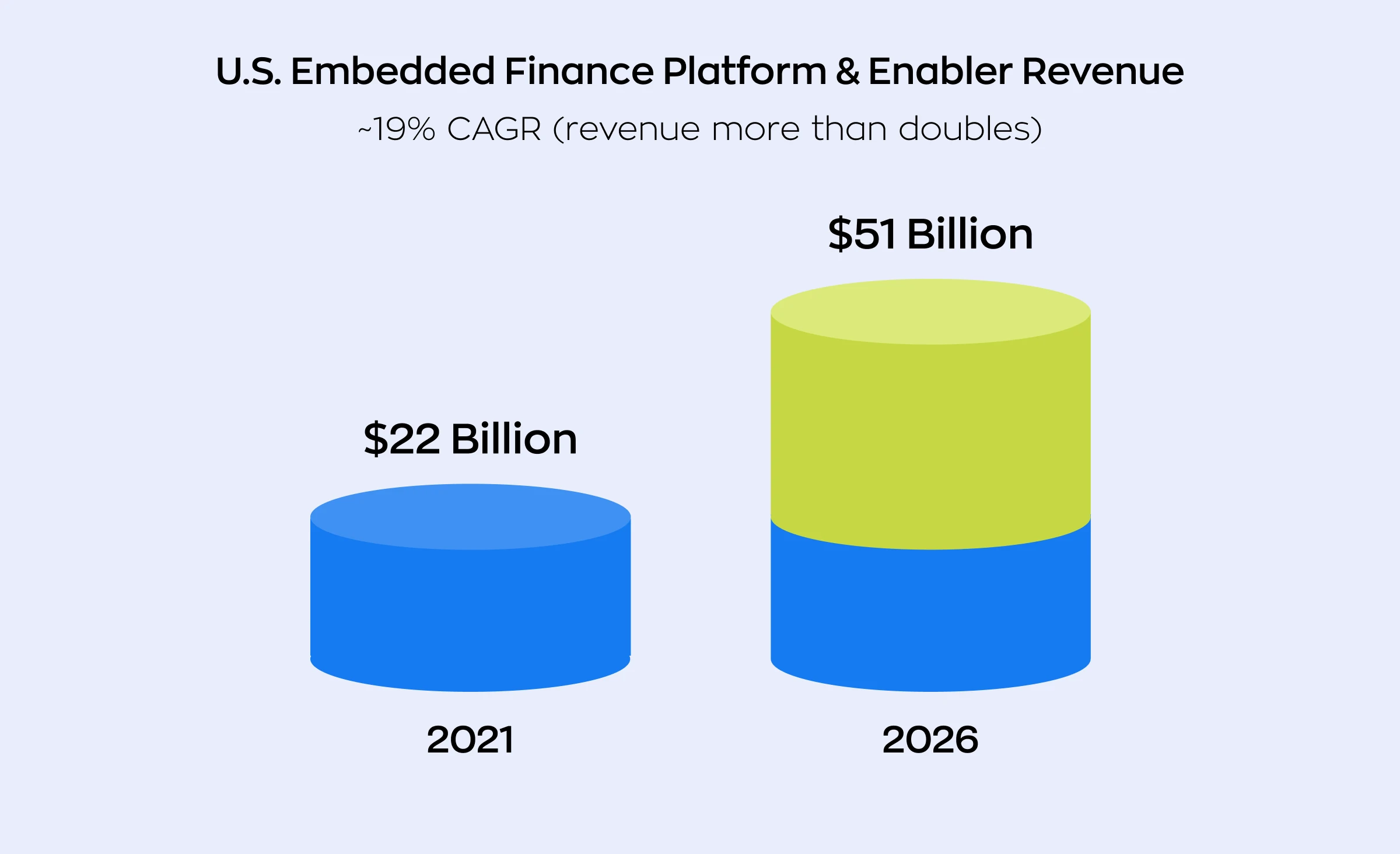
Embedded finance in the USA is moving from a niche add-on to a default layer of digital products. A 2022 Bain & Company report projects that embedded finance transactions will exceed $7 trillion by 2026, or over 10% of total US transaction value, up from nearly 5% in 2021. In the same report, platform and enabler revenue across US payments, lending, and banking is set to more than double from $22 billion in 2021 to $51 billion by 2026, a 19% annual growth rate. Several factors drive this growth.
High digital literacy
Americans demonstrate a high level of digital literacy: users are already comfortable with banking apps, contactless cards, digital payments, and online payment platforms.
Developed API infrastructure
The country has a mature fintech API infrastructure. Banking-as-a-Service platforms such as Stripe Treasury and Unit give businesses the tools to add accounts, cards, payments, and lending to their products through APIs, without building the banking stack themselves.
Openness to new models
Consumers in the USA are open to new business models and embedded fintech products. People will try financial features from brands they trust, even when those brands are not traditional banks.
Lower customer acquisition cost
For a platform, embedded finance turns users it already has into financial customers at a fraction of the cost a standalone bank or fintech pays to win them. As ad costs on channels like Google and Meta climb, monetizing that existing audience through payments, cards, or lending is one of the cheapest ways a platform can grow.
Faster payment rails
US money increasingly moves in real time. FedNow, the Federal Reserve's instant-payment service, went live in 2023 and, alongside the private RTP network, lets platforms settle payouts and transfers in seconds instead of days. Instant settlement makes embedded payouts, wallets, and lending far more useful, which pushes more platforms to build them.
Embedded finance examples in the USA
There are several notable examples of successful embedded finance integrations in popular U.S. products, including Shopify Capital and Uber Wallet.
Shopify Capital
Shopify Capital lets merchants access cash advances or embedded lending directly within the Shopify platform. By embedding financing in daily operations, Shopify uses merchants’ sales data to offer personalized financing options and amounts. Repayments are automated, with a fixed percentage taken from daily Shopify sales, so they track the merchant’s real cash flow. Shopify earns a share of each advance’s repayment, which turns Capital into a revenue line beyond its usual transaction fees.
Uber Wallet
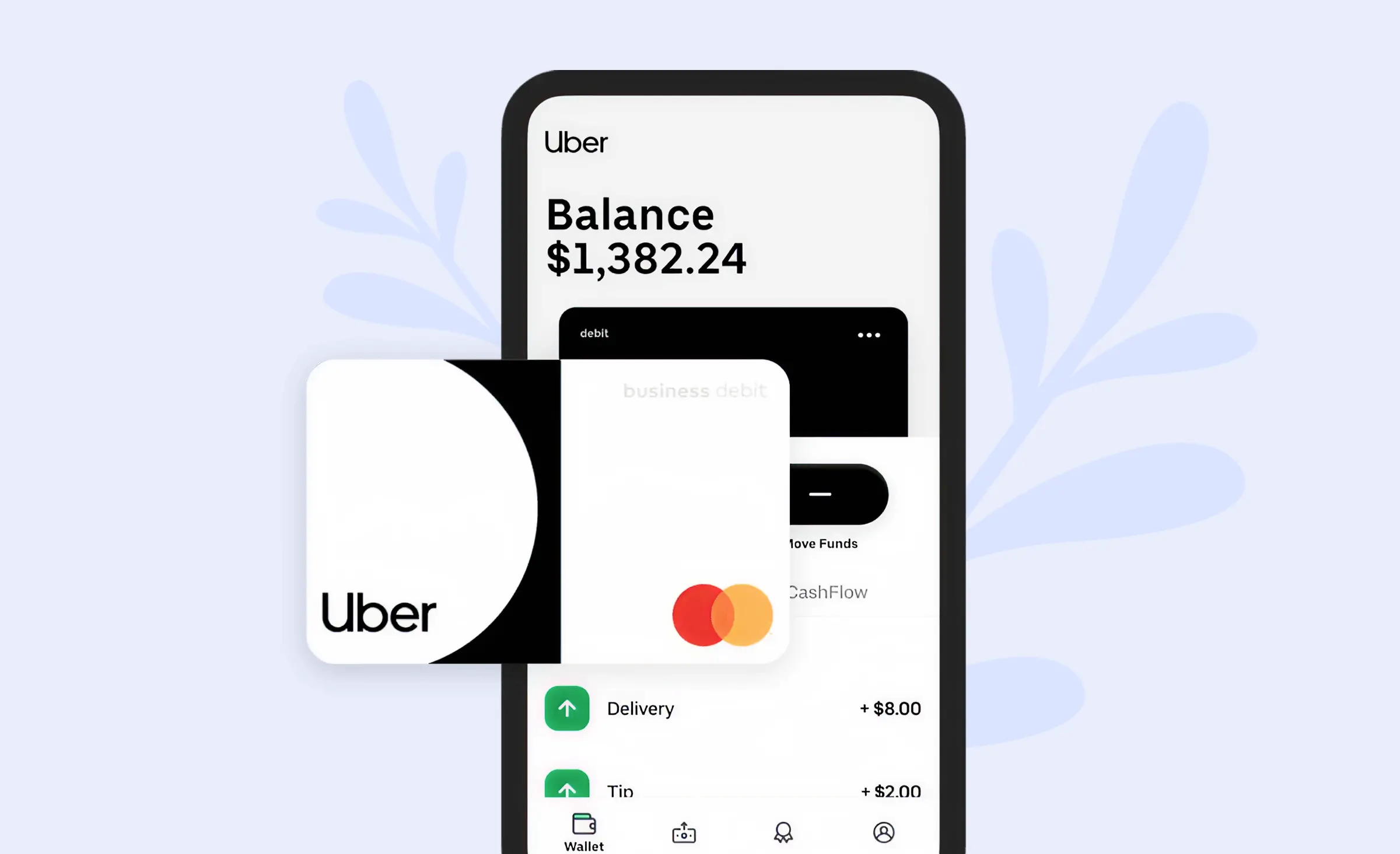
Uber Wallet is embedded finance at work: Uber builds payments, account-like balances, and card issuing directly into the app, so drivers and couriers get instant payouts, store earnings, and spend via a linked debit card, without visiting a bank. For earners, the value is faster cash flow, automated payment processing, and rewards; for Uber, it increases retention and keeps financial transactions inside its ecosystem.



Banking-as-a-service (BaaS): the infrastructure behind embedded finance
Banking-as-a-service (BaaS) lets licensed banks expose their core banking infrastructure through APIs, so a non-financial company can offer customized financial solutions without holding a banking license of its own. Here is how a BaaS program works, step by step:
A chartered bank holds the license: it keeps customer deposits and carries the regulatory responsibility for the accounts and cards behind the product.
The BaaS provider exposes it through APIs: it sits on top of that bank and turns accounts, cards, payments, and lending into APIs, plus the compliance, fraud, and reconciliation tooling around them.
The platform integrates the APIs: a retailer, marketplace, or SaaS tool plugs those APIs into its own app or website, so it can offer financial features without building or becoming a bank.
Customers use the features in-app: end users open accounts, make payments, or borrow directly inside the platform they already use, while the bank and BaaS provider run everything in the background.
Not every fintech API is BaaS: account-linking and data APIs like Plaid move a user's bank data between apps (open banking), while BaaS supplies the regulated accounts, cards, and payments themselves.
Several established BaaS providers serve the US market, each running a different model. When we evaluated them for a neobank we built for a US client, that model mattered more than any feature list, so this table compares the main options:
| Provider | Model | Best fit |
|---|---|---|
| Unit | Orchestration layer across several chartered partner banks, with tooling to migrate a program if one bank exits | Teams that want multi-bank resilience and a fast start |
| Galileo | Card processor owned by SoFi; works either as a processor behind your own sponsor bank or as a full program manager | Card issuing and payment processing at scale |
| Stripe Treasury | Single-API embedded accounts and cards over partner banks such as Fifth Third Bank | Teams already building on Stripe payments |
| Synctera | Orchestration over US community banks with heavy compliance, fraud, and BSA tooling | Compliance-first programs after the 2024 regulatory tightening |
| Column | A nationally chartered bank with a direct developer API and no middleware in between | Teams that want to work straight with a chartered bank |
Behind each of these APIs sits a chartered bank that actually holds the license; names like Evolve Bank & Trust, Cross River, Column, and Lead Bank power US programs. Provider strategies also shift: Synapse collapsed into bankruptcy in 2024, Bond (the provider on that neobank project) is now part of FIS, and Treasury Prime moved to a bank-direct model in 2024. Check both the provider and its sponsor bank before you commit.
Embedded lending: how to offer credit without your own lending license
Embedded lending lets a non-financial platform offer credit inside its own product, without holding a lending license. A licensed bank or lender originates the loan and carries the credit and regulatory responsibility, while your platform owns the customer experience. Point-of-sale “buy now, pay later” is the best-known form, but embedded lending is broader: it also covers revolving credit lines, term loans, merchant cash advances, and invoice financing. Adding Bain’s 2026 estimates for US point-of-sale lending ($7.5 billion) and B2B lending ($1.3 billion) puts embedded lending revenue near $8.8 billion, one of the fastest-growing parts of embedded finance.
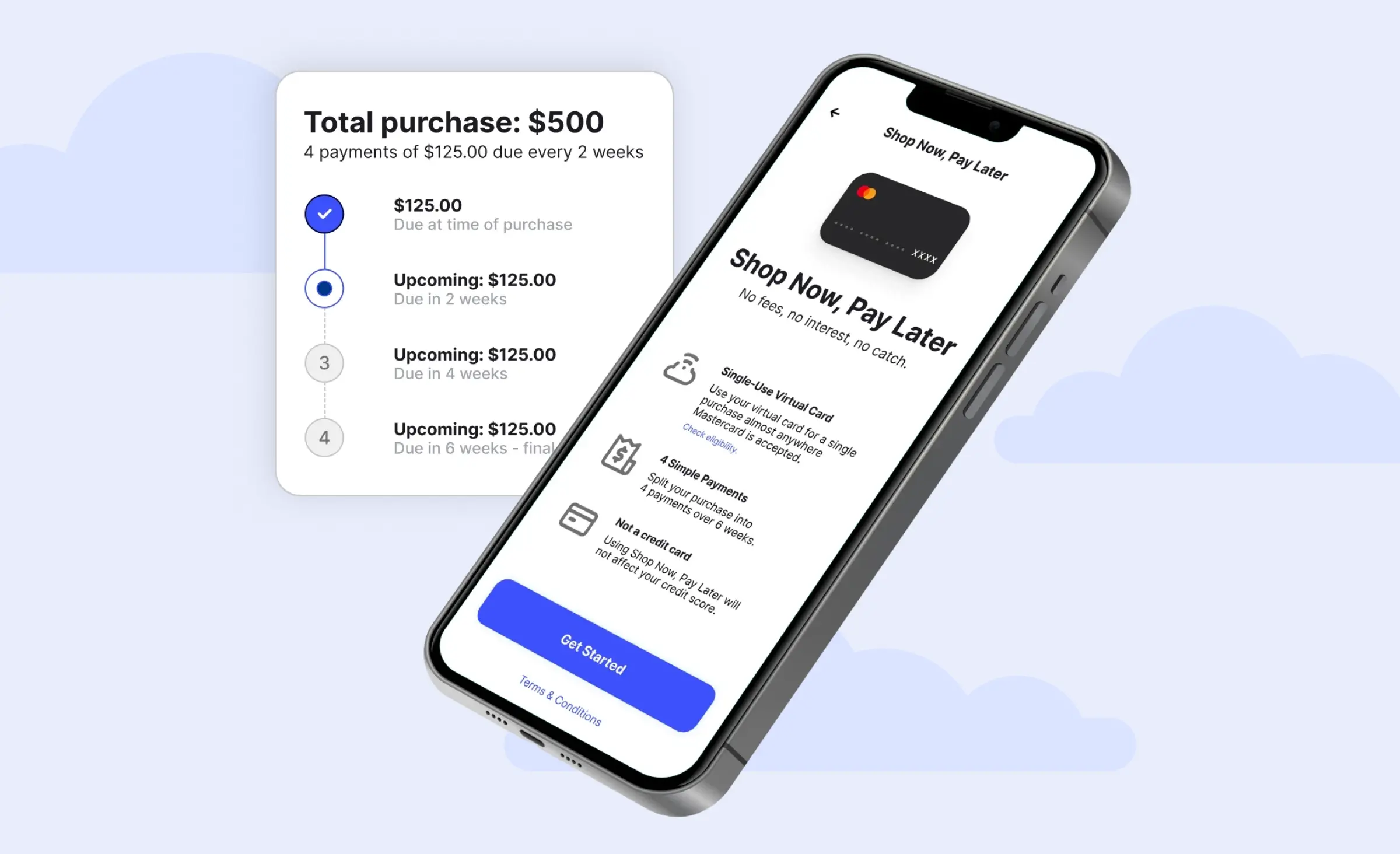
Three parties make an embedded lending program work. The platform integrates financing into checkout, invoicing, or payouts and owns the customer relationship. The bank or lender provides capital, originates loans, and holds the license. A loan management layer handles origination, servicing, repayments, and compliance tracking. Because your platform doesn’t hold the loan on its own balance sheet, it usually earns money through a revenue share on the interest and fees or a per-loan referral fee, rather than the interest margin itself.
Embedded lending now reaches well beyond retail checkout. Healthcare platforms finance procedures at the point of care, education tools spread tuition into installments at signup, property software offers deposit or renovation financing, travel apps let customers pay for a trip over time, and B2B marketplaces advance working capital against future invoices. Any platform that already sits between a customer and a purchase is a candidate for embedded credit.
You still run KYC and AML checks, and depending on the product you may need state-level licenses. Watch the “true lender” question in particular: US state regulators increasingly challenge programs where a bank originates a loan mainly to pass it to a non-bank partner, so your documentation has to show a genuine bank role. We cover these rules in our guide to US fintech regulations and compliance.
Challenges and solutions for implementing embedded finance in the USA
Embedded finance opens real opportunities for non-financial companies, but it also brings specific challenges worth planning for.
Managing technical complexity
Non-financial companies must integrate with many APIs from various BaaS providers, payment processing gateways, embedded lending engines, and other financial services. Orchestrating these diverse APIs, each with its own documentation, standards, and update cycles, requires expert development and ongoing maintenance. Additionally, non-financial platforms launching embedded finance often face challenges with scalability, system compatibility, and real-time processing requirements for financial transactions.
Solution: Build strong internal development teams or work with leading fintech software development companies for integration, maintenance, and updates. Choose a well-established embedded finance platform that offers pre-built integrations and ongoing technical support.
Navigating regulatory aspects
The sponsor bank holds the banking license, but the non-financial company offering the embedded finance product is responsible for "last-mile" compliance. This means they ensure correct customer onboarding with KYC and AML procedures, manage fraud detection at the user interface, handle customer complaints about financial services, and follow consumer protection laws.
It helps to know who watches what. The OCC, FDIC, and Federal Reserve supervise the sponsor banks and, since their 2023 interagency guidance on third-party relationships, expect those banks to oversee the risk in their fintech programs. The CFPB handles consumer protection; its Section 1033 open-banking rule was finalized in 2024, then enjoined and reopened for reconsideration in 2025, so the rules for consumer data access are still unsettled in 2026. Regulators have already acted: the FDIC issued a consent order to Cross River in 2023 over fair-lending practices, and the Federal Reserve did the same to Evolve Bank & Trust in 2024 for weak oversight of its fintech partners. State regulators add money-transmitter and lending rules on top.
Solution: Thoroughly research AML/KYC and other relevant finance regulations. Work closely with the embedded finance provider to implement compliant processes for all financial transactions and data handling.
Securing sensitive customer data
When non-financial companies integrate embedded finance products, their platforms handle highly sensitive information like bank account details, payment histories, and lending applications. This is complex because a non-financial company usually lacks the security infrastructure and financial-data-protection expertise of a traditional financial institution. That makes companies offering embedded finance a target for attacks.
Also, companies must comply with US privacy laws like CCPA/CPRA and financial-services rules like GLBA that govern financial data handling; GDPR applies only if you also serve customers in the EU.
Solution: Implement stringent data security protocols, including advanced encryption and secure data storage during fintech software development. Ensure compliance with data protection laws specific to the USA. Lean on the security expertise of a reputable BaaS provider or fintech company.
Building user trust
Users trust their banks with money and financial data. When a ride-sharing app or an e-commerce platform offers a bank account or embedded lending, users might question its legitimacy or ability to handle sensitive financial transactions. They might fear data breaches, misuse of data, or a less secure environment compared to a traditional bank.
Solution: Clearly communicate about the financial services offered. Be transparent about partnerships with regulated banks or BaaS providers. Provide excellent customer support for all embedded payments, lending, and banking functions.
Choosing the right BaaS partner
Many issues connect directly to choosing the right BaaS provider. A non-financial company needs a BaaS provider whose licenses and regulatory expertise match the specific financial services it offers and the states where its customers are located in the United States. The fragmented regulatory landscape in the USA means not all BaaS providers cover every type of banking or lending product in every jurisdiction.
Solution: Evaluate potential partners based on their regulatory standing and experience in the United States. Assess the quality of their APIs and the range of financial products they offer. Consider their scalability, security features, and the level of customer and technical support provided. Work closely with the BaaS provider's consultants to implement all functionality correctly.
Why choose Ronas IT to build your embedded finance product?
We’ve been building custom software solutions since 2007 and have launched multiple projects in the fintech space. Our team has hands-on experience with API integration and wiring multiple BaaS and third-party providers into a single fintech product. Here’s one project that shows how we do it.
Neobank app for building credit in the US market
Our client, an entrepreneur from the USA, came to us with an idea for a neobank app that helps users build their credit score and get access to core banking services, even with low or no credit history. Our goal was a secure, reliable app that let users manage everyday transactions and improve their financial standing. We launched it on the App Store. During its beta and store-launch period, 1,285 accounts were opened by verified users. The product was later removed from both app stores. To get there, we built 7 microservices and integrated 8 third-party services into a single product.
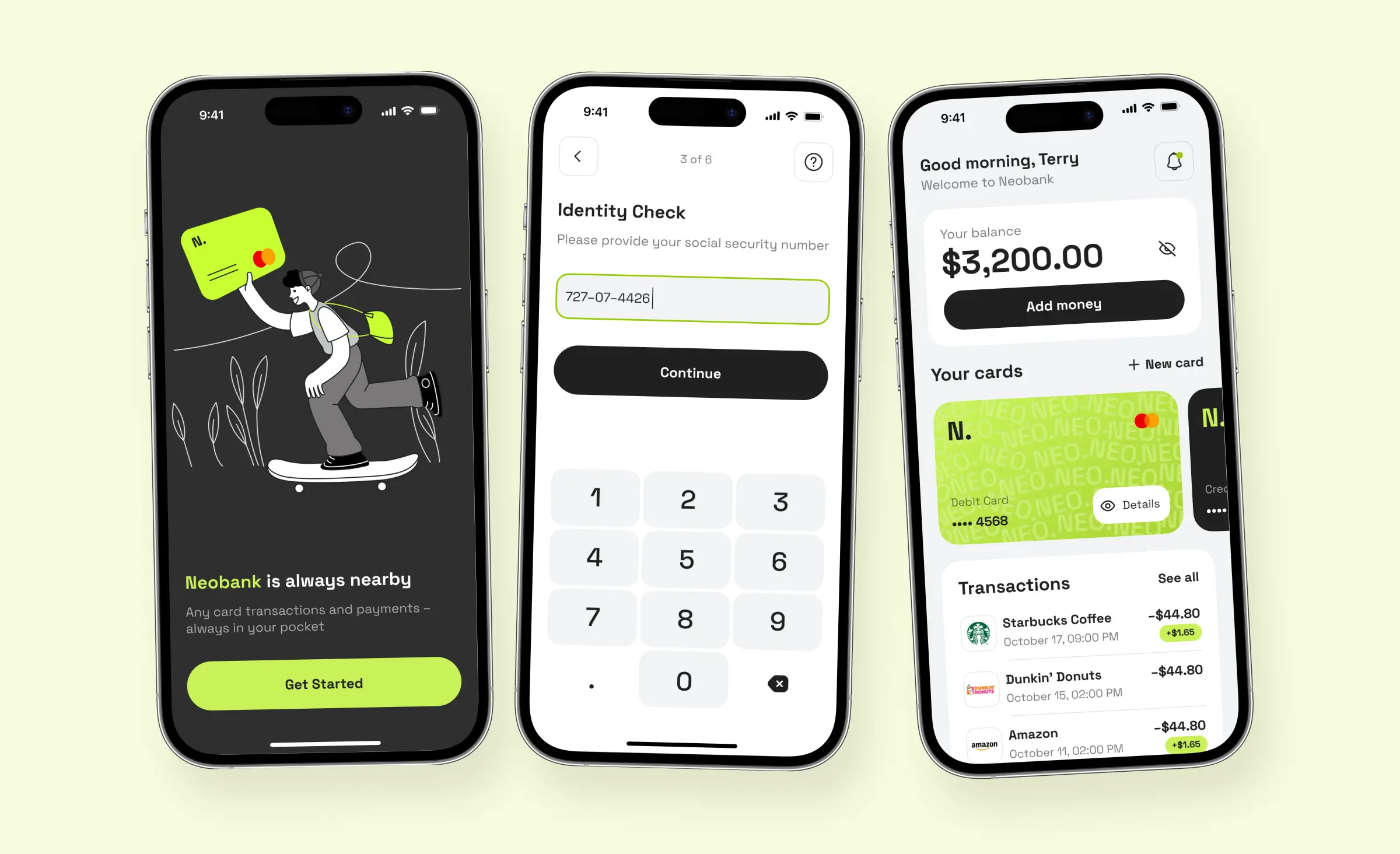
Shaping the architecture
We opened the project with three event-storming sessions: workshops where the whole team walks through every event the product has to handle (a user signs up, a card is issued, a payment clears) to find the natural seams in the system. The client was represented by the manager working closely with them at the time. Those seams became the app’s microservices, separate services that can be built and fixed on their own so a problem in one does not take down the rest. We then split the backend team along those services so features could move in parallel. The frontend was harder to divide, so once a shared architecture and a common UI-kit were in place, one part of the team took one flow while another took the next.
Design and the interface
Design ran early, in parallel with the architecture work. We began with mind mapping and close collaboration with the client, using references and anti-references (examples of apps we wanted it to feel like, and ones to avoid) to settle the style, then designed clear, minimal interfaces for both light and dark modes. The complete UI-kit and shared components we built up front became the foundation the frontend team worked against, and kept card management, transaction tracking, and cashback easy to reach.
Wiring the integrations into one flow
Making a stack of separate providers act as one flow was the real work, since each one has its own rules, data format, and failure modes. We built the mobile app on that microservice architecture and connected Bond as the BaaS gateway to US banks such as Evolve Bank & Trust, Auth0 for authentication, Persona and Sardine for KYC and fraud checks, and Plaid, Pinwheel, and Getkard for account linking, direct-deposit switching, and cashback. On top of that plumbing we built the custom pieces the banking app needed: secured charge-card issuance, detailed transaction analytics, a flexible rewards program, and salary-deposit management, wired so a delay or failure in one provider did not break the rest.
Debugging across the BaaS boundary
With so much logic living on the provider’s side, the hardest question during any failure was whose bug it was, ours or Bond’s. We answered it by tracing the whole chain end to end (our request, Bond’s response, Bond’s webhook, and the resulting state on our side) until the broken step was obvious. We leaned on Laravel Telescope, a request-level debugging tool, customized it well past its defaults, and wrote several debugging tools of our own during the project, which let us tell our defects from provider defects quickly, fix what was ours, and flag the provider-side ones upstream, both while building and once real users started hitting edge cases.
Security and compliance
Data protection was a top priority, given the strict standards for financial products in the USA. We kept financial data safe with the microservice split, least-privilege access (each service and teammate could reach only the data it needed), data minimization, and Auth0 for authentication. Sensitive information was never stored on our servers; we received it from the user and passed it straight to the KYC vendor or the BaaS provider. Our team passed the SOC 2 audit. We also considered PCI DSS and ISO/IEC 27001 requirements when building the product, but the app did not hold separate certifications for those two standards.
Launch, store review, and after
We shipped the first release in March 2024. Getting a financial app through App Store and Play review took extra work: both stores ask for more documentation from finance apps, and we helped the client prepare and submit it. After launch we kept hardening the product against abuse with strict, layered API rate limits, checks on the registration IP, and device-ID checks on top of the Persona and Sardine KYC. Day to day we worked real user reports, from people who could not pass KYC to a card that would not order, a payment that failed, a transaction that did not appear, or a cashback that never arrived. The build, the store approvals, and the verified user base are what we delivered and shipped.
Today, we continue to support both fintech startups and non-financial businesses in developing embedded financial services tailored to their customers’ needs.
“The hard part of embedded finance is wiring a dozen APIs into one product that stays consistent and compliant, not any single integration on its own. On the neobank project we split the backend into microservices so a support agent never sees a user’s financial data, and the transaction service never sees personal data. That separation is what keeps the product safe to run and easy to extend.”
Evgeny Leonov, CTO at Ronas IT
Wrapping up
Embedded finance can open new revenue streams for any company, fintech or not, while making the customer journey smoother and improving financial inclusion. The trade-off is real work: technical complexity, strict regulation, data security, and earning user trust.
If you are planning to add embedded finance to a US product, a practical order of operations is:
- Pick the one financial feature that fits your users best, such as embedded payments, lending, or a branded account, instead of shipping everything at once.
- Choose a BaaS provider, and the sponsor bank behind it, whose licenses cover that feature in every US state where your customers live.
- Map your KYC, AML, and “last-mile” compliance duties before you write integration code.
- Build on a microservice architecture so financial data stays isolated and you can add features without breaking the rest of the app.
Ronas IT helps fintech startups and non-financial companies work through each of these steps. If you want a partner to launch an embedded finance product in the USA, tell us about your project and we’ll map out a reliable, secure build with you.
Frequently Asked Questions (FAQs)
What is embedded finance?
What is the difference between embedded finance and Banking-as-a-Service?
Can my platform offer lending or banking without a banking license?
How does embedded lending make money if the platform does not hold the loan?
What are real examples of embedded finance in the USA?
How do I choose the right BaaS provider?
How do you keep financial data secure in an embedded finance app?
What are the main compliance requirements for embedded finance in the USA?
How long does it take to launch an embedded finance product?
How much does it cost to build a fintech or embedded finance product?
Related posts






Related Services
React Native App Development Services
Save time and costs with Ronas IT's React Native app development, allowing cross-platform capabilities for iOS and Android. Our team has built 20+ React Native apps since 2020, ensuring rapid development, flexible maintenance, and cost-effective solutions.
Fintech Software Development Services
We build secure, scalable fintech solutions like neobanks, trading, and investment platforms — tailored to your market and regulatory needs. Our team ensures robust KYC, compliance, and data privacy, delivering modern, user-friendly interfaces and flexible microservice architectures. From code audits to full-cycle development and ongoing support, we help you launch and manage high-performing fintech apps with confidence.
Custom Web App Development Services
Build secure, scalable web applications with Ronas IT’s custom web app development services. Our team covers the full cycle — from concept and UI/UX design to development, testing, and ongoing support — using leading tech like React and Laravel. With 200+ custom apps delivered across various industries, we ensure intuitive interfaces, smooth integration, and solutions tailored to your business goals.