Fraud detection and prevention with AI: When the system needs automation


Fraud in the digital space keeps changing, and so do the tools used to fight it. As businesses adopt new technology, cyber attacks and financial crime tactics evolve right alongside them. According to statistics from the UK government, the share of fraud attempts and actions stays high, even where the overall numbers dipped.
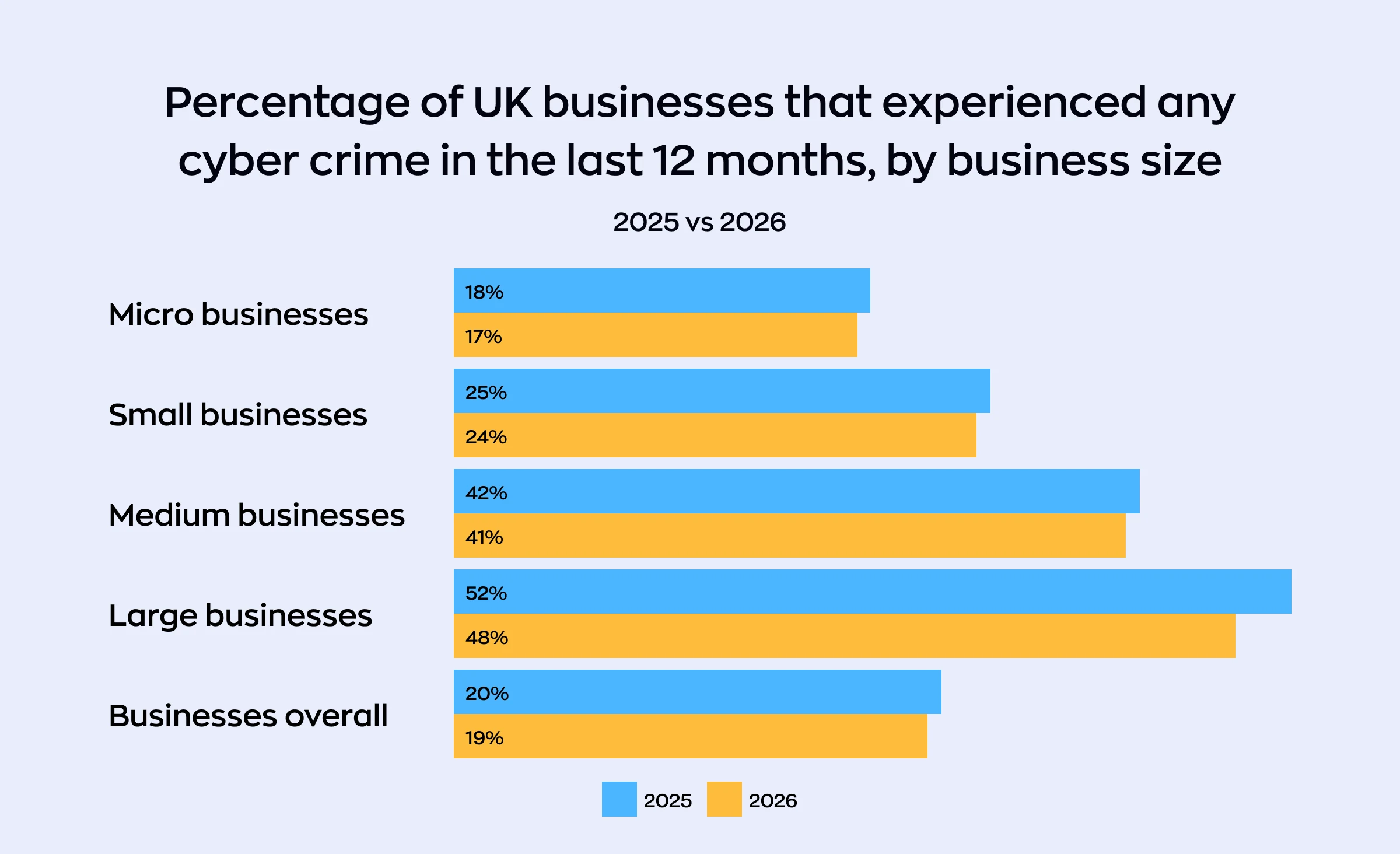
Cyber threats stay high. In the government's 2025/2026 survey, 43% of UK businesses reported a breach or attack in the past year. That is level with the year before and down from 50% two years earlier, and phishing is still the most common attack by far, at 38%. Cyber crime specifically eased slightly, from 20% of businesses to 19% year over year, though the risk still climbs steeply with company size, reaching 48% of large businesses. Around 3% suffered cyber-facilitated fraud, roughly 43,000 companies.
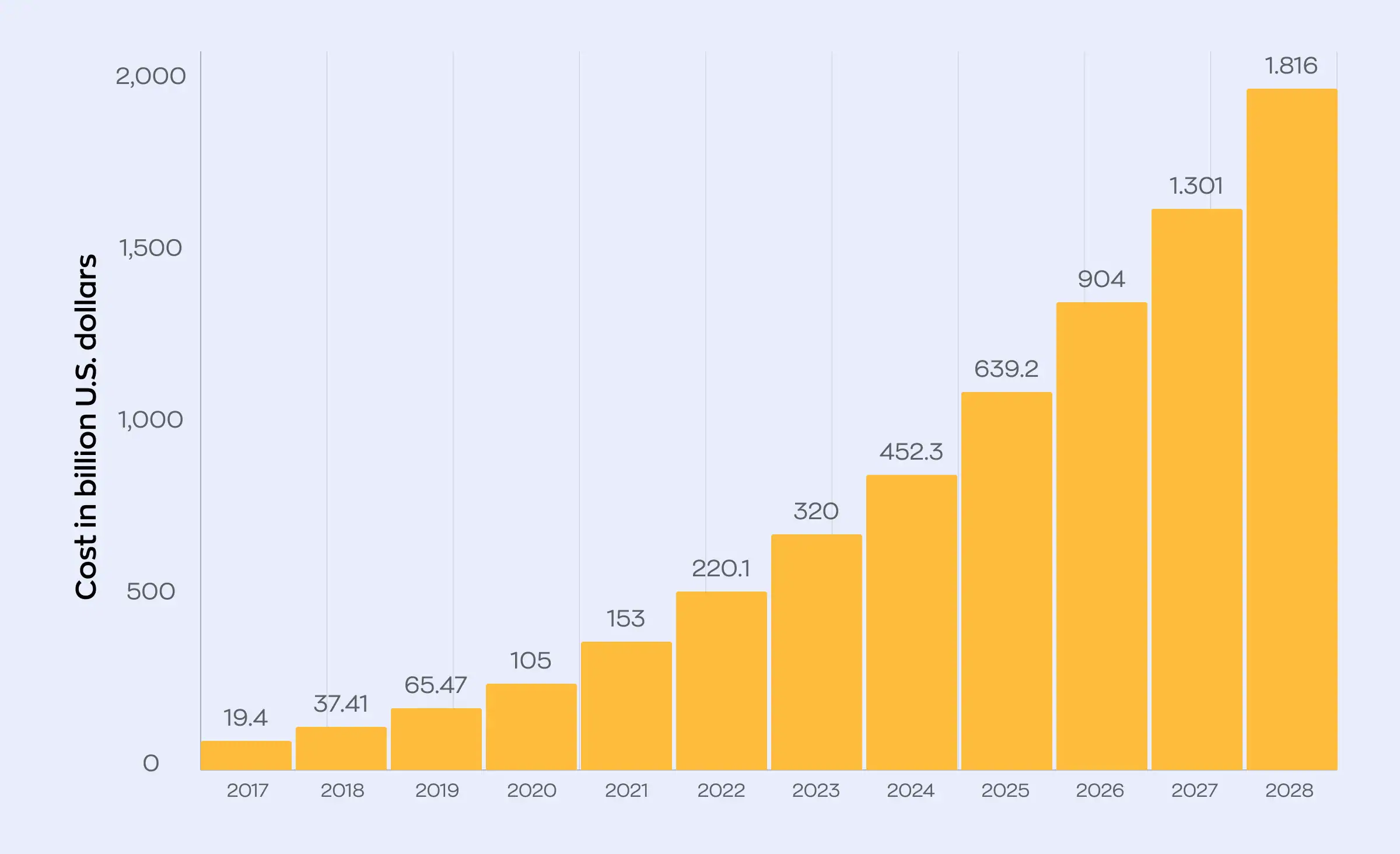
This pushes organizations to invest more in cyber security. Statista estimates that U.S. cybercrime costs reached $452.3 billion in 2024, and projects a rise to $1.82 trillion by 2028. That figure is a broad economic estimate. Losses that victims actually report are smaller but rising fast: the FBI's Internet Crime Complaint Center logged $20.9 billion in reported cybercrime losses in 2025, up nearly 26% from $16.6 billion in 2024. For the first time, the report tracked AI-enabled fraud on its own, a signal that fraud tactics are moving faster than most legacy defenses.
Even heavy spending on cybersecurity struggles to keep pace with fraud losses. Banking and financial services have led the shift to AI-based detection to protect transactions, while adoption in other sectors is still catching up.
Short answer first: you likely need AI fraud detection if your product moves money or stores sensitive personal data, and if fraud patterns keep shifting faster than fixed rules can keep up. If your app is a simple content or utility tool with no payments, basic security checks are usually enough to start. The rest of this guide helps you tell the two apart and decide what to build versus what to integrate.
Understanding AI and machine learning in fraud detection
In fraud detection, the main technology is machine learning, a branch of AI that processes large volumes of data to recognize repeating patterns. It helps identify fraud in content, behavior, activity, and transactions. So how does it actually work? There are three main types of machine learning:
Supervised learning
Supervised machine learning requires labeled data where each data point is tagged as normal or anomalous. The system learns from these examples to classify new data points. The method is effective for identifying known anomalies as its recognition is based on labeled examples and flag outliers. In reverse, it makes it less effective for detecting unknown anomalies.
Unsupervised learning
Unsupervised learning doesn’t require labeled data. Instead, it finds inherent structures or clusters in the data by analyzing similarities and differences. The AI system groups data points into clusters and identifies normal patterns and flags data points that do not fit well into any cluster as anomalies. Unlike supervised learning, it helps identify unknown anomalies and handle complex, unlabeled datasets. However, in this case, AI algorithms may mislabel anomalies, so some human monitoring is still needed.
Reinforcement learning
Reinforcement learning is a method where agents (which are AI-based software systems) learn to make better decisions by trying different actions and receiving feedback, which helps them adjust and improve over time. It's particularly effective at adapting anomaly detection systems to new and changing data patterns, as it uses feedback to fine-tune detection methods. Anomaly detection also benefits reinforcement learning by identifying and warning about unusual situations that could lead to mistakes. This type of learning is the key to training AI agents.
Together, supervised, unsupervised, and reinforcement learning cover most fraud detection needs, and the approach you choose directly affects how accurately a system identifies fraud.
General reasons to implement AI
PwC’s early research on AI’s impact on fraud detection was conducted at a time when generative AI was already gaining significant attention but hadn't yet reached advanced technologies, such as AI agents. Back then, they outlined the possible areas of AI technology implementation and the reasons they believed it was worth implementing. They provided three main considerations:
- By processing both structured and unstructured data, AI models can identify fraud and scam activity more effectively than manual review.
- AI can monitor for suspicious activity around the clock, freeing the team from routine manual checks.
- AI can also fight AI-generated fraud, detecting voices, messages, and images created by other AI systems, such as the deepfakes used to bypass identity checks.
That forecast has largely held up. Since AI agents arrived, processing large datasets has become easier and more effective. Below we look at how AI agents can help with fraud detection and when they are the right fit.
AI agents in fraud detection
Adopting AI agents means rethinking workflows in the places where rule-based, deterministic logic no longer fits. So how do they actually help with fraud detection?
An AI agent runs on a large language model, so it works more like an experienced detective than a checklist. It reads context, spots subtle patterns, and flags suspicious activity even when nothing breaks an explicit rule, which suits the messy, ambiguous cases common in payment fraud. A rule-based system, by contrast, only checks transactions against criteria someone defined in advance.
Use this checklist to decide whether a fraud workflow has outgrown fixed rules and would benefit from an AI layer. The more of these describe your product, the stronger the case:
- Fraud that keeps evolving: attackers probe your thresholds and change tactics faster than you can write new rules, so fixed rules keep missing fresh schemes.
- Complex, context-sensitive decisions: catching fraud means weighing many weak signals together, like device, location, and behavior, rather than checking one yes-or-no rule.
- High transaction volume: you process more transactions than manual review or rule tuning can keep up with, and you need a risk score in real time, often within milliseconds.
- Too many false positives: rigid rules block legitimate users and bury your team in manual reviews, while a model that scores risk in context lets more good transactions through.
- Heavy unstructured data: detection depends on reading natural language, documents, or images rather than clean, structured fields.
- Sprawling rule sets: you maintain so many overlapping rules that each change is slow, costly, and prone to new errors.
In practice this is rarely all-or-nothing. Deterministic rules stay in place for clear-cut and regulated checks, such as sanctions screening or hard transaction limits, while an AI layer handles the evolving, context-heavy cases the rules miss. If several signals above describe your product, adding AI to your fraud stack is likely worth it; if none do, a well-tuned rule-based system may be enough.
Generative AI is both the new threat and the defense
The same technology that powers modern fraud detection also powers a new wave of fraud. Deepfake voices, AI-generated ID documents, and synthetic identities let attackers pass checks that used to stop them. Deloitte's Center for Financial Services projects that generative-AI-enabled fraud losses in the U.S. could reach $40 billion by 2027, up from $12.3 billion in 2023, a compound annual growth rate of 32%.
This is why onboarding is now a front line. A synthetic identity looks legitimate on paper, so the defense has to confirm a real person is behind the document. Running identity verification and fraud scoring at signup does exactly that: it catches fabricated or high-risk identities before an account ever exists. If your product onboards users who can move money, treat identity verification as part of fraud detection rather than a separate box to tick.
Does a new digital product need AI protection against fraudsters?
When you build a new product, decide early whether it needs AI-based fraud prevention at all. Not every app development project does. The deciding factor is what the app touches: if it moves money, processes payments, or stores sensitive personal data, fraud detection belongs in the plan from day one. If it does not, basic security is usually enough to launch, and you can add AI-based checks later as the app grows or new threats appear.
For the products that do need it, AI watches activity in real time and flags anything unusual, which protects user data and cuts financial crime. An experienced mobile and web app development team can help you map where your product is exposed and how much protection it actually needs.



Industry-specific application of fraud detection with AI
AI-driven fraud prevention is most often discussed in the context of banking, and for good reason. The banking sector leads AI investment: its spending is projected to climb from $31.3 billion in 2024 to over $53 billion in 2026. Still, the same tools protect data and stop fraud well beyond banking. Below are the major areas where they apply, banking included.
Payment systems
Payment systems handle card details, transaction amounts, and customer data, which makes them a prime target for fraud. AI helps first with credit card fraud, both in-person and online: it analyzes large volumes of transaction data in real time to spot patterns and anomalies that signal fraud, and it learns from past cases to block unauthorized transactions. It can also watch point-of-sale activity and catch internal fraud when behavior looks unusual.
E-commerce
AI helps prevent account takeover and identity theft. Each time a customer visits an online store, it can weigh signals like IP address, device fingerprint, purchase history, and behavior, then cut off a suspicious session while letting legitimate users through. It also watches accounts for suspicious changes and helps with friendly fraud, the chargeback cases where customers dispute purchases they actually made. At checkout, it monitors transactions in real time and uses behavioral analytics to catch anomalies.
Banking and financial services
Every day, vast amounts of data flow through banking systems. To help financial fraud detection in banking, AI agents analyze vast volumes of transactional data in real time to identify deviations from typical spending behaviors, such as unusual purchase locations or amounts. They use supervised learning models trained on historical fraud cases to recognize known fraud patterns and unsupervised learning to detect new, evolving threats. AI continuously scores transaction fraud risk, enabling instant blocking or flagging of suspicious activities.
Insurance
Insurance fraud detection relies on AI to analyze claims data, customer profiles, and historical fraud cases to identify suspicious patterns such as duplicate claims, inflated billing, or inconsistent documentation. AI agents use predictive data analytics and anomaly detection to assign risk scores to claims, prioritizing those that warrant deeper investigation.
Cryptocurrency
In cryptocurrency, AI focuses on transaction network analysis and behavioral biometrics to detect fraud and money laundering. It scans blockchain data for unusual transaction flows, rapid fund movements, or attempts to hide the origin of funds. Machine learning models flag likely fraud by spotting patterns of suspicious wallet behavior. On the backend, AI also supports identity verification and compliance using biometrics and natural language processing, adapting quickly as fraud tactics in decentralized finance change.
Healthcare
In healthcare, an AI fraud detection system analyzes billing records, medical claims, and patient data to spot inconsistencies such as duplicate claims, overbilling, or services not rendered. Natural language processing helps interpret unstructured medical notes to detect discrepancies. If implemented, AI agents can continuously learn from confirmed fraud cases to improve accuracy and reduce false positives, providing real-time flagging of suspicious claims and protecting both providers and payers from financial abuse.
Telecommunications
AI powered fraud detection in telecom monitors call patterns, SIM usage, and network traffic to identify scams like SIM box fraud or impersonation. Traditional rule-based systems are enhanced with AI’s ability to detect subtle anomalies in call routing or voice patterns, including those generated by deepfake technologies. Behavioral biometrics further strengthen identity verification, enabling telecom companies to respond quickly to emerging fraud threats.
Across these industries, AI implementations share core mechanisms (real-time data collection and ingestion, pattern and anomaly detection, risk scoring, and adaptive learning), but apply them to domain-specific data and fraud typologies. It means that the list of industries that deal with sensitive data can go further and not be limited by those listed.
Benefits and challenges
AI in fraud detection brings clear benefits, along with a few challenges worth planning for.
Benefits
- Real-time detection: AI scores transactions as they happen, so it can catch and stop fraud in the moment rather than after the money has moved.
- Fewer false alarms: by weighing risk in context, AI catches more real fraud while raising fewer false alarms than rigid rules.
- Trust and compliance: protecting customer data and meeting compliance rules builds trust and keeps you on the right side of regulators.
- Lower cost: AI cuts the manual review load, which lowers costs and speeds up operations. That makes it a strong fit for startups that need solid fraud defense without a large in-house team.
Challenges
- Data privacy and ethics: because AI processes sensitive data, you need strict controls around privacy and ethics, so favor proven, well-documented services with a clear data-handling policy.
- Data quality: AI models are only as good as their training data, and high-quality, representative datasets are hard to collect and keep clean.
- User experience: strong security has to be balanced with a smooth experience, or legitimate users get blocked.
- Regulation: AI fraud prevention also has to keep up with complex, constantly changing regulations.
How do you deal with these challenges? The most reliable strategy is to partner with a team that has shipped products under real compliance and regulatory pressure. The Ronas IT team has built and maintained apps in fintech, where getting fraud handling wrong carries direct financial and legal consequences.
How Ronas IT approaches fraud detection in real projects
Our approach is deliberately practical: we lead with proven, vetted fraud and identity services and design the flow around each product's real constraints rather than its ideal architecture.
On a US neobank we built for credit building, this looked concrete. During onboarding, we ran identity verification through Persona to confirm each user was real, while Sardine ran fraud checks in parallel to catch users tied to risky or fraudulent behavior. Only after a user cleared both did we create their account and enable transactions through the Bond banking API. We also isolated the services with a microservice architecture, so the support system never touches financial data and the transaction service never touches personal profiles. That separation limits the blast radius if any single service is compromised.
“The trap we see is teams trying to train a fraud model before they have any fraud to learn from. A brand-new product has almost no confirmed fraud cases, so a custom model starts out guessing and annoying real users with false flags. A vetted service already carries that pattern knowledge from thousands of other clients on day one. Build your own later, once your own data is worth learning from.”
Evgeny Leonov, CTO at Ronas IT
We also treat fraud prevention and customer experience as one problem, not two. Overly aggressive checks block legitimate users, so our analysts and designers tune the flow with the developers to keep friction low for real customers. The goal is a system that stays secure as new fraud tactics appear, without turning every login into an obstacle course.
Conclusion
Fraud tactics change fast, and attackers increasingly use AI themselves, including deepfakes and synthetic identities. On defense, AI helps because it reads large volumes of data, spots complex patterns, and adapts to new schemes that fixed rules miss. If you are deciding what to do next, a short checklist helps:
- Map where your product touches money or sensitive data, since those flows are where fraud detection pays off first.
- If you onboard users who can move money, verify identity at signup, where deepfakes and synthetic identities now strike first.
- Decide between rules and AI per flow: keep rules for clear, fixed checks, and add AI where decisions need context and judgment.
- For a new app, integrate a vetted fraud and AI service first, then build custom models later once you have clean data and real volume.
- Tune thresholds with real usage so legitimate customers are not blocked.
Frequently asked questions
What are AI fraud detection services?
How effective is AI at detecting online shopping fraud?
Should a new app build its own AI fraud model or integrate a service?
How much does it cost to add AI fraud detection to an app?
Which industries need AI fraud detection the most?
Does AI fraud detection replace rule-based systems?
Related posts







Related Services
React Native App Development Services
Save time and costs with Ronas IT's React Native app development, allowing cross-platform capabilities for iOS and Android. Our team has built 20+ React Native apps since 2020, ensuring rapid development, flexible maintenance, and cost-effective solutions.
AI Software Development Services
We deliver custom AI solutions, including generative AI, chatbots, predictive analytics, and recommendation systems. From strategy to integration and ongoing support, our expert team ensures secure, scalable, and value-driven AI applications tailored to your needs, so you can innovate faster and stay ahead of the competition.
Fintech Software Development Services
We build secure, scalable fintech solutions like neobanks, trading, and investment platforms — tailored to your market and regulatory needs. Our team ensures robust KYC, compliance, and data privacy, delivering modern, user-friendly interfaces and flexible microservice architectures. From code audits to full-cycle development and ongoing support, we help you launch and manage high-performing fintech apps with confidence.