Product-market fit for tech startups: how to validate and measure it


You validate product-market fit in two stages. Before you build, you check that a specific buyer has an urgent problem and wants your answer to it. After you launch the smallest product that can test that answer, you measure fit: ask active users the Sean Ellis question and watch whether the retention curve flattens. If at least 40% of them would be “very disappointed” to lose the product and cohorts stop leaking, you have a strong fit signal.
The stakes are high. In its 2026 CB Insights review of failed startups, poor product-market fit was one of the leading root causes at 43%, second only to running out of capital.
Technology does not create that fit. The market does. What a strong tech foundation gives you is speed: faster experiments, cleaner data, and a shorter loop between a hypothesis and a validated answer. This guide is the process we use when we build MVPs for startups: how to validate demand, measure fit, and build a foundation that carries you past launch.
AI app builders and coding agents have made a first prototype much cheaper to build. That helps you test ideas, but a cheap build is not a validated one: shipping fast tells you nothing until real users react, and a prototype built in an AI app builder still needs auth, data rules, and tests before real users arrive. The market still decides, and it does not care how little the prototype cost to make.
“A founder does not pay us for code. They pay us to reach a clear yes-or-no answer about their idea as cheaply as possible. Our job is to make each validation loop short, so the budget buys learning, not features nobody asked for.”
Roman Surikov, CEO at Ronas IT
What product-market fit means for a tech product
Product-market fit (PMF) is the point where enough people in your target market prefer your solution over the alternatives and keep coming back. It sits on top of two things you do not fully control (a real problem and a market that wants it solved) and one thing you do: the product you build to serve them. Without fit, a product struggles to attract and keep customers no matter how much you spend on marketing.
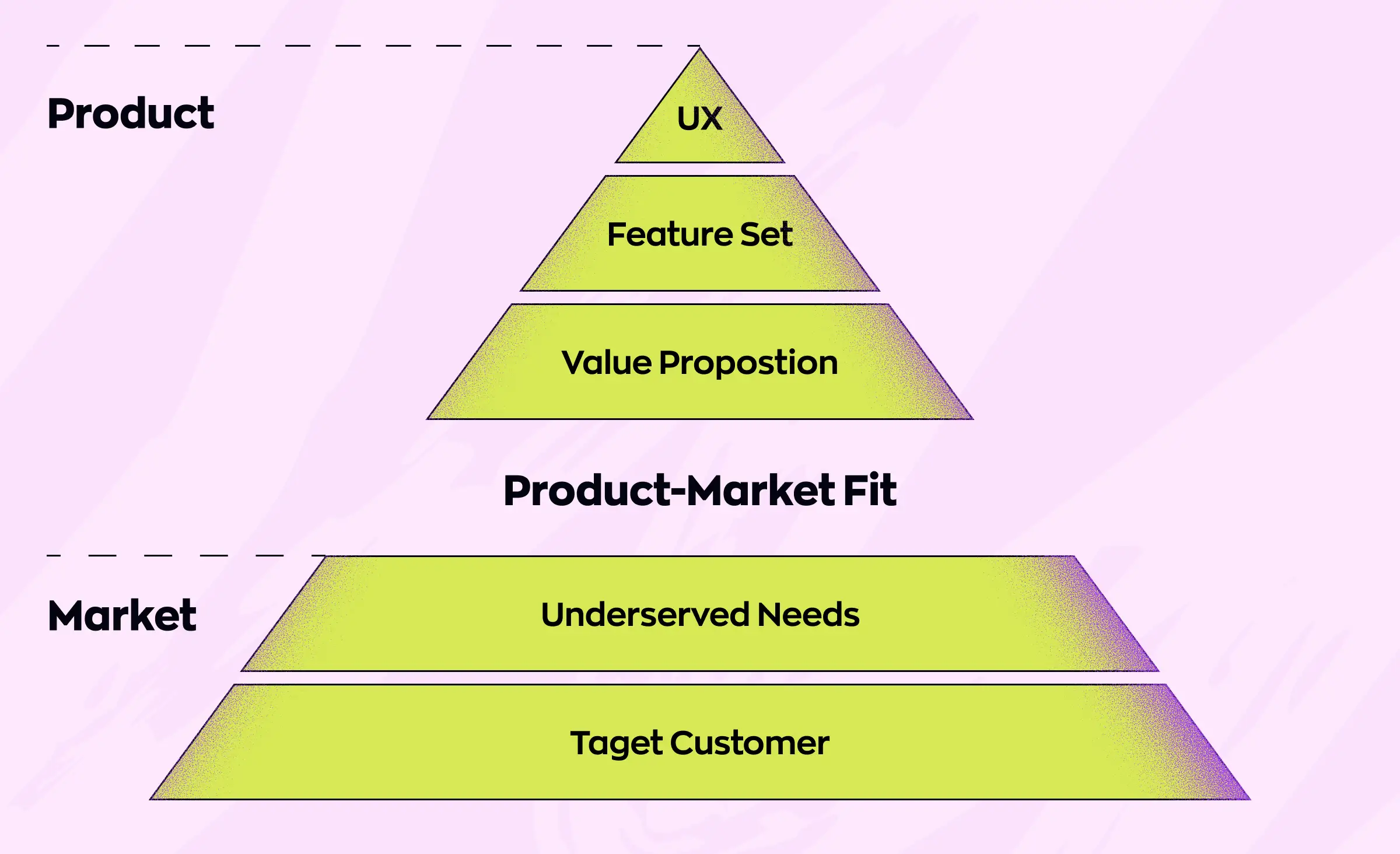
Fit is not a single on/off state. Marc Andreessen, who popularized the term in his 2007 essay “The only thing that matters,” framed it as a good market plus a product that can satisfy that market, and argued the market matters most: a weak product can still sell in a strong market, but no product wins in a market that is not there. Dan Olsen's product-market fit pyramid breaks that idea into five elements across two halves.
The market, which you research but do not control:
- Target customer: the specific user whose problem you choose to solve.
- Underserved needs: the high-priority needs that current options do not meet well for that customer.
The product, which you build and control:
- Value proposition: how your product meets those needs better than the alternatives.
- Feature set: the functionality that delivers the value proposition.
- User experience: how the customer interacts with that functionality.
Product-market fit is how well your decisions in the top three product layers match the market in the bottom two. Get the market wrong and no amount of features or polish saves the product.
How to validate product-market fit before you build
The bottom two layers of the pyramid, and the value proposition above them, can be checked before a line of code. This work does not prove fit, because fit needs real usage, but it tells you whether the product is worth building at all. It follows the pyramid from the bottom up.
1. Name the target customer
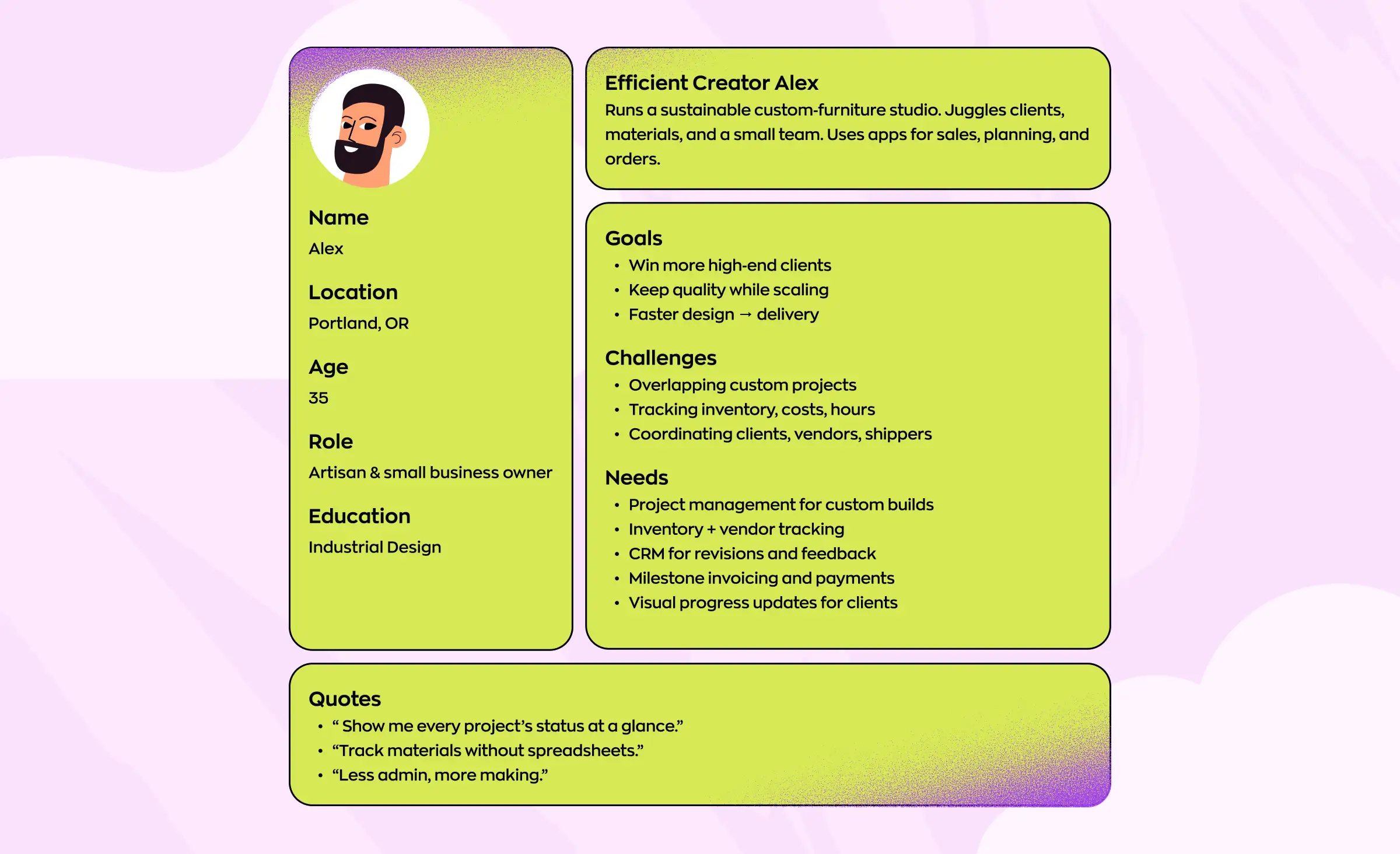
Avoid building for “everyone.” Start with a broad segment, such as small businesses or healthcare professionals, and narrow it to a niche, such as product managers in SaaS teams or independent game developers. Write 2-3 short profiles of that customer: role, company size, the tools they use today, their goals and what slows them down.
2. Find the underserved need
Talk to 10-20 people from that segment. Ask them to walk you through how they do the task today, which steps take the most time, and what they already tried. Where you can, watch them do it over a screen share: people describe a workaround as normal until you see how long it takes. Then rank the problems you heard by how often they come up and how much they cost the user, and keep the top 3-5.
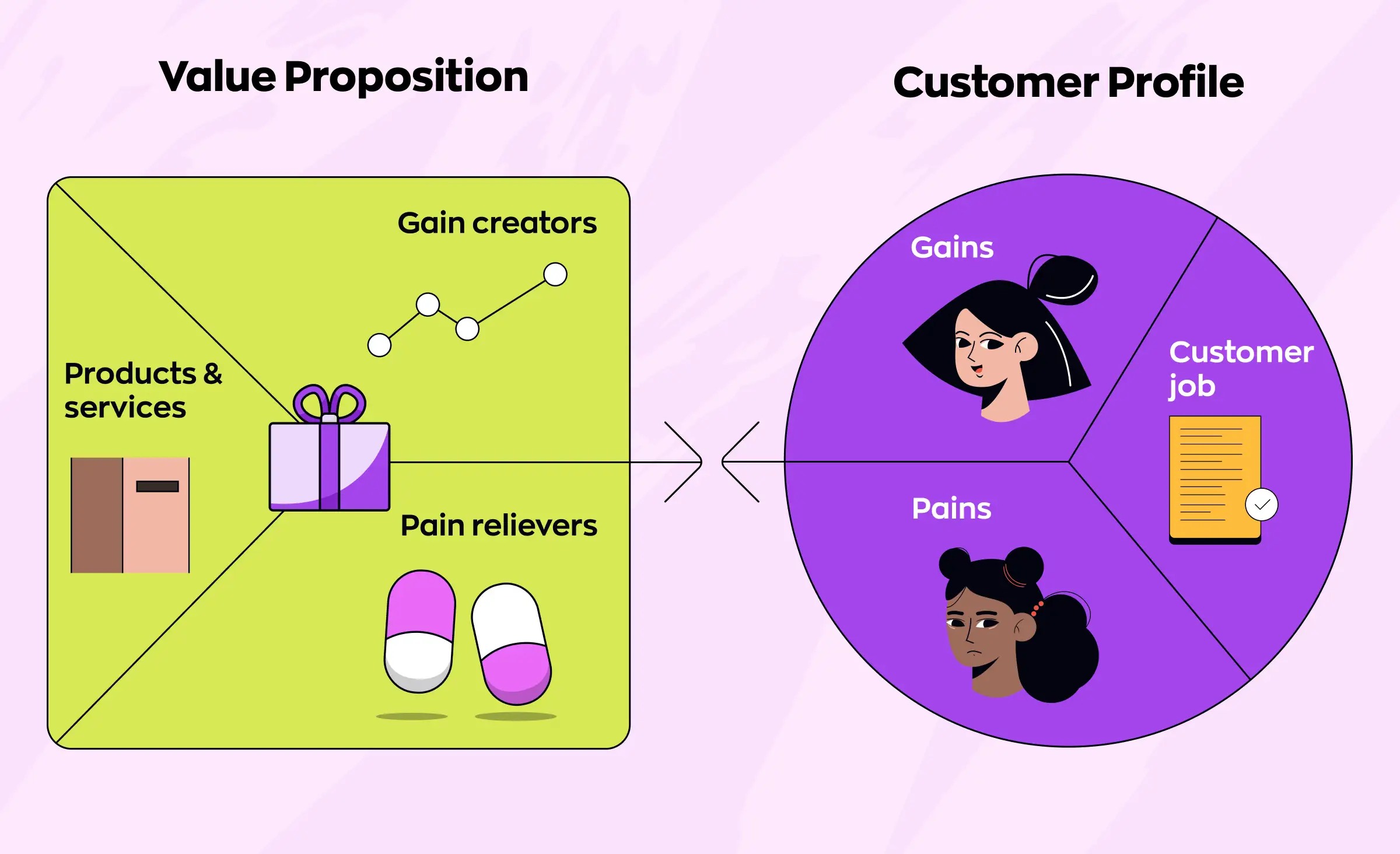
3. Write the value proposition and test it
State in one sentence who the product is for, which problem it solves, and what changes for the user. For example: “For online store owners who copy orders between their CRM and their inventory by hand, a two-way sync that keeps stock levels right without manual entry.” Show it to the people you interviewed and ask whether it addresses a problem they have and which part matters most. If the answers are polite but vague, go back to step 2 before you spend on a build.
When the problem is confirmed, scope the first release around it. Our guide on how to build an MVP covers that step, and interactive prototypes let you test screens with the same users before development starts.
The Ronas IT PMF-validation checklist
Most PMF advice tells you what fit is, not how to test for it in a real build. This is the sequence we run on startup engagements. Each gate has to pass before we spend budget on the next one, which keeps the cost of being wrong low.
- Confirm problem-solution fit first. We go through the validation steps above with the founder. If the problem is not urgent, no product fixes that.
- Define one core assumption to test. We reduce the idea to the single riskiest belief. The MVP exists to prove or kill that one thing, not to be a small version of the whole roadmap.
- Ship the smallest product that produces a real signal. A basic MVP with us takes at least 2 weeks, so founders get usage data in weeks, not quarters.
- Instrument before launch. Analytics, cohort tracking, and feedback capture go in from day one. You cannot measure fit you did not set up to see.
- Measure with the Sean Ellis 40% test and retention. Ask active users one question: “How would you feel if you could no longer use the product?” If at least 40% answer “very disappointed,” you have a strong fit signal. Cross-check it against a retention curve that flattens rather than dropping to zero.
- Iterate or pivot on the data, then scale the foundation. If the signal is weak, change the product before spending on growth. If it is strong, the same stack scales up instead of forcing a rewrite.
How to measure product-market fit: the Sean Ellis test and retention
Sean Ellis, who coined the term “growth hacker,” set the 40% benchmark after comparing nearly a hundred startups with his survey, as First Round Review reports: companies with strong traction almost always passed the line, and those that struggled to grow almost always fell below it. It is one of the most widely used single measures of product-market fit.
The survey is the primary signal, but pair it with four metrics that show whether usage is deepening or leaking:
- Cohort retention: track how many users from each weekly or monthly cohort stay active 30 days after sign-up. A curve that flattens instead of decaying to zero is the strongest sign of fit.
- Churn rate: users lost in a period divided by users at its start. Falling churn across cohorts confirms the Sean Ellis signal from the other direction.
- LTV to CAC ratio: lifetime value against customer acquisition cost. A ratio above 3:1 is the common rule of thumb for a product worth paying to acquire users for, the same line investor David Skok uses.
- Net Promoter Score: the share of promoters (a 9 or 10 out of 10) minus the share of detractors (0 to 6), useful as a trend line between the deeper Sean Ellis surveys.
Match the metrics to your business model. A two-sided marketplace like the Noah project below has to measure retention on both sides at once, because supply and demand can reach fit at different speeds: producers may stay while consumers churn, or the reverse. A single blended curve would hide that gap.
Signs you have reached product-market fit
Beyond the numbers, fit shows up in behavior you did not have to pay for. Watch for four signals:
- Users come back on their own, and word of mouth brings new ones without paid acquisition.
- People ask to pay, upgrade, or expand their usage before you push them.
- Support and sales start hearing “I could not go back to the old way of doing this.”
- Organic sign-ups and referrals begin to outpace your paid channels.
Fit itself sits in a sequence: problem-solution fit first, then product-market fit, then scale. The checklist above follows that sequence rather than jumping straight to building features.
From MVP to fit: tech decisions that help or hurt
Early technology decisions set the ceiling for how fast you can learn later. Fit rarely comes from building a feature-heavy product up front. It comes from a focused build, real usage data, and steady refinement as you learn what your customers actually need.
Decisions that help
- Run short build-measure-learn loops. The lean startup approach, defined by Eric Ries, treats every release as an experiment: build the smallest change, measure what users do, and decide whether to keep, change or drop it before the budget runs out.
- Build features toward fit. Ship one feature per cycle tied to a clear hypothesis, then check whether it moved activation or retention before you build the next one. Let usage data, not the loudest opinion in the room, set the order of the backlog.
- Choose a stack that scales with you. Well-supported frameworks such as React, React Native, Laravel for the backend, and PostgreSQL let the same codebase carry you from the first MVP to scale without a rewrite.
- Fix the friction users hit most often, as your analytics show it, before you add anything new.
Mistakes that delay fit
- Over-engineering the MVP. Packing the first version with extras nobody asked for wastes money and delays real feedback. Cut the MVP back to the one assumption you most need to prove.
- Neglecting technical debt. Skipping refactoring feels harmless until the debt slows releases and adds bugs. Small, regular cleanups cost far less than one big rewrite later.
- Choosing the stack by trend. A framework with a small hiring pool can lock you into a costly migration once you have paying users.
- Launching without analytics. Without event tracking and user feedback in place, you are guessing where users engage and where they drop off.
- Ignoring security. Weak data protection and identity management erode trust and get expensive to fix later. Proven building blocks like Auth0 for authentication and managed infrastructure on AWS, Google Cloud, or Cloudflare cover the basics from day one.



Examples: Noah and Lainappi
Two products we built show how the same approach plays out in a real launch. Neither is a promise of fit: both show how a team sets up a product so the founder can measure it.
Noah: instrumenting a marketplace launch
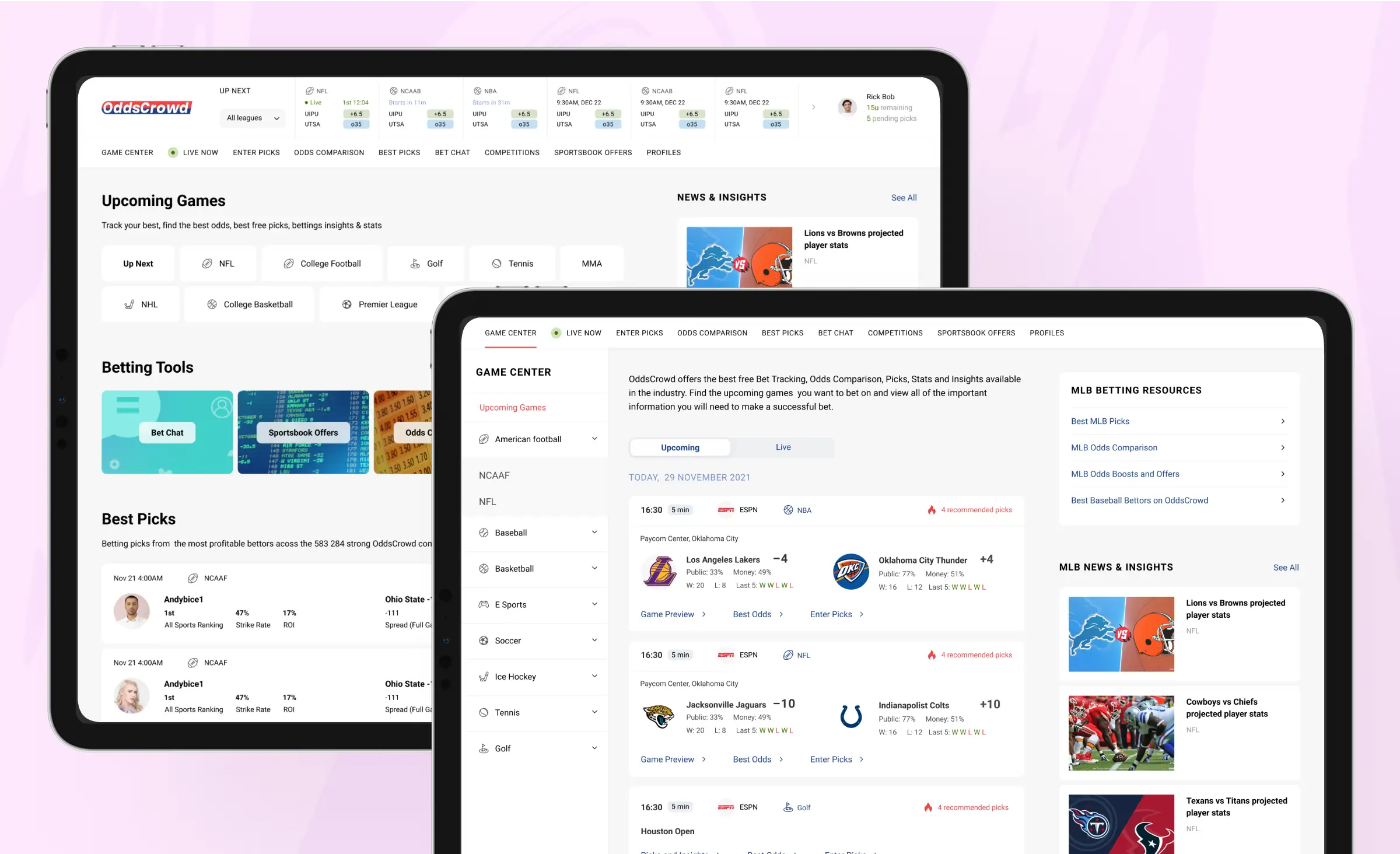
In 2019, a startup founder from Sweden asked us to build the Noah farmer marketplace, which connects local food producers with everyday consumers and aims to make the region less dependent on foreign suppliers. The harvest season set a tight window, so in 4 months our team designed and built consumer apps for iOS and Android, a separate mobile app for producers, and a web admin panel. The client chose native development for the mobile apps, so we built them in Swift and Kotlin, and the admin panel in Angular and Laravel.
We wired in analytics with Firebase from the start so the team could measure real user flows, and integrated the Stripe SDK for in-app payments and the Google Maps SDK for producer search. The app launched in a pilot market, which gave the founder real usage data from producers and buyers instead of guesses. After the first release we kept adding features and providing support, so the same stack carried the next round of work instead of forcing a rebuild.
Lainappi: a rental app launched to test the idea
Lainappi is a Finnish app where people and businesses rent out items or borrow them, so they have access to goods without buying them. The client wanted to launch quickly and avoid extra costs while testing the idea on the market. We built one React Native app for iOS and Android with item management, owner verification through Stripe Connect, chat between owners and renters, and map search with filters. The app recorded 5,685 launches and 2,397 registered accounts. Numbers like these show interest; the founder then reads retention and the 40% survey to see whether that interest turns into fit.
The lesson is the same in both cases. A focused first version built for learning, tight feedback loops, and quick iteration let a startup find its footing before it commits to a full roadmap.
What to do next
If you are working toward fit, here is a concrete way to start this week:
- Write down the single riskiest assumption your business depends on.
- Talk to 10-20 people from your target segment and confirm that the problem is urgent for them.
- Define the smallest product that could prove or disprove the assumption, and scope only that.
- Set up analytics and cohort tracking before launch, not after.
- Run the Sean Ellis 40% survey once you have a base of active users, and watch your retention curve.
Once the signal is strong, a flattening retention curve and real usage data are exactly what investors want to see before they fund your next stage, and the foundation you built scales up instead of forcing a rewrite.