

Most founders do not fail because they build the wrong feature. They fail because they spend months and a full budget building the wrong product before a single user tells them what they actually want. A minimum viable product (MVP) is the antidote: the smallest version of your idea that a real user can use to solve a real problem, shipped fast enough to learn from before the money runs out.
This guide walks through the six steps we use at Ronas IT to take an idea to a launched MVP, the same framework behind projects like the UK Retreats holiday-stays app. Along the way we cover realistic timelines and costs, how we prioritize features, and where generative AI genuinely helps. If you already know you want a partner for this, our MVP development service is where this framework lives in practice.
Why most MVPs fail (and what the data says)
Before the steps, it helps to know what actually kills early products. In its March 2026 analysis of 431 shut-down startups, CB Insights found that running out of capital tops the list at 70%. But the report is explicit that this is the final symptom, not the root cause. The deeper reasons are poor product-market fit (43%), bad timing (29%), and unsustainable unit economics (19%).
The takeaway is simple: capital runs out because the product never reached product-market fit. An MVP exists to test that fit cheaply, before you have committed a large budget. Every step below is designed to reach a real user faster and spend less proving whether your idea holds up.
Types of MVP: not everything needs to be built
An MVP is not always a coded product. Before you commit to development, it is worth knowing which format tests your riskiest assumption for the least money. The classic examples still hold up:
- Landing-page MVP. A single page describing the product, with a sign-up or pre-order button to measure real demand. Buffer validated its whole idea this way before writing the app.
- Explainer-video MVP. A short demo of a product that does not exist yet. Dropbox's demo video pushed its beta waitlist from 5,000 to 75,000 people overnight, before the product was built.
- Concierge MVP. You deliver the service manually behind the scenes instead of automating it. Zappos began by photographing shoes in local stores and buying them at retail after each order, to prove people would buy shoes online at all.
- Single-feature MVP. A working product stripped to one core action. Early Uber was an invite-only app in one city that did one thing: request a car.
Most of our clients need the last type, a real single-feature or few-feature app that users can pay for. The rest of this guide focuses on building that well, but if a landing page or a video can answer your biggest question first, start there.
Step 1. Define the problem
Before you think about how to build an MVP, define the specific problem your product solves and the people it solves it for. This is the step most failed startups skip. A useful way to force clarity is to fill in a single sentence:
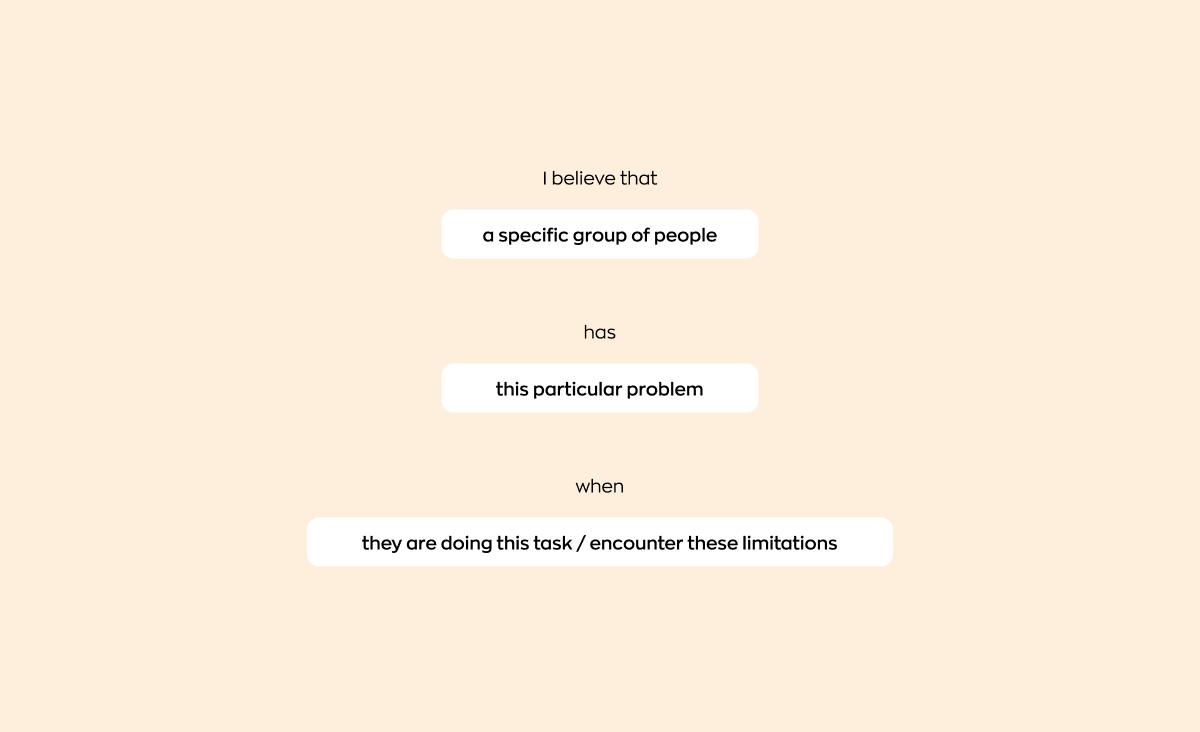
Consider Spotify, which grew during the music industry's digital piracy crisis. Its founders named one sharp problem: getting legal, affordable, convenient access to a large music library was hard, so people pirated instead. For listeners it removed the cost and risk of unreliable downloads; for artists and labels it opened a new revenue stream. The product came second. The problem came first.
You can use a generative AI chat as a sparring partner here to pressure-test and reshape your idea, as long as you give it accurate context. For example, you might describe a gap you have noticed and ask for MVP concepts:
| User | I've observed that people often need designs for a specific room or corner when decorating their apartments. However, interior designers typically undertake full projects. Suggest 6 mobile app MVP ideas that could address this issue. |
| AI assistant | Here are six mobile app ideas that could address the need for specific room or corner designs without requiring the assistance of a full-fledged interior designer:
These app ideas aim to provide users with accessible, budget-friendly, and user-friendly solutions for designing specific areas of their homes without the need for a full-scale interior design service. |
Step 2. Outline the target audience portrait
A named problem still needs a named audience. A target audience description focuses on shared traits, while a buyer persona is a semi-fictional portrait of one ideal customer, with their behaviors and motivations. Both matter: the audience tells you who to build for, and the persona keeps that person concrete while you make trade-offs.
Start with your competitors' data rather than your own, since you don't have users yet. Marketing tools can show you who already engages with similar products. Once you understand the demographics, run customer development interviews (also called in-depth interviews) to find real pain points. Generative AI is useful here too, both for drafting interview questions and for structuring the raw answers afterward:
| User | I am thinking about how to build an MVP of the mobile app. What questions should I pose to a potential customer during my customer development interview? My target audience encompasses people who are interested in improving specific areas within their apartments instead of redesigning the entire space. This group includes millennials of any gender, many of whom are either married with children or are planning to start a family. |
| AI assistant |
|
Treat AI output as a draft, not a verdict. It can prepare questions, collect raw notes, and surface themes, but the interviews themselves, with real people, are where the signal comes from.
Step 3. Pressure-test the idea before you build
Before you commit a budget, it is worth stress-testing the idea on paper. Several lightweight frameworks do this, and you only need one:
- Riskiest Assumption Test. Name the one belief that has to be true for the product to work, then find the cheapest way to check it. Best when a single unknown makes or breaks the idea.
- Lean Canvas. A one-page snapshot of the whole business model: problem, solution, customers, costs, and revenue. Best for seeing whether the idea holds together before you go deep.
- Value Proposition Canvas. Maps what customers want (their jobs, pains, and gains) against what your product offers. Best for sharpening product-market fit.
- SWOT analysis. A quick scan of strengths, weaknesses, opportunities, and threats. Best for a fast landscape check when you already know the space.
None of these builds anything yet; they exist to catch a weak idea before it costs you a full budget. We will walk through SWOT here because it is fast and needs no special setup, but any of them can play the same role. Work through four questions:
Identify strengths. What unique features, expertise, partnerships, or value proposition do you have that competitors do not?
Assess weaknesses. Where are you short on resources, skills, market knowledge, or technical capacity?
Identify opportunities. Which external trends, technology shifts, or untapped niches work in your favor?
Evaluate threats. What competition, regulation, or shifting preferences could get in the way?
“Even as a vendor, we see the same risks a founder does: legal compliance, budgets that overrun, thin project transparency, deadlines that slip, and support that goes quiet after launch. We keep those in mind from day one and build our process to catch them early. Building the MVP is only half the job; the other half is making the whole thing less stressful and more predictable for the founder.”
Roman Surikov, CEO at Ronas IT
Here is a short SWOT for the room-design app idea from the earlier steps:
Strengths:- Uses generative AI to provide personalized recommendations
- Offers budget-friendly solutions for specific room or corner designs
- Provides user-friendly interfaces and step-by-step guides
- Targets a niche audience interested in specific area improvements
- Limited resources for marketing and scaling
- Lack of brand recognition or customer base
- Technical complexity of implementing generative AI well
- Growing interest in DIY home improvement and decor
- Rising adoption of mobile apps for home design
- Collaborations with interior design professionals for added expertise
- Competition from existing home design apps and services
- Changing consumer preferences in home decor
- Privacy and data protection requirements
AI can speed up a SWOT draft, but it may lack current market data. Pairing it with real market research gives you a grounded view before you lock the scope.
A SWOT is only useful if it leads to a decision. For an MVP, that means taking the weaknesses and threats you just listed and turning the most dangerous one into a riskiest assumption test: make proving or disproving it the goal of your first release. That is what turns a strategy exercise into a plan to learn, and it is the logic behind the rest of these steps.



Step 4. Select the essential features with MoSCoW
To select the essential features, keep only the ones that directly solve your core problem and cut everything else. The most common MVP mistake is doing the opposite and building too much. For a room-design app, a focused first release might include:
Room layout design tool. Let users create and customize room layouts to fit their space.
Furniture and decor selection. Offer a curated set of furniture and decor so users can try different styles and arrangements.
3D visualizations. Show designs in realistic 3D so users can judge the result. Augmented reality is a growing option in mobile app development.
Save and share designs. Let users store designs and share them for feedback.
Features like in-app purchases, social integration, and advanced editing can wait for later releases. At the MVP stage the discipline is to cut non-essential features, because design, DevOps, and project management all add to the bill.
“How we set priorities depends on the client and the project. Sometimes the client tells us what matters most; sometimes we work it out as a team during a sprint. We use MoSCoW a lot because it is clear and keeps everyone focused on what has to ship, without going over budget.”
Roman Surikov, CEO at Ronas IT
MoSCoW is the prioritization method we lean on most, both at presale and during sprints. It sorts every feature into four buckets:
- Must have: Critical for success. If a Must-have item is missing, the release is not complete.
- Should have: Important but not critical. Valuable, yet the product can ship without them, at least for now.
- Could have: Nice-to-haves. Included only if time and budget allow after Must and Should are covered.
- Won't have (this time): Consciously deferred to a future release.
One example of MoSCoW in action is our work on a custom tutoring website. Together with the client, we ran it like this:
Discovery. First we mapped the idea before prioritizing anything:
- The business analyst and client listed every potential feature.
- Features were grouped by user role (student, tutor, admin).
MoSCoW prioritization. Then we sorted those features into the four buckets:
- Must have: core features (user registration, tutor booking, messaging).
- Should have: helpful extras (calendar sync, review system).
- Could have: nice-to-haves (advanced analytics, tutor rating badges).
- Won't have (this time): future-release features (AI tutor matchmaking, group video calls).
Outcome. Focusing on the Must-haves paid off:
- Time and budget went to what mattered most for launch.
- The client got a clear, realistic roadmap.
- Development stayed on track, with expectations aligned.
By focusing on the essential features, you learn how to build an MVP that meets your audience's core need while keeping the process efficient and the budget under control.
On more complex projects, this prioritization happens inside an analysis phase (sometimes called a discovery phase): a short paid step from $2,000 where an analyst works with you to turn rough requirements into structured ones, define each user role and what it needs, and find where the build can be made cheaper by unifying overlapping flows. You leave with a tighter, more reliable cost estimate and a set of documents you own, whether you keep building with us or not. For a small, well-defined idea a scoping call is enough, but when the domain is complex or you want to trim cost before committing to a full build, it usually pays for itself.
The Ronas IT MVP framework: timeline and cost
Founders always ask two questions early: how long will this take, and how much will it cost? Here is how we answer both, tied to our published pricing. These are starting points; the final figure depends on your feature set, integrations, and how many platforms you launch on.
| Package | Starting price | Timeline | Best for |
| Proof of concept | from $8,000 | from 2 weeks | Validating one risky assumption before committing |
| Basic MVP | from $15,000 | from 4 weeks | One core flow, one platform, fast market test |
| Full-featured MVP | from $25,000 | from 6 weeks | Several connected flows, ready for early paying users |
| Urgent MVP | from $45,000 | from 6 weeks | A hard external deadline, such as a demo day or funding round |
Most first releases land in the 6-week, full-featured band: enough scope to put a real product in front of paying users, small enough to ship before the learning goes stale. The urgent tier costs more for the same 6-week window not because it is rushed, but because we put a larger, parallel team on it to fit more scope into a fixed deadline, such as a demo day or an investor commitment. If you are pre-idea and need to de-risk a single assumption first, a proof of concept is the cheaper starting move. For founders who need engineering leadership without a full in-house team, our CTO as a service (from $1,500/month) covers architecture and technical direction.
“No one can give you a precise final price from a one-line brief, and it is fair to be wary of anyone who tries. The estimate gets sharper as the unknowns drop away: a rough range while it is still an idea, a tighter number once we have structured the requirements with you, then a firm figure after design. Early on, our job is to find the shortest route to your goal, so the budget you plan around is realistic instead of wishful.”
Evgeny Leonov, CTO at Ronas IT
Step 5. Find a reliable development partner
Building an MVP usually needs designers, developers, UX/UI experts, and a project manager. Unless you have that mix in-house, you will want a reliable development team. Look for prior MVP experience and a track record you can verify, an understanding of your market, and a clear, agile way of working. Check the portfolio and read reviews on platforms with real verification, such as Google reviews, Clutch, GoodFirms, and Trustpilot.
Before signing, make sure expectations, deadlines, and budget are clear. A dependable partner will work through your vision with you and give honest, cost-aware recommendations. It helps to ask a few direct questions up front:
- What MVP experience do you have? Can you share examples you have shipped?
- How well do you understand my industry and target market?
- Can you walk me through your process, from concept to delivery?
- How do you scope and estimate an MVP, and can you help me prioritize features to fit my budget?
- How do you handle project management, and do you work in agile sprints?
- How often will we communicate, and in what form?
- What are your cost structures and payment terms?
- How flexible are you with changes or pivots mid-project?
- Who owns the code and the IP once the MVP is delivered?
- Do you provide post-launch support and iterations based on user feedback?
As a vendor, we are always happy to share how we have solved problems for other founders. A few examples:
- A SaaS platform for collaborative project management built for agile teams across Europe.
- A mobile-first educational platform for selling online courses, compliant with GDPR and WCAG 2.2 AA.
- A travel platform with AI recommendations and BNPL payments for the Canadian market.
- A web platform for real estate investments with portfolio management and AI-powered market analytics.
If you would rather build it yourself, low-code and no-code tools are a real option for narrow scopes. Adalo and Bubble are popular for quickly assembling mobile and web apps, while Mendix and Appian target larger, more complex enterprise builds. They work well for validation, but tend to hit limits once you need custom logic, real scale, or tight control over the data.
A newer and fast-growing option is AI app builders like Lovable, Replit, and Base44, which generate a working full-stack app from a plain-English prompt instead of a drag-and-drop editor. That approach is vibe coding, and it comes with its own trade-offs, which we look at later in this guide.
Step 6. Launch, measure, and iterate
Launch day is where the real work starts. Plan a launch that reaches your audience: a clear value proposition, the channels where your users already are, and, where it fits, partnerships with relevant publications or creators in your niche.
Then measure. Track user behavior and feedback from day one, and use it to decide what to improve, add, or cut. A few metrics matter more than vanity downloads:
- Activation rate: the share of new users who reach the first moment of real value.
- Retention: how many come back after day 1, day 7, and day 30.
- Churn: the rate at which users stop returning or cancel.
- Conversion: the share who take the action your business depends on, such as subscribing or paying.
Y Combinator's motto sums it up: make something people want. The way to find out what people want is to treat the first version as a learning tool, not a monument, so stay attached to your users rather than to your MVP. Keep a lightweight roadmap so you can forecast growth, revenue, and the budget needed for the next iterations.
This is where the Won't-have-this-time list from Step 4 earns its keep: it becomes your post-launch backlog. On the UK Retreats project, the only changes after release were small fixes, and the deferred features shipped as later iterations. When you build with us, the same team that shipped your MVP stays on for that iteration and maintenance work, so you are not re-onboarding a new team every time you want to add a feature.
A real MVP in practice: UK Retreats
To see all six steps in one place, here is a project we shipped end to end. UK Retreats is a company that helps people find unusual stays across the UK. They already had a database of unique venues and a social media following, and they wanted an app, called UKR Club, to turn that following into paying members. What they did not have was an Airbnb-sized budget to build it.
After UK Retreats found us on Instagram, we scheduled a short meeting, and on that first call we saw how to cut the complexity and cost. The key scope decision: instead of a native mobile app, we built a mobile-first web app. The reasoning was practical. Mobile devices now drive the majority of global web traffic, around 62 to 64% (Statista, 2025), so a mobile web experience reached their audience without the cost and app-store friction of native. The MVP was a subscription-gated private club: a map of unique properties with search and filters, plus an admin dashboard so the client could upload venues themselves. Not a full product, a minimum viable one.
What we built: a mobile-first web application, a separate landing page to drive subscriptions, the backend API, and an admin dashboard.
Stack: React with React Router for the web app, Next.js for the SEO-friendly landing page, Laravel for the backend API, Laravel Nova for the admin dashboard, Mailgun API for automated email, and Google Geocoding API to place venues on the homepage map.
The scope was agreed on the first call and barely changed during development; the only fixes came after release, which is normal for an MVP. Because the client had few fixed design requirements, we had room to cut hard and still deliver the core functionality within their budget and deadline. You can read the full UK Retreats case study for the design and technical detail.
What about vibe coding?
We have covered building MVPs with a team and with AI as an assistant, but not vibe coding, where you build working software largely by prompting AI. It has become popular fast, and it lets non-technical founders turn ideas into clickable, deployable apps.
Vibe coding is a great way to experiment and feel out a product. But we have recently worked with founders who got stuck partway through: once the app needs to evolve, the AI-generated code is often unclear and needs not just an audit but a rewrite. We do not want to discourage anyone from building; we just think founders should know the trade-offs before they bet a launch on it.
Pros of vibe coding your MVP
- Very fast time to first version. You can go from idea to something clickable in days, which is ideal when your priority is validating the core value proposition, not engineering polish. It shines for landing pages, simple internal tools, and small B2C concepts where speed of learning beats everything.
- Tight feedback loop. Pairing with AI in real time lets you change flows, wording, or screens on the spot instead of waiting for sprint cycles.
- Higher product intuition. Seeing the product evolve live surfaces friction that Figma and docs hide: awkward steps, unclear CTAs, missing states.
- Momentum. For solo founders, shipping something real quickly is motivating and keeps you talking to users instead of stuck in planning.
Cons of vibe coding your MVP
- Heavy technical debt by default. Code from a “just make it work” flow tends to be inconsistent, under-tested, and hard to extend, which gets expensive if the MVP becomes your real product.
- Security and data risks. Vibe-coded apps often skip the boring work: auth edge cases, input validation, rate limiting, permission boundaries. That is dangerous the moment you handle real user data, payments, or anything regulated.
- Scalability limits. Architecture decided on the fly rarely supports tens of thousands of users or complex features later, leading to bottlenecks and fragile systems.
- Poor documentation. When a product emerges from live AI sessions, there is little record of why decisions were made, so new team members struggle to change it safely.
- Harder to estimate scope. Deciding and building at once invites scope creep and makes it hard to answer “what exactly is in v1, and when is it done?”
When vibe coding your MVP makes sense
Use it when:
- The problem and scope are narrow, and you mainly need a demand signal.
- You are fine treating the code as disposable.
- It is an internal tool or test where security and compliance risk is low.
- You explicitly plan a rebuild if the idea works.
Avoid it, or constrain it tightly, when:
- You are handling sensitive data, payments, or regulated workflows.
- You expect to scale and maintain this codebase for years.
- Multiple teams need clear interfaces, tests, and ownership from day one.
How we use AI at Ronas IT
We use AI heavily ourselves. Our engineers reach for AI coding tools every day, and on the right task we vibe-code too. Once generating code became cheap, the effort moved from writing it to making sure it is right: verifying output against intent, keeping the architecture coherent, steering the model rather than trusting it, and using it to surface edge cases and ideas faster than we could alone.
So a senior engineer stays in control. AI drafts, we direct and review, and the judgment, the architecture, and the responsibility stay human. That is the difference between vibe coding that scales and vibe coding that collapses, and it is the same discipline we bring when we take over a prototype that has hit its limits.
If your AI-generated prototype is hitting its limits, our Vibe Coding Rescue service turns a vibe-coded prototype into a scalable product: we audit the code, fix security and performance issues, and refactor for maintainability and safe feature growth.
Your MVP checklist
To turn this guide into action, here is what to do next, in order:
- Write your problem in one sentence, then test it in real user interviews before you build.
- Build a buyer persona and study competitors' data before your own.
- Pressure-test the idea with a quick SWOT or a riskiest-assumption test to find your biggest risk.
- List every feature, then use MoSCoW to keep only the Must-haves for v1.
- Pick a build path: an in-house or partner team for anything you plan to scale, or no-code and AI app builders for a narrow test.
- Set a hard deadline, ship, and measure real usage before adding anything.
A good MVP is the smallest thing you can ship that still teaches you something real. Build that, listen to your first users, and let what they do decide your next release.
Frequently Asked Questions (FAQs)
How long does it take to build an MVP?
How much does it cost to build an MVP?
What should be included in an MVP?
What is the difference between an MVP and a prototype?
Do I need a discovery phase before building an MVP?
How do I choose which features go into the MVP?
Which tech stack is best for an MVP?
Can you rebuild an MVP that was vibe-coded or AI-generated?
Related posts





Related Services
MVP Development Services
Need to launch your startup quickly? Ronas IT offers urgent MVP development services, allowing you to get a fully-functional app in 4 to 12 weeks, depending on scope. Ideal for testing business ideas, presenting to investors, or entering the market swiftly. Benefit from our extensive experience and accelerated development process.
AI Software Development Services
We deliver custom AI solutions, including generative AI, chatbots, predictive analytics, and recommendation systems. From strategy to integration and ongoing support, our expert team ensures secure, scalable, and value-driven AI applications tailored to your needs, so you can innovate faster and stay ahead of the competition.
CTO as a Service for Startups
Accelerate your startup’s growth with Ronas IT’s CTO as a Service. Get expert tech guidance, architecture design, comprehensive audits, and ongoing strategic support — without hiring a full-time CTO. We help align technology with your business goals, ensure secure and scalable systems, and optimize your development processes so you can focus on launching your product and gaining market traction.