

Rapid application development (RAD) is a project management methodology, similar to agile or waterfall, used in custom web engineering and custom mobile app development. The core idea of the RAD model is to accelerate development through short iterations and continuous feedback, putting working software ahead of extensive upfront planning. It fits small-to-mid-sized products on a tight timeline, such as mobile apps, dashboards, and MVPs. It is a weaker fit for large, tightly coupled systems that need heavy upfront architecture.
The RAD model was introduced in the 1980s by Barry Boehm in his paper, “A Spiral Model of Software Development and Enhancement.” It arose as a response to the rigidity of the waterfall model. Later, in 1991, James Martin further elaborated on the model in his book, “Rapid Application Development.” Today, RAD can be used by following Martin's concepts and integrating modern technological advancements.
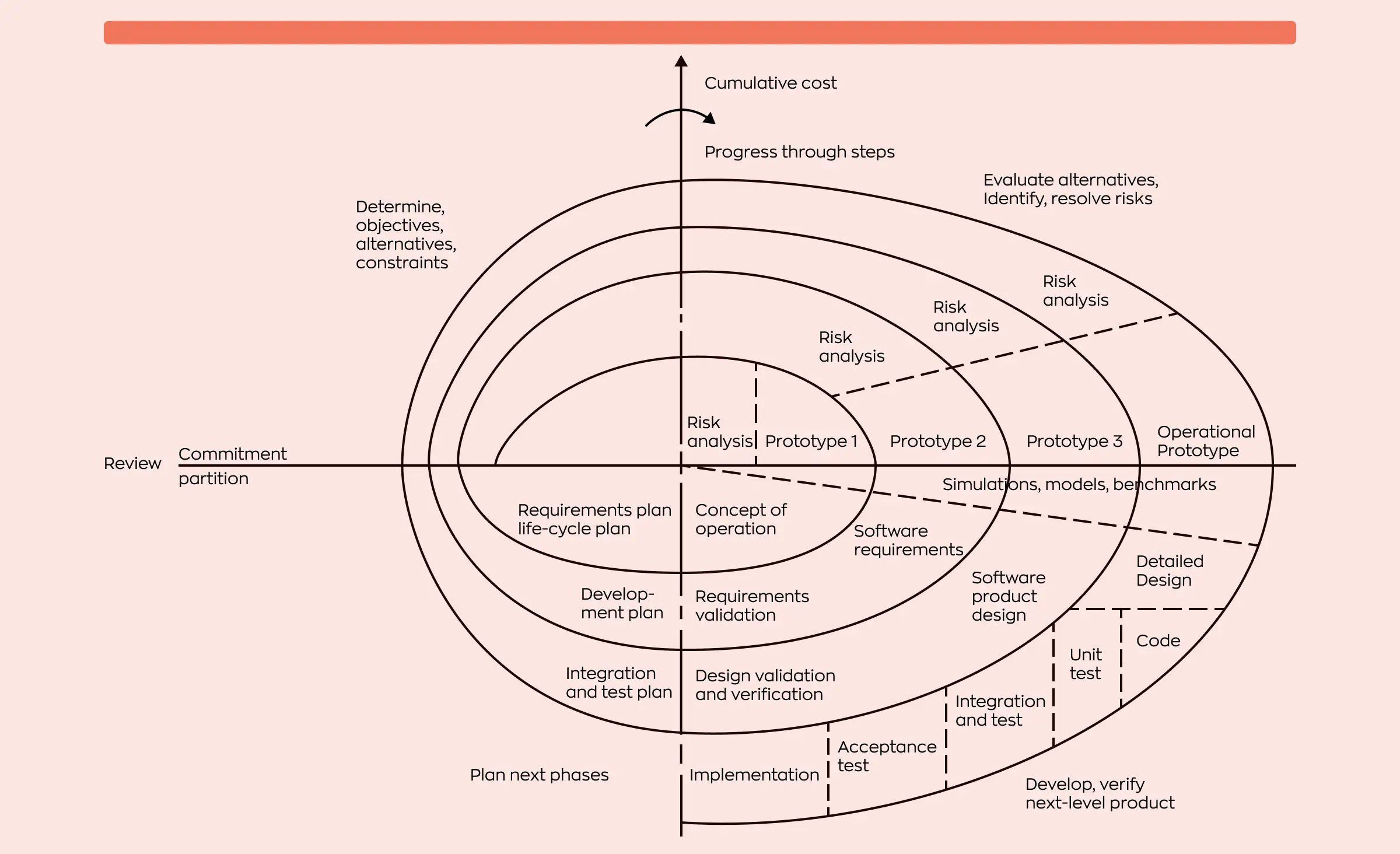
In this article, we look at the rapid application development model as James Martin formulated it, explain how it compares to agile and waterfall, show when RAD is the right choice and when it is not, and walk through how our team applies RAD principles to ship a working product fast.
Key characteristics of the rapid application development approach
The model is for commercial products
The RAD model, as described by James Martin in his book, is particularly well-suited for commercial product development rather than complex systems creation. This model remains relevant today, serving as an effective approach for any enterprise or business developing a new product.
RAD model promises lower costs
The key characteristic of the RAD approach is developing in small, agile teams, using code generation to speed up the process. This minimizes the need for large development teams, resulting in lower costs and faster deployment times. Automation of tasks within the RAD model proves to be more efficient and profitable than traditional, larger team structures.
No compromise between speed and quality
Martin offers to achieve the desired quality of the product through its early reach to end users. In other words, prototyping is key. The sooner the application creator understands what a target audience needs, the better the result will be. Thus, iterative development practiced within the RAD approach helps to avoid implementing unnecessary features while meeting users' demands.
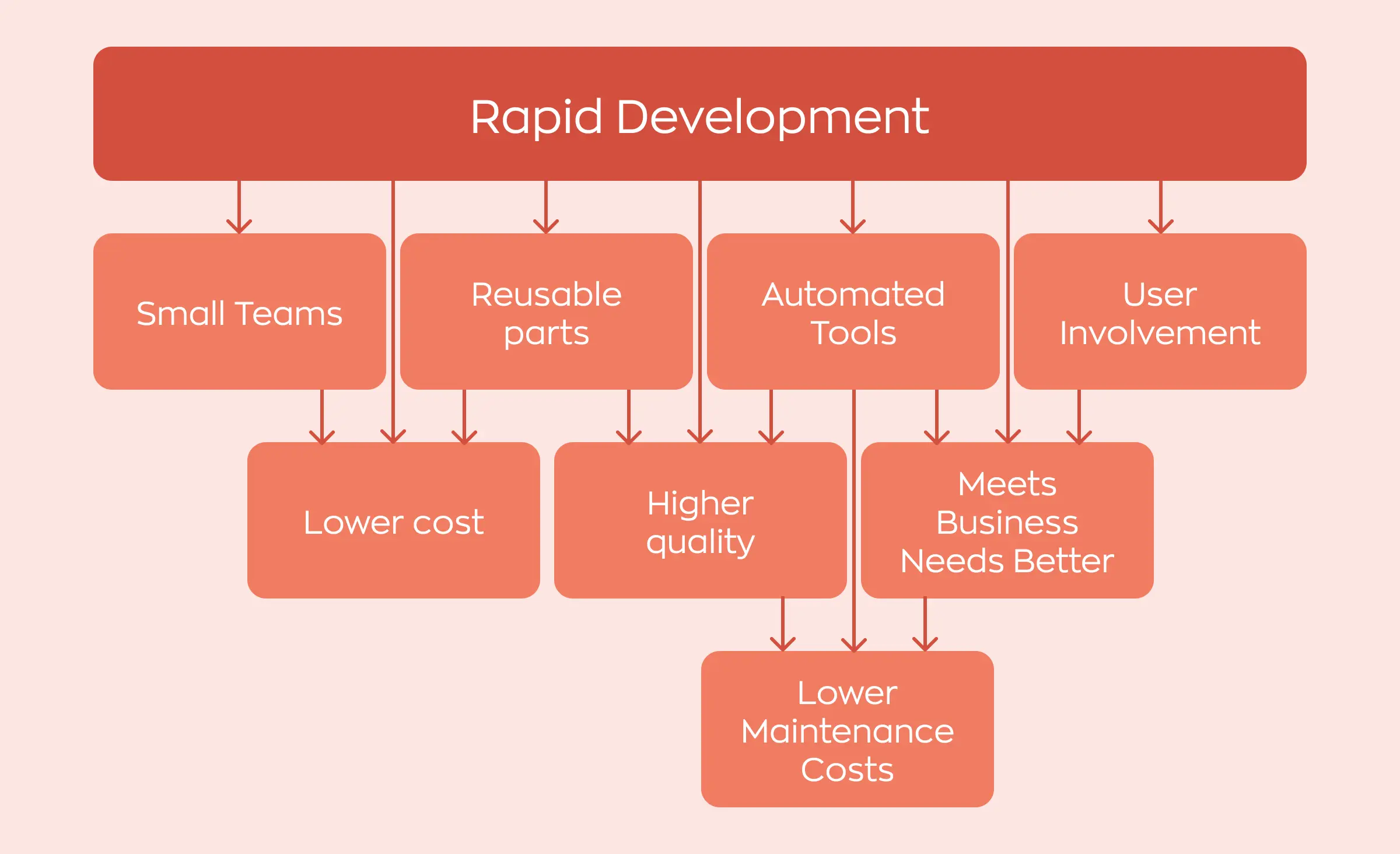
There are four essentials to rapid development
These are tools, people, methodology, and management. Developing in small teams is nearly impossible without computer-aided software engineering (CASE), or rather, the latest technologies. Tools are crucial, but they are ineffective without people who know how to use them efficiently. Therefore, skilled development teams are equally important. Additionally, having a well-defined methodology that is neatly managed is essential.
There should be practical metrics
Practical metrics should be established for each project within a company, and specifically for a development team. Nowadays, team metrics are often measured through time trackers. However, the Rapid Application Development (RAD) model provides specific project and teamwork metrics. According to Martin, these metrics should be:
- Small
- Graphical
- Easily computed
- As reliable as possible
- Objective, in that they measure external characteristics of the system
- A basis for estimating
- A basis for taking corrective action when needed
He also emphasizes that the main metric should be the total elapsed time or development cycle time, as it clearly shows the progress of the rapid application development process. Although specific tools for measuring progress have changed over time, the basic principles remain the same.
At Ronas IT, we help businesses visualize their data with convenient tools to better understand the company's state of affairs. You can read more about the importance of data visualization in our related article.
Automation is key
Recommendations for improving application development in the original rapid application development model might seem outdated to modern engineers. Still, they boil down to two ideas that have aged well: automation and reusability. Martin praised building with reusable components, which modern frameworks include by default. For example, the React Native and Expo ecosystems let our team reuse navigation, maps, media, and permissions handling and move faster on mobile app development.
The same principle applies to features a skilled team should not recreate for every project. Once a payment integration such as Stripe is built and tested, the team reuses it rather than reinventing the wheel on the next commercial app. On our Lainappi rental marketplace build, this reuse is what let the client validate the idea on a lean budget: React Native covered iOS and Android from one codebase, and libraries like react-native-maps and expo-location handled map and location features that would otherwise take weeks to build from scratch.
Phases of the rapid application development methodology
The rapid application development methodology laid the foundation for the agile methodology. Like RAD, agile methodology implies breaking the product creation process into phases and focusing on continuous improvement. Both RAD and agile development are cyclic, but agile has more phases than the RAD model. Nevertheless, let's begin by looking at the phases of Agile's predecessor.
In RAD methodology, the software development life cycle is divided into four phases:
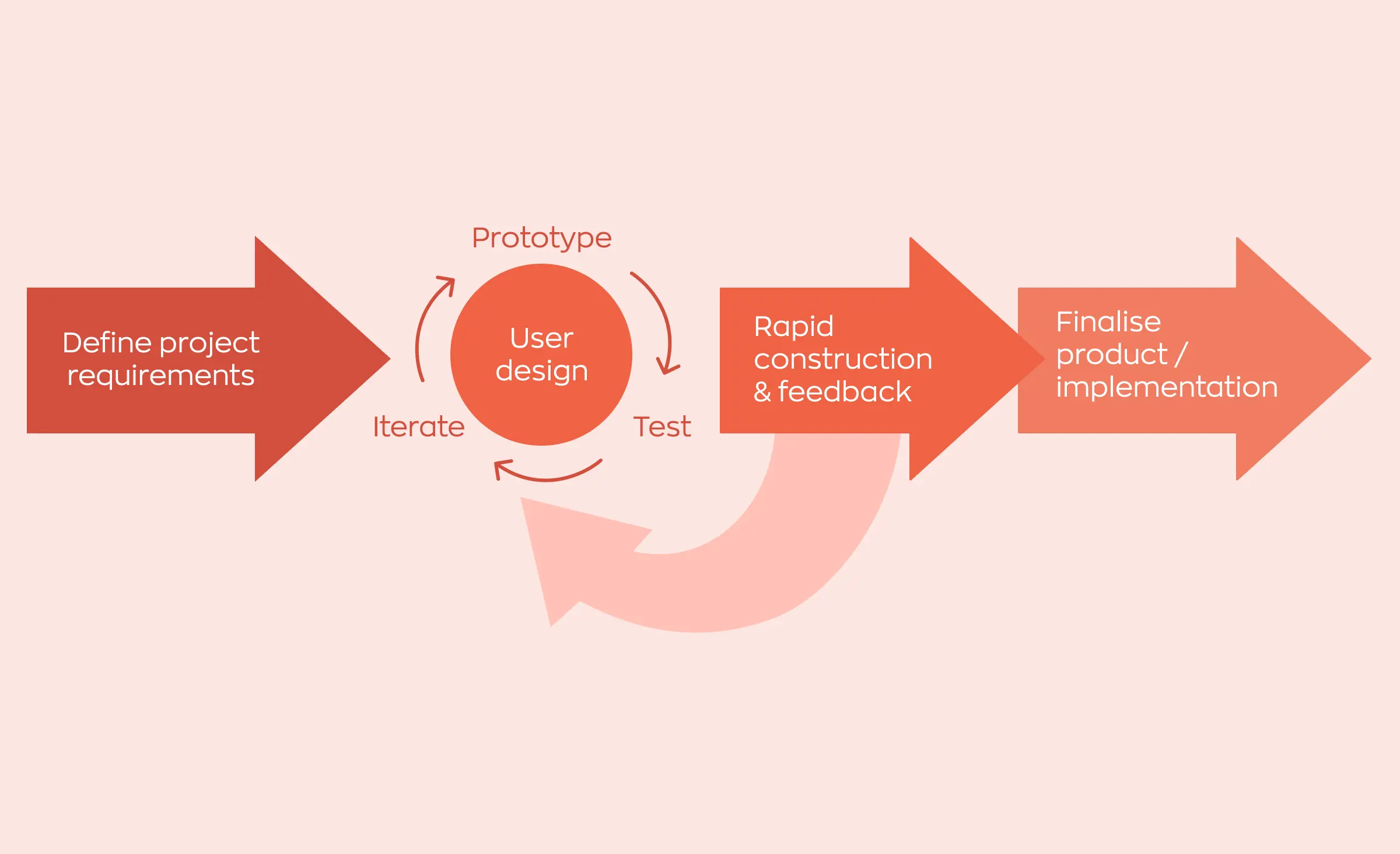
Requirement planning phase
No matter which stakeholders are involved in this phase, the planning should be performed from the end user's standpoint. Martin suggests involving users in planning and design. This rapid application development method persists today and is conducted through customer interviews and prototyping. It's beneficial to revisit the original source of RAD, which recommends two techniques for user involvement: Joint Requirements Planning (JRP) and Joint Application Design (JAD). The first technique, JRP, is conducted during the requirements planning phase.
The results of the joint requirements planning should be the following and are still quite informative and useful for the startups:
Outputs of the joint requirements planning from Martin's “Rapid Application Development”
- List of departments and locations served by the system
- List of system objectives
- Details of possible system functions: benefits, ROI, prioritization
- A process decomposition diagram of the system
- A process flow diagram of the system
- A flow diagram showing interfaces with other systems
- Listing of unresolved issues: responsibilities, deadlines, details
- Implementation target dates
- What happens next
User design phase
Martin advocates for involving end users in the nontechnical parts of the development process. User convenience should always be a priority in the UI/UX design of any application. However, considering the extensive study of user behavior, there may not be a direct need to involve users in the design process, at least not in the UI/UX design. The goal here is to adhere to patterns familiar to users of Android or iOS platforms. Nonetheless, it is still valuable to test the design later with a focus group discussing the app's prototype.
In fact, prototyping is seen as the main approach to design within rapid application development methodology. Martin gives the following definition to the term, “Prototyping is a technique for building a quick and rough version of a desired system or parts of the system. The prototype illustrates the system to users and designers.” So it's about testing the functionality and design before they are fully elaborated, which eventually is very important in exploring the right way to product-market fit. Today we use a clickable prototype to verify it.
Construction phase
This is the phase where design is transmitted to code with the generous use of automated rapid application development tools. Testing of the code should be performed in parallel with transforming data models and processes into the final working product. The construction itself should be carried out by SWAT teams, which stands for Skilled With Advanced Tools. This means the team should be small, highly skilled, and equipped with tools that allow for faster product development.
Cutover phase
Testing should not be performed manually after the code is written, as it takes substantial time. This approach aligns with modern development practices, where automated tests eliminate the need for a lengthy manual testing process. For example, in React Native development, we use tools like Maestro and Detox to conduct end-to-end (E2E) tests. End-to-end testing mimics real-life scenarios to assess the app’s performance effectively.
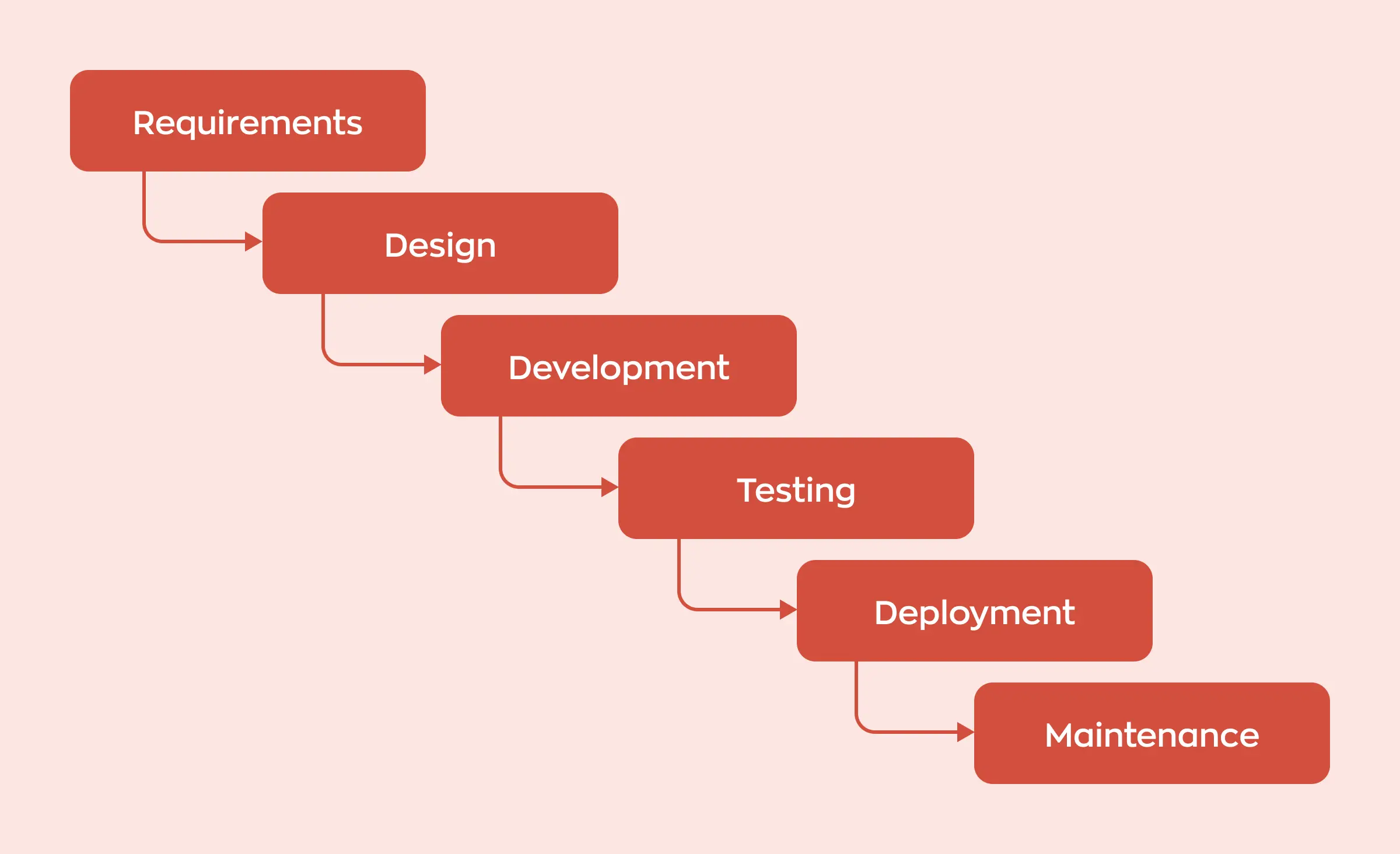
The rapid app development model as opposed to the waterfall model eliminates the need to adjust to a strict plan and adds flexibility to the development process. The following are the points in which the two approaches differ.
| RAD | Waterfall | |
|---|---|---|
| Project flow | Even though RAD has phases, development is performed in iterations that include coding, testing, and feedback gathering. | Has a sequential process where development cannot move to the next step without finishing the previous one. |
| Development stages | Consists of four phases: user requirements gathering, user design or prototyping, construction, and cutover. | Usually has the following structure: requirement gathering, system design, implementation, testing, deployment, maintenance. |
| Required timeline | Takes less time due to iterative approach allowing for faster delivery of functionality. RAD doesn’t rely on strict planning and rather focuses on user feedback in iterations. | Takes more time as each phase is completed fully. Requires extensive upfront planning. |
| User feedback | User feedback is integrated continuously throughout the whole process of development. | User feedback is limited to the planning and final delivery phases. |
| Testing | Inspires continuous testing with the use of automation. | Quality check is conducted later in the process which might make it costlier. |
| Project type | Good for web and mobile app development where user feedback is crucial and time-to-market is essential. | Suits projects that are well-defined and have strict requirements. These are usually large-scale systems associated with high risks. |
| Pros and cons | In general: flexible, rapid, lower risks. But: resource-intensive, requires constant user engagement, inconvenient for large projects. | In general: clear, manageable, and predictable. But: Inflexible, hard to change, risky in case they are needed. |
Modern development practices enhancing the rapid app development approach
Even though the RAD model was formulated over 30 years ago, its core ideas remain relevant: user feedback, prototyping, iterative development, reusable components, and less bureaucracy in team communication. In 2026 the most visible way to apply RAD is through low-code and no-code platforms, which vendors like Kissflow and Mendix position as RAD delivery tools. Those tools speed up internal apps, but they are not the only path. AI coding assistants now push the same idea into full-code work: they draft boilerplate and speed up the construction phase, while a skilled team still reviews every change. So, what can be added to the RAD approach if you decide to stick to its principles?
Agile integration
RAD laid the foundation for agile project management, encouraging businesses to seek flexible methodologies to adapt products to user requirements. Sprints, Scrum, and Kanban methodologies are frequently integrated with RAD principles to provide a structured yet flexible framework for rapid and iterative software development.
Improved prototyping
Modern tools allow for the creation of high-fidelity prototypes that closely resemble the final product, as Martin originally required in his methodology. Today, design tools such as Figma, Adobe XD, Sketch, and InVision let teams build interactive prototypes quickly and collaborate with stakeholders on them.
DevOps practices
In modern development, continuous integration and continuous delivery pipelines are responsible for sped-up processes. Continuous integration is a procedure where developers integrate code changes in the shared repository, integrations are automatically verified by running tests, while CD is an automated process of delivering code to testing and development environments. Tools like Jenkins, CircleCI, Travis CI, and Azure DevOps automate testing, integration, and deployment to ensure quick and reliable delivery of updates. CI/CD pipelines perfectly correspond to the idea of an ongoing testing process and rapid construction of the RAD model.
Cloud services
Cloud services add flexibility to the development process through scalable infrastructure, development environments, and deployment. Among the most reliable and popular are AWS, Google Cloud, and Microsoft Azure. They help developers reduce setup time and scale more easily, which matters for iterative app development within the RAD frame.
Version control systems
Versioning is critical for application development, as previous versions of the app must coexist on users’ devices alongside new versions. Utilization of Git and platforms like GitHub, GitLab, and Bitbucket help in efficient code management, collaboration, and maintaining a history of code changes.
Containerization
Containerization is a deployment process that allows applications to run smoothly across different platforms. Technologies such as Kubernetes and Docker are commonly used for containerization.
Collaborative tools
The RAD model designed by James Martin even offered how to organize an office space for effective workshops and communication within teams. Today’s work processes are enhanced and managed with tools such as Slack, Jira, ClickUp, Microsoft Teams, and others to facilitate collaboration between engineers, designers, managers, and stakeholders.
Microservice architecture
This architectural style suits the rapid app development methodology. In the microservice approach, an app is built from independently deployable, loosely coupled services, which makes it more flexible and easier to scale.
Modern implementations of RAD use current technologies, tools, and practices to support the principles of rapid, iterative software development, flexibility, and user involvement. However, companies often use a combination of methodologies that complement RAD ideas. Usually, it’s not a single approach but a combination of them, where one methodology can be enhanced to meet the specific demands of a project. Thus, rapid application development can be one of the techniques applied if there is a need. For example, at Ronas IT, we integrate various approaches to tailor our processes to the distinct needs of each project. Let us show how.
When RAD fits, and when it doesn't
RAD is not a default for every project. It rewards a specific set of conditions and struggles outside them. Use this as a quick decision aid before committing to the approach.
| RAD is a strong fit when | RAD is a weak fit when |
|---|---|
| The product is small-to-mid-sized with a build of roughly two to three months. | The system is large and tightly coupled and needs heavy upfront architecture. |
| Requirements are roughly clear at the start but sharpen as users try working prototypes. | The domain is heavily regulated and documentation must precede development, as with medical devices or a bank's core transaction system. |
| A stakeholder is available to give feedback on iterations throughout the project. | No one on the client side can commit time to frequent reviews. |
| A skilled team can reuse prebuilt modules instead of rebuilding basics. | The team is junior or spread thin, so fast iterations create more defects than value. |
There is a common misconception that RAD means picking up a low-code platform. It can, but that is a trade-off.
“We treat RAD as a set of habits, not as a specific tool: prototype early, reuse what we have already built, and ship in short iterations. For a throwaway internal tool, a low-code platform can be the right call, and we will say so. For a product you plan to grow and own, we apply those same habits in full custom code, so the app does not hit a platform ceiling later.”
Evgeny Leonov, CTO at Ronas IT
If your goal is a disposable internal dashboard, a low-code builder may serve you better than a custom team. If you are building a product to scale, RAD principles on a real stack are the safer bet.
How Ronas IT applies RAD principles
Rather than forcing a ready-made model onto every project, our team studies the project requirements and the client's goals first. Depending on how much flexibility or structure an application needs, we choose the methodology that fits, while keeping RAD's core habits of prototyping, reuse, and short iterations.
Scrumban
Scrumban is a methodology that suits most of the projects that we work with. It allows us to work with projects with a predictable scope, for example, when we have a ready design and know exactly what features we should engineer, and with projects that have evolving requirements where we can flexibly change the scope of work on the run. Working in this approach helps to eliminate the need to choose between strict Waterfall and loose RAD.
Scrumban is a combination of Scrum and Kanban, which are agile project management frameworks. From Scrum, it took work in sprints which are similar to iterations. Sprint is a period by which a team has to complete a particular amount of work. Usually, the sprint takes two weeks and up until it ends, a team does not receive the next tasks. Also, Scrumban includes daily standups to catch up on the progress and retrospectives at the end of every sprint to analyze the performance.
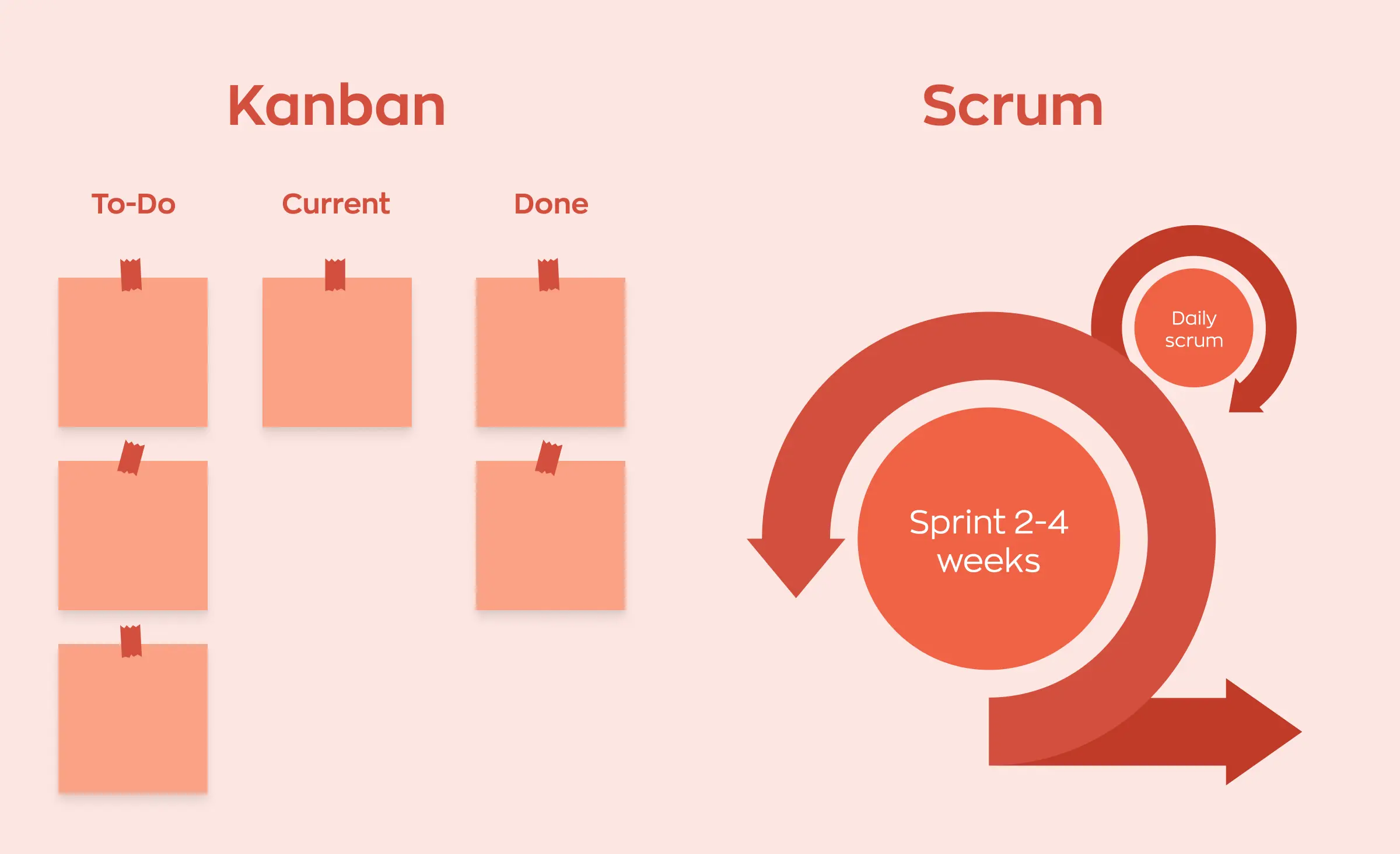
As for the Kanban, it became a source of work process visualization. Scrumban uses its board with columns indicating the phase of the project. The classic Kanban columns are “to do”, “in progress”, and “done”. Each task is described in a card, and once a developer starts to work on a certain task, they drag a task from one column to the next. Kanban makes capabilities and progress visible. Thus, a team can see how many cards and in what period a single developer can work. This very much helps to plan wisely and prevent burnouts. On the other hand, a development team can show its accomplishments to stakeholders and make processes transparent.
It is important for us that the chosen methodology meets the requirements of flexibility — sometimes customers want to be able to change something during development, sometimes they don't, and our team should be able to adapt. Scrumban allows for such adaptability.
How do we choose a methodology?
Sometimes a project needs a waterfall approach, and there is nothing wrong with a strictly scheduled workflow. The main criterion is common sense — the methodology should be the one that delivers the project as required, on time and on budget.
RAD habits pay off most on early-stage products. Because we reuse pre-built modules such as authentication, payments, and navigation instead of rebuilding them each time, a basic MVP starts from 4 weeks, depending on scope (current timelines and prices are on our pricing page). The short timeline comes from that reuse, not from cutting corners on quality. If you are weighing where a proof of concept, prototype, and MVP each fit, our guide on PoC vs prototype vs MVP breaks down the differences.
Key takeaways
The rapid application development methodology was formulated decades ago, but its core ideas carry into modern practice. The specific tools Martin named are outdated; the principles behind them are not: working in iterations, prioritizing automation, and testing continuously.
If you are deciding whether RAD is right for your next project, here is what to do:
- Check the fit first. RAD works best for a small-to-mid-sized build of two to three months with an available stakeholder; skip it for large, architecture-heavy, or document-first systems.
- Pick the vehicle deliberately. A low-code platform can fit a throwaway internal tool, but a product you plan to scale is better served by RAD principles on a real, full-code stack.
- Lean on reuse. Reusing prebuilt modules such as authentication and payments is what makes the timeline short without cutting quality.
At Ronas IT we apply these habits on every early-stage build, which is what keeps an MVP timeline short. If that matches what you are planning, tell us about your product and we will map out the fastest honest path to launch.



Frequently asked questions about RAD
What is rapid application development (RAD)?
What are the four phases of the RAD model?
How is RAD different from agile?
When should you use rapid application development?
Does RAD require low-code or no-code tools?
How fast can RAD deliver a first version?
What tech stack supports rapid application development at Ronas IT?
Related posts







Related Services
React Native App Development Services
Save time and costs with Ronas IT's React Native app development, allowing cross-platform capabilities for iOS and Android. Our team has built 20+ React Native apps since 2020, ensuring rapid development, flexible maintenance, and cost-effective solutions.
MVP Development Services
Need to launch your startup quickly? Ronas IT offers urgent MVP development services, allowing you to get a fully-functional app in 4 to 12 weeks, depending on scope. Ideal for testing business ideas, presenting to investors, or entering the market swiftly. Benefit from our extensive experience and accelerated development process.
Custom Web App Development Services
Build secure, scalable web applications with Ronas IT’s custom web app development services. Our team covers the full cycle — from concept and UI/UX design to development, testing, and ongoing support — using leading tech like React and Laravel. With 200+ custom apps delivered across various industries, we ensure intuitive interfaces, smooth integration, and solutions tailored to your business goals.