How to estimate software development cost: methods, process, and how to read an estimate


A software development estimate is built from two numbers: how many hours the project will take, and the hourly rate of the team doing the work. Multiply them and you get a budget. The rest of this guide is about where those hours come from and how to tell a solid estimate from a risky one before you sign.
If you are a founder or product owner comparing quotes from several teams, this guide gives you the vocabulary to read those quotes critically. We build products for startups and small businesses, so the process below is the one we actually run for MVP development, not a textbook summary.
Why estimation is worth doing properly
A good estimate does more than set a budget. It is the first real test of your idea. It shows whether the product can pay off, whether an off-the-shelf tool would be cheaper than building from scratch, and where the expensive parts of the project hide. Getting this wrong is common and costly: a 2012 McKinsey and Oxford study of 5,400 large IT projects found they ran 45% over budget on average while delivering 56% less value than predicted. The Standish Group's CHAOS report tells the same story for the wider field: in its 2020 edition, only 31% of software projects were fully successful, while 50% were challenged (delivered late, over budget, or with fewer features than planned) and 19% were cancelled.
Most of that overrun starts with a weak estimate, not weak developers. A number pulled together in an hour to win a deal will drift the moment real work begins. A number built from a proper breakdown holds up.
The three methods of software project estimation
Estimation methods differ mainly in how much they lean on past data versus expert judgment. Three are common in the industry today, and most teams combine them rather than pick one.
| Method | How it works | Best for | Main limitation |
|---|---|---|---|
| Analog estimation | The project is split into modules and each is compared to a similar module the team has built before. | Products with familiar building blocks: auth, catalog with filters, payments, chat. | Cannot price features the team has never built or technologies it has not used before. |
| Expert estimation | A senior developer reviews the input and states the hours and resources needed. | Early, rough numbers when the scope is still fuzzy and you need a fast answer. | Experts tend to be over-optimistic; real work often runs meaningfully longer than the first guess. |
| Three-point estimation | The expert gives an optimistic, a pessimistic, and a most-likely value, then combines them. | Improving the accuracy of an expert estimate by pricing in risk. | Still rests on expert judgment, so it inherits some of the same bias. |
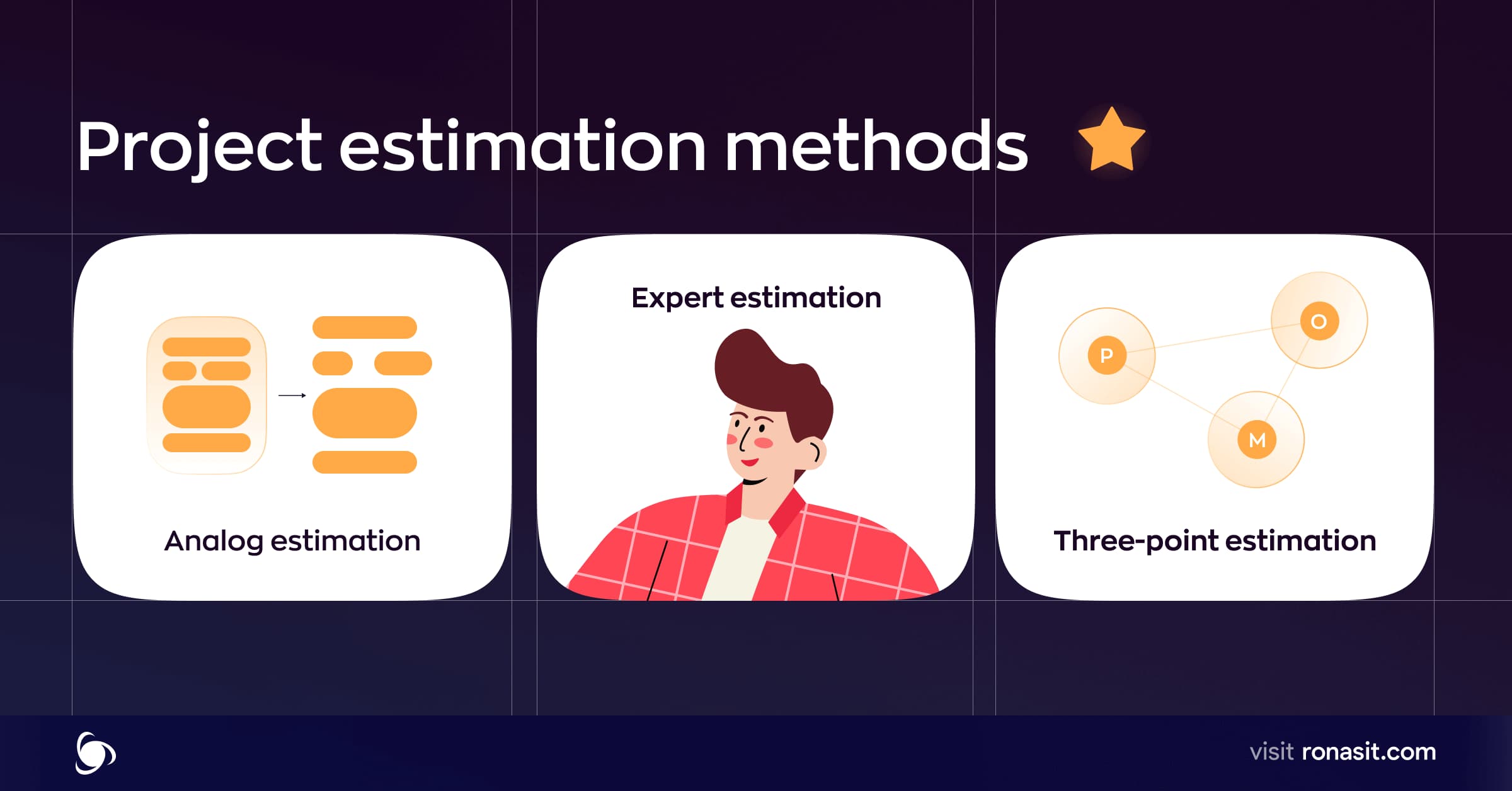
In practice, we use expert estimation to give a rough number early, then switch to analog estimation for the detailed figure once the design and user stories exist. Comparing the new project against our past ones is what makes the detailed number reliable, because we already know how long a login flow or a filtered search took to build last time.
How Ronas IT estimates a project, step by step
Different companies run different processes. Here is ours. It fits products built from scratch and is designed to give you a precise number before development starts, not after.
- Input study. An analyst meets you to understand the business goals and how the product will affect them, then reviews any materials you have: a spec, a design concept, or a prototype. This is where a paid analysis phase fits if you want a documented scope.
- Decomposition. The analyst breaks the project into measurable objectives and then into user stories: short descriptions of what a user can do, such as “I can add a product to the cart” or “I can pay for an order”. This is the raw material for the estimate.
- First estimate. A designer estimates the design and an engineer gives a rough development figure. We do not give a detailed development number yet, and that is deliberate: design work almost always reshapes the functionality, and a premature detailed number would be wrong. At this stage the design estimate is usually within 5–10% on time, while the development estimate can still be off by around 40%.
- Detailed estimate. Once the design is done, the engineer studies the finished screens and user stories, matches them against comparable past projects, and produces the precise development hours. This is the number you plan your budget around.
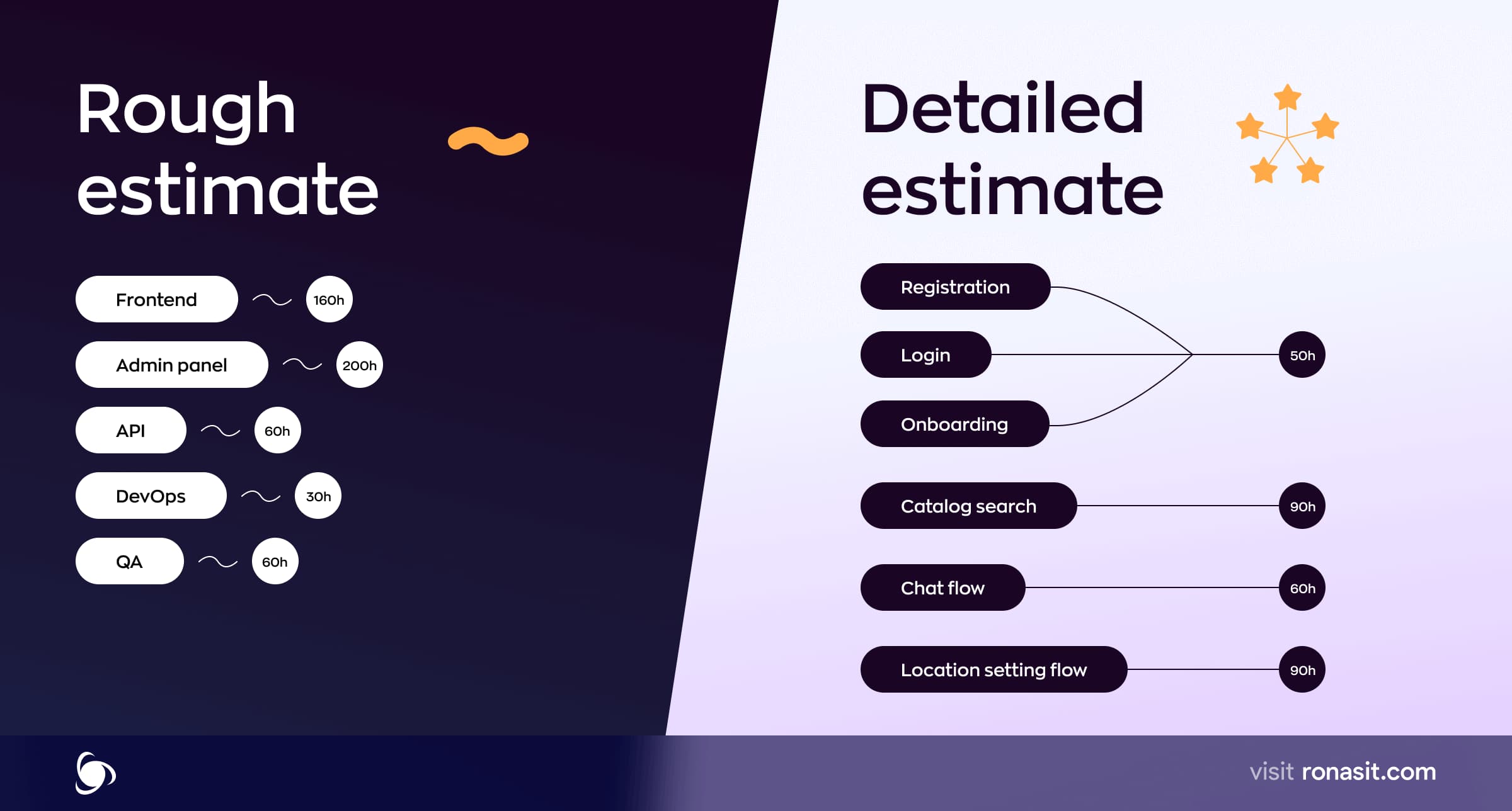
The reason for two passes is control. A rough number lets you decide whether to proceed at all. The detailed number, produced after design, lets you commit with confidence. On our OddsCrowd sports-prediction web platform, for example, we agreed to run an initial iteration, complete the risky work with the external data feeds inside it, and only then re-estimate the rest of the build once the design was finished and the integrations were proven.
What a real estimate looks like
A finished estimate is not one number. The project is divided into functional models (flows) made of user stories, and the hours for each flow are split between front-end and back-end work. Technical tasks such as deployment and architecture, and process tasks such as team meetings, are counted explicitly rather than buried in a markup.
The breakdown below is the shape a real mid-size project estimate takes at Ronas IT. It shows how the roles add up rather than a fixed price:
| Role | What it covers |
|---|---|
| Design | UI kit, concept, and screens for every flow |
| Front-end | Usually the largest single block on a UI-heavy product |
| Back-end | Business logic, database, and integrations |
| DevOps | Deployment, environments, and infrastructure setup |
| QA | Testing each flow across devices and edge cases |
| Management | Planning, coordination, and communication with you |
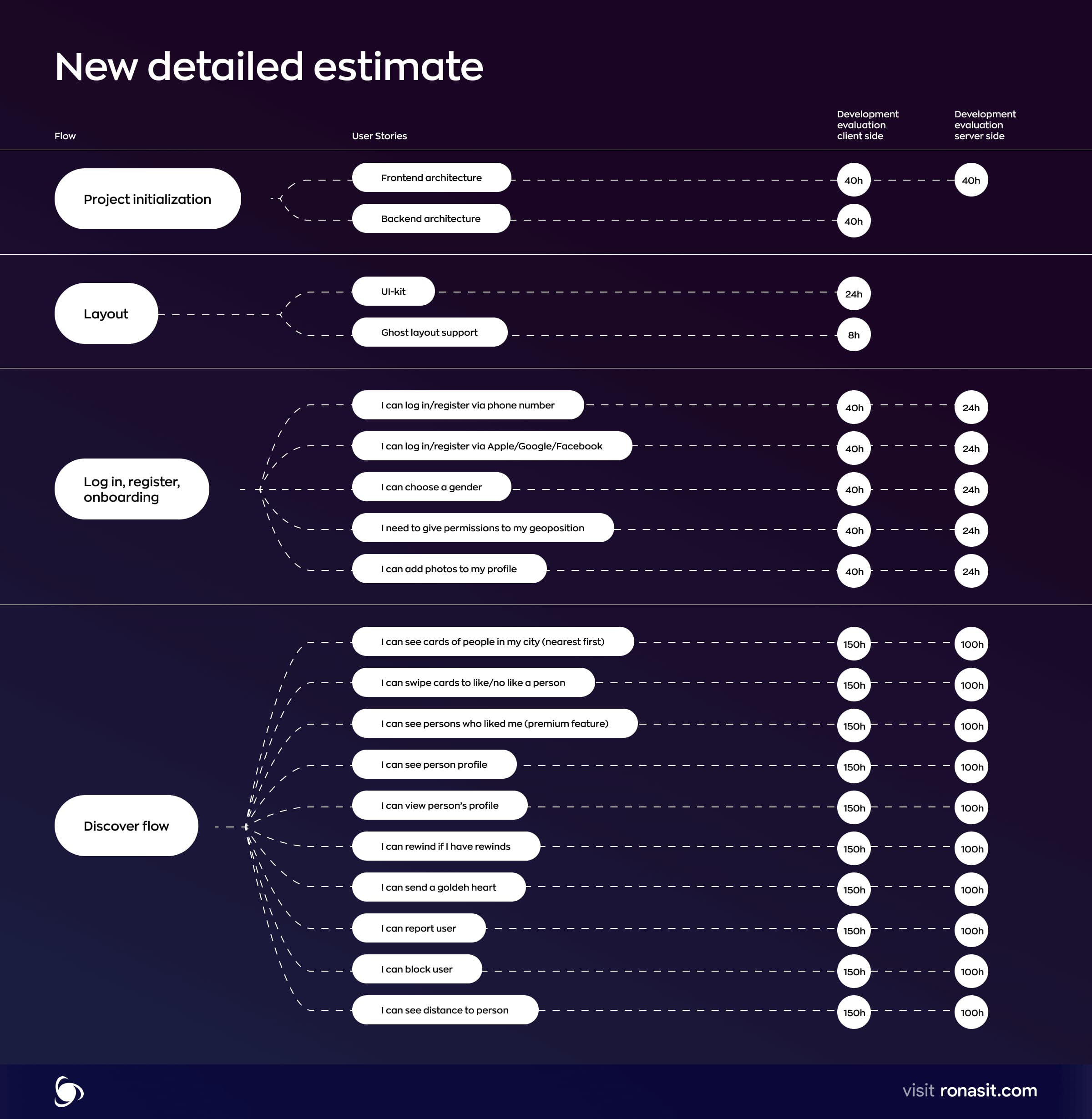
When you receive an estimate that looks like this, you can see exactly where your money goes and challenge any line that seems off. When you receive a single lump sum, you cannot.
One thing to keep in mind when you read the totals: the hours and the timeline are two different axes. These roles work in parallel, not one after another, so a project of several hundred hours does not translate into that many hours of calendar time. The duration in weeks reflects the longest chain of dependent work, which is why a 6-week build can still add up to a large hour count across the team.
What drives the cost of your project
With the process in mind, the main cost drivers are easy to reason about:
- Number and complexity of features. Each flow adds design, front-end, and back-end hours. A simple content app and a marketplace with payments and messaging are not in the same range.
- Platforms. Two separate native apps for iOS and Android cost more than one shared codebase. A cross-platform app built with React Native starts from $20,000 precisely because it reuses one codebase across both platforms. This is not a separate price tag on top of the MVP tiers below; it is where the platform choice puts you inside them.
- Integrations. Payments, maps, identity verification, and external data feeds each carry their own build and testing effort.
- Design polish. A minimalist interface is faster to build than a heavily custom one, which is why trimming the first version often trims the budget more than dropping features does.
- Familiarity of the work. The same feature costs less when the team has built it before. An unfamiliar technology, a strict compliance requirement (HIPAA, GDPR, PCI DSS, or SOC 2), or a stack the team has to learn acts as a multiplier on the base hours, not a small add-on.
One category founders often forget is the non-labor costs that sit outside the hourly estimate: an Apple Developer account ($99 a year) or a Google Play Console account ($25 one-time), paid third-party APIs (Stripe, Twilio, Google Maps), and hosting or cloud usage. These are usually a small share of the total, but they are real line items, so ask whether a quote includes them or assumes you will cover them separately.
How much estimation itself costs at Ronas IT
A rough ballpark estimate is free, and you can get an instant one from the project time calculator on our home page, which returns an approximate number of work days for your idea; the team applies its hourly rate to those days to reach a ballpark cost. We bill on a time-and-materials basis, so you pay for the hours actually worked against the estimate rather than a fixed lump sum. If you want a documented scope and a detailed number before committing to a full build, two paid options bridge the gap:
| Step | Price | Duration | What you get |
|---|---|---|---|
| Analysis phase | $2,000–$3,000 | From 1–2 weeks | A documented scope and a detailed estimate |
| Proof of concept | From $8,000 | From 2 weeks | The riskiest feature built and validated |
Once you decide to build, a Basic MVP starts from $15,000 (from 4 weeks), a Full-featured MVP from $25,000, and an Urgent MVP from $45,000 (both from 6 weeks). The Urgent tier costs more because a larger, dedicated team works in parallel to hit a tight deadline, even though the calendar time is the same. These are entry points for common project shapes, not fixed quotes: whatever you build is still broken into the itemized estimate described above before you commit. If you need senior technical oversight without a full hire, CTO as a service is $1,500 per month. All current figures live on our pricing page.
How to tell a good estimate from a bad one
“The estimate is a planning tool, not a sales pitch. We would rather show a client a rough range with an honest margin and then tighten it after design than hand over one confident number that we both regret in month three. Most of the accuracy comes from decomposing the work into real user stories, not from a developer's gut feeling.”
Evgeny Leonov, CTO at Ronas IT
When you compare quotes from different teams, judge the estimate itself, not just the total. A trustworthy one has four traits:
- A breakdown by feature or flow, so you can see what each part costs and drop what you do not need yet.
- A front-end and back-end split, which shows the team has actually thought through the build, not just guessed a round figure.
- Technical and process tasks included: deployment, architecture, QA, and management are real hours, not free extras.
- A stated accuracy margin for any number given before design. A range with a margin is honest; a single fixed number given before any analysis usually hides the risk instead of managing it.
If one quote is dramatically lower than the rest with no breakdown behind it, that is not a bargain. It is an estimate that has not been done yet, and the difference will surface as change requests later.



Frequently Asked Questions (FAQs)
How do you estimate software development cost?
What are the main methods of software project estimation?
How accurate is a software development estimate?
How much does it cost to get a project estimated?
Why is a development estimate a range and not a fixed number?
Why does the timeline in weeks not match the total hours?
Who should prepare the estimate?
What should I do if the quote I already have is just one lump sum?
Related posts







Related Services
React Native App Development Services
Save time and costs with Ronas IT's React Native app development, allowing cross-platform capabilities for iOS and Android. Our team has built 20+ React Native apps since 2020, ensuring rapid development, flexible maintenance, and cost-effective solutions.
MVP Development Services
Need to launch your startup quickly? Ronas IT offers urgent MVP development services, allowing you to get a fully-functional app in 4 to 12 weeks, depending on scope. Ideal for testing business ideas, presenting to investors, or entering the market swiftly. Benefit from our extensive experience and accelerated development process.
Custom Web App Development Services
Build secure, scalable web applications with Ronas IT’s custom web app development services. Our team covers the full cycle — from concept and UI/UX design to development, testing, and ongoing support — using leading tech like React and Laravel. With 200+ custom apps delivered across various industries, we ensure intuitive interfaces, smooth integration, and solutions tailored to your business goals.
CTO as a Service for Startups
Accelerate your startup’s growth with Ronas IT’s CTO as a Service. Get expert tech guidance, architecture design, comprehensive audits, and ongoing strategic support — without hiring a full-time CTO. We help align technology with your business goals, ensure secure and scalable systems, and optimize your development processes so you can focus on launching your product and gaining market traction.