How to build a stock trading platform: market data, KYC, latency, and order flow


Most guides to stock trading platform development describe screens. Screens are the cheap part. What decides whether the product ships, and what it costs to run afterwards, sits underneath: where the prices come from and what a licence for them costs, how an identity check is wired so people finish it, how many milliseconds you are allowed to spend between a tap and a fill, and who is legally the broker when money moves.
The short answer: a stock trading platform is four subsystems, not one app. They are market data, identity and accounts, order management, and risk. Licences and broker arrangements set the schedule more often than code does, so plan 6 to 12 months. On our published rates a first version without execution starts at $25,000; a regulated build with KYC that routes live orders through a partner broker starts at $75,000 and takes at least 3 months.
What a trading platform is actually made of
A trading platform is a system that shows a licensed price, verifies who the customer is, sends an order to a venue through somebody's licence, and keeps a defensible record of all three. It is not one application. It is four subsystems with different owners, different failure modes, and different contracts behind them. Getting the split right early is what keeps the second year affordable.
| Subsystem | What it does | What it is bound by |
|---|---|---|
| Market data service | Ingests quotes and trades, fans them out to clients, stores history for charts | Exchange and SIP licence terms, per-subscriber reporting, bandwidth |
| Account and identity service | Signup, KYC and AML checks, funding instrument linking, account state | Customer identification rules, sanctions screening, vendor SLAs |
| Order management system (OMS) | Accepts, validates, routes, tracks, and reconciles every order | Broker or clearing firm APIs, audit and record-keeping duties |
| Risk and compliance engine | Pre-trade limits, suitability, surveillance, regulatory reporting | Regulator reporting formats and deadlines |
The mistake we see most often is treating market data as a feature of the chart component and identity as a step in the signup form. Both are systems of record with their own billing, their own audit trail, and their own uptime requirement.
Which kind of trading product are you building?
The four subsystems stay the same; what changes is who supplies each one and which regulator sets the rules. Settle the archetype before the architecture.
- Equity and ETF brokerage. Data comes from exchange plans, execution goes through a broker or clearing firm, and the securities regulator owns you. This is the case the rest of this guide works through.
- Analytics and social trading. No order routing in version one. You pull performance data from the venues your users already trade on, which moves the hard problem from execution to data accuracy and comparability.
- Crypto brokerage. Orders go to an exchange or a liquidity provider and the assets can sit with a custody partner, so the build looks like the equity case on different rails. In the EU it still needs a MiCA licence before launch rather than after.
- Crypto exchange. Here custody and a matching engine really do become yours, which makes it a different product from everything else on this list, under the same MiCA requirement.
- Robo-advice and managed portfolios. Order flow is simple and periodic; the weight moves to suitability, rebalancing logic, and advice records.
These are not permanent categories. The UK platform described later in this guide started as analytics and social trading, and the client turned it into a copy-trading product after release, which pulled execution into a system that had been built to read data rather than send orders.
Market data: where prices come from and what a licence costs
Displaying a live US stock price is a licensed act. You have three routes. All three publish their fee schedules, and they are not within an order of magnitude of each other.
- Delayed or historical data. Fifteen-minute delayed quotes and end-of-day history carry the lightest terms. Good enough for research tools, watchlists, and content, not for order entry.
- Consolidated real-time data (the SIPs). The Consolidated Tape Association covers NYSE-listed and regional-listed securities, and the UTP Plan covers Nasdaq-listed ones. This is the normal choice for a retail app: one schedule per plan, and a price per subscriber.
- Direct exchange feeds. Full depth of book, straight from each venue, with the lowest latency and the highest fixed cost. You pay per venue: NYSE's proprietary market data fee schedule priced the NYSE Integrated Feed at $8,400 a month for access, $16 per non-professional user and $4,400 a month to redistribute as of 16 March 2026, and that is one venue, not the whole market. This is a market-making and proprietary trading choice, not a retail app choice.
The CTA publishes its Schedule of Market Data Charges openly, which makes the retail economics easy to model.
| Charge (CTA schedule) | Network A | Network B |
|---|---|---|
| Non-professional subscriber, per subscriber per month | $1.00 | $1.00 |
| Professional subscriber, per device per month (Network A, 1 to 2 devices; Network B is a flat rate) | $45.00 | $23.00 |
| Per quote packet, standard rate | $0.0075 | $0.0075 |
| Redistribution, per month | $1,000 | $1,000 |
| Non-display use, last sale, per month | $2,000 | $1,000 |
| Non-display use, quotation, per month | $2,000 | $1,000 |
Rates from the CTA Schedule of Market Data Charges, checked September 2026. Schedules are amended periodically, so verify before you budget.
Put a number on it. Ten thousand non-professional subscribers watching both tapes is 10,000 × $1.00 × 2 = $20,000 a month, plus $1,000 per network for redistribution, so $22,000 a month before Nasdaq names, before any server-side use, and before your first professional user. The per-quote-packet rate of $0.0075 is the alternative to that per-subscriber charge: it suits an app where most users glance at a handful of symbols, and for non-professionals the schedule lets a vendor cap it at $1.00 per network per month anyway, which is why the flat rate is the one worth modelling first.
Three engineering consequences fall straight out of that table, and they are the reason market data is a subsystem rather than an API key.
- You have to classify every user, every month. A non-professional pays a dollar a network; a professional pays forty-five on Network A alone. The distinction is contractual, not technical, so your account model needs a professional or non-professional attribute, an attestation flow that captures it, and a monthly report you can defend.
- Anything the user cannot see is billed differently. The same feed used to trigger an alert, run a screener, or price a portfolio server-side is non-display use, and on Network A that is $2,000 for last sale plus $2,000 for quotation on top of the per-subscriber display fee. If you build alerting on the display feed without declaring it, you are under-reporting.
- Two tapes means two bills. Network A and Network B are priced independently, and Nasdaq names sit under a third plan. A retail app that shows the whole US market is paying three sets of fees, not one.
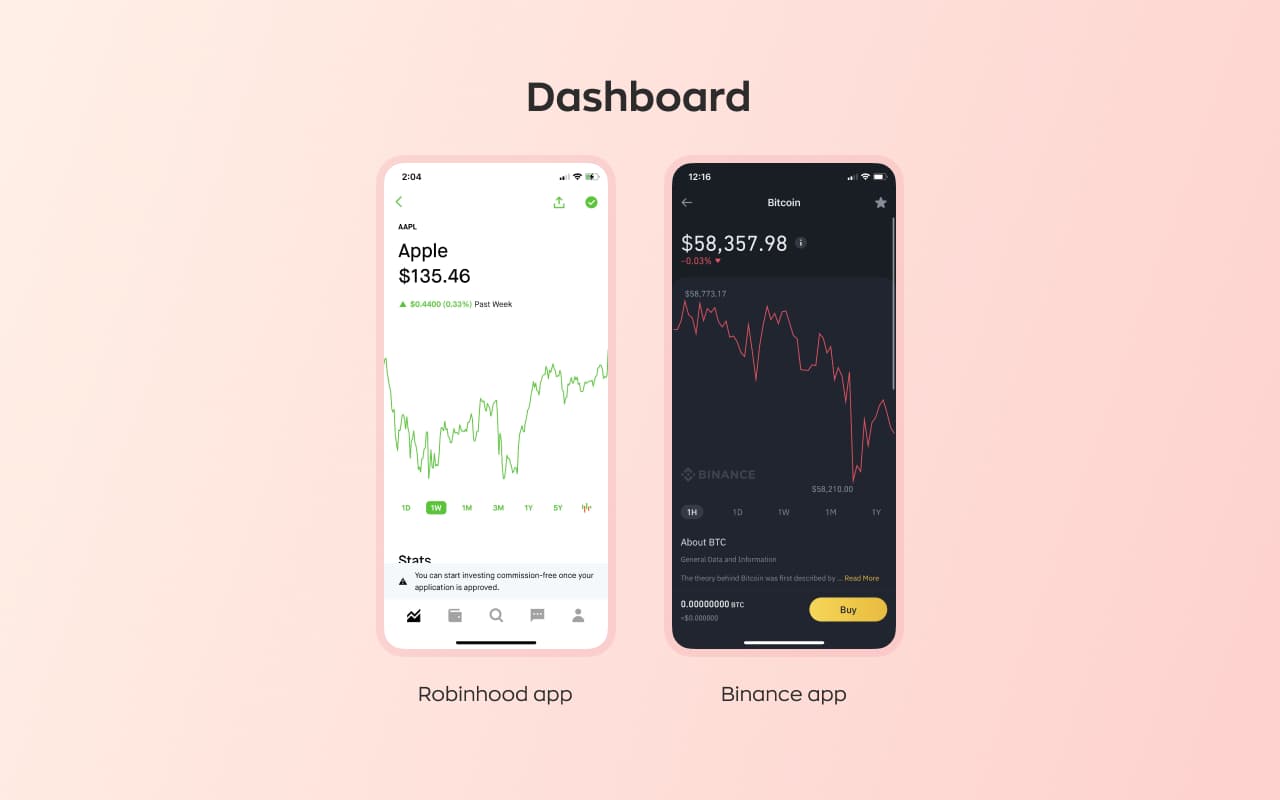
Every quote on a screen like this is somebody's licensed data. Screens from earlier versions of both apps.
None of this is US-specific in shape, only in price. On a trading platform we rebuilt for the Nigerian market, real-time exchange data came from the NGX group API rather than a consolidated US tape, and the entitlement question moved with it. Whichever market you serve, the first architectural question is the same: who owns the data you are showing, and on what terms.
There is a practical way to defer the whole problem in version one: build against a vendor API that already holds the exchange agreements and resells entitled data, then move to direct plan agreements when subscriber counts make it cheaper. On a UK fintech product we delivered under NDA, an analytics and social trading platform for forex traders, we started with Alpha Vantage for economic calendar and market data and changed provider several times at the client's request until the data matched what traders expected. Treat the provider as swappable from day one: one adapter interface, no vendor field names leaking into your domain model.
"The thing teams underestimate is the metering, not the feed. Pulling quotes is a week. Knowing, on the last day of every month, exactly how many entitled subscribers you had, in which category, on which network, and being able to show the working, is a subsystem someone owns forever." — Evgeny Leonov, CTO at Ronas IT
KYC onboarding: the funnel is the product
Identity verification is where trading products lose the users they already paid to acquire. Fenergo surveyed 600 senior decision-makers at banks, asset managers, and fund administrators in August 2025 and found that 70% of firms had lost clients in the past year because onboarding was slow or inefficient, up from 67% in 2024 and 48% in 2023. Those are institutional onboarding numbers, and retail signup is less forgiving, not more.
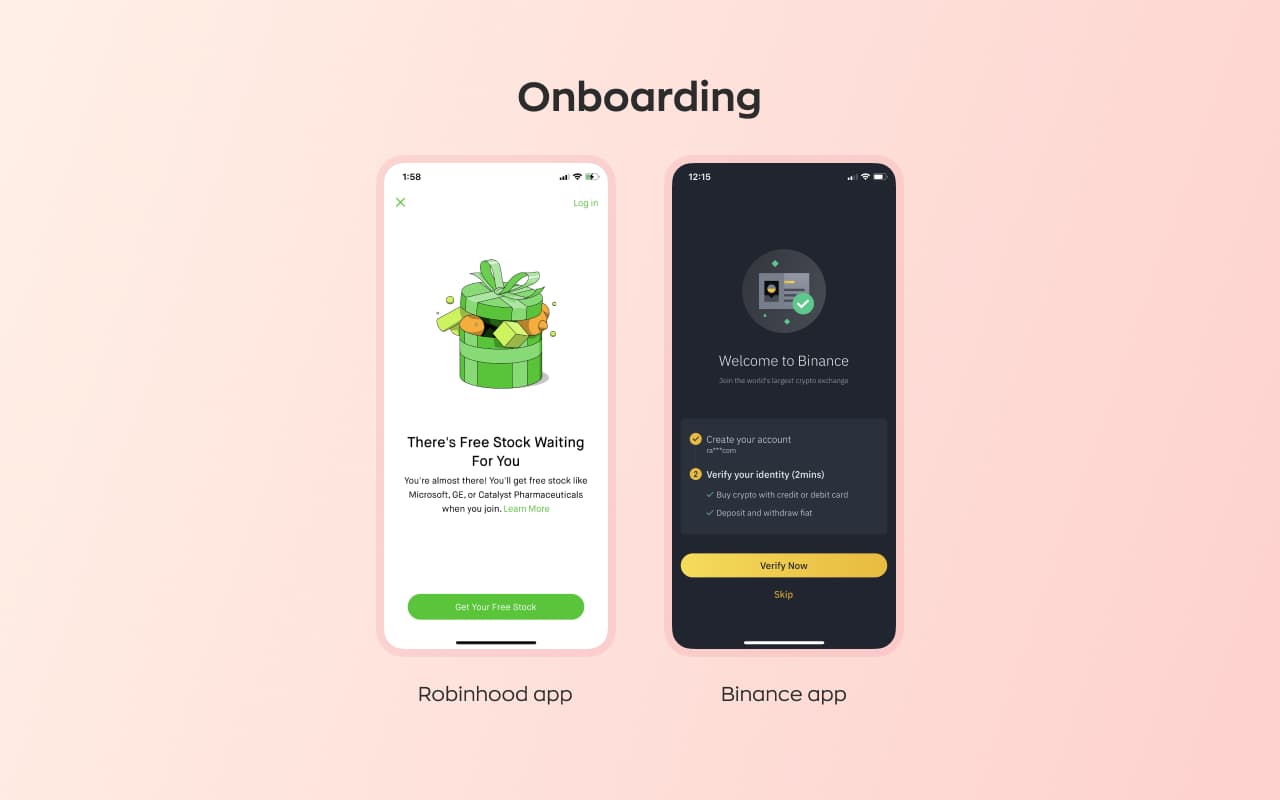
In the Binance onboarding above, verification was promised in two minutes and offered as a step the user could skip. That framing is an architecture decision, not a copywriting one. It only works if verification is asynchronous and the account has states between "nothing" and "fully tradeable".
Design the account as a state machine, not a form
The onboarding flow that survives contact with real verification vendors looks like this:
- Registered. Email or phone verified. The user can browse instruments and build watchlists on delayed data. Nothing regulated has happened yet.
- Identity submitted. Document and selfie captured, sent to the vendor, result pending. The user is out of the flow and into the app. This step must survive the user closing the app.
- Screened. Sanctions, politically exposed person, and adverse media checks returned. Some results are automatic; some go to a human queue with an SLA you have to staff.
- Funded. A payment instrument is linked and the first deposit has settled. Settlement time, not API response time, is what the user experiences.
- Tradeable. All prior states satisfied plus any product-specific gates such as suitability or appropriateness questions.
Each transition needs an idempotent webhook handler, because verification vendors retry, and an immutable audit record, because a regulator will ask who was allowed to trade, when, and on what evidence. Each state also needs a defined re-verification trigger: identity documents expire and sanctions lists change under you.
Identity rails are local, and that changes the flow
A KYC vendor is not a drop-in component you can pick once and reuse in the next market. On the Nigerian trading platform we rebuilt, verification ran through NIN token, a local service: the user submits a bank verification number and phone number, photographs an ID card, and the data goes encrypted to the government service, which returns the result to the user by text message. Nigerian law then requires a questionnaire about the user's experience with financial instruments so the app can build a risk profile before the account can trade.
That extra questionnaire is a whole state in the machine above, and it exists in one jurisdiction and not in others. Assume every market you add moves a boundary in this subsystem, and keep the verification steps behind an interface rather than hard-coded into the signup screens.
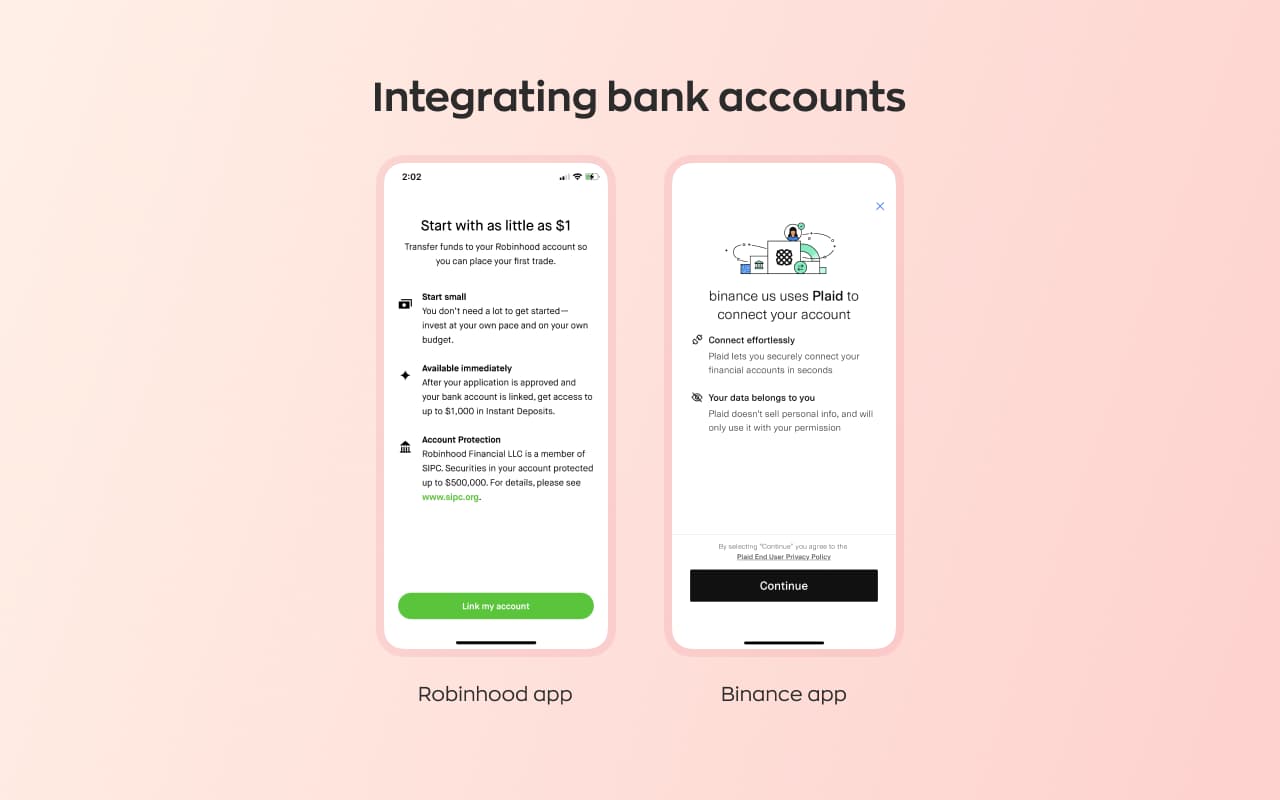
Linking a funding instrument is its own state in the machine above, and its own vendor contract.
On the UK platform, the security work that came with all of this was ordinary and non-negotiable. It had to satisfy GDPR, ISO 27001, and the UK Data Protection Act 2018, including a working account deletion path. Concretely:
- Authentication through Auth0, with two-factor confirmation over SMS.
- TLS for data in transit and AES encryption for data at rest.
- Role-based access control, so each role could reach only the requests and records it needed. This is the boring one, and it is the one auditors read first.
- An account deletion path that actually removes the user, wired to email confirmation.



Latency: the number you actually need
Retail trading is not high-frequency trading, and copying HFT engineering into a consumer app is an expensive way to be slow at the things users notice. The targets below are the budgets we plan against on retail products. They are our engineering practice, not exchange or regulatory requirements.
| Path | Practical target | What dominates it |
|---|---|---|
| Quote update reaching a visible chart | Sub-second, smooth under load | Fan-out strategy, client render, batching |
| Order accepted and acknowledged in the UI | Tens to low hundreds of milliseconds | Validation, risk checks, broker API round trip |
| Order reaching the broker or venue | Single-digit to low tens of milliseconds | Network path, gateway, serialization |
| Fill reflected in balances and positions | Seconds, but never wrong | Reconciliation with the system of record |
Timing has also stopped being purely a product concern. The SEC's amended Rule 605 extends execution quality reporting to broker-dealers that introduce or carry 100,000 or more customer accounts, and it requires average time to execution measured in increments of a millisecond or finer, plus realized spread at 50 milliseconds, 1 second, 15 seconds, 1 minute, and 5 minutes after execution. The SEC moved the compliance date from 14 December 2025 to 1 August 2026, and firms in scope have been collecting that data since. If you grow past the account threshold, millisecond-resolution timestamps on every order event stop being a nice-to-have and become a reporting input, and retrofitting clock discipline across services is far worse than designing for it.
Practically that means one synchronised UTC clock across every service that touches an order, disciplined by NTP or better, since a monotonic clock is local to a process and cannot be compared across hosts or across restarts. Keep monotonic clocks for measuring elapsed time inside a single process, capture the recorded timestamps at the boundary rather than deep inside handlers, and carry receive, validate, route, and acknowledge times on every order event through to storage.
How real-time delivery is usually built
For the browser and mobile clients, WebSockets remain the default. On the UK trading platform we ran WebSockets integrated with Laravel so data flowed continuously to the user without polling, and used Laravel's caching for the frequently requested slices. That combination is unremarkable and it is exactly why it works: the interesting engineering is in what you push, not in the transport.
The three decisions that matter more than the transport choice:
- Subscribe server-side, not client-side. Clients ask for symbols; one upstream connection per process serves all of them. Otherwise your upstream subscription count grows with users.
- Conflate before sending. A user looking at a chart does not need every tick. Coalescing updates into a fixed cadence per symbol cuts outbound volume without changing what the user sees.
- Snapshot plus delta. Send state on connect, deltas afterwards, with a sequence number so a client that misses a message can detect the gap and resynchronise instead of drifting.
Order flow: what happens between the tap and the fill
The OMS is the part where correctness beats everything. It has to hold complete, consistent, auditable order state across restarts, network failures, and partial fills.
The order lifecycle a retail platform has to model:
- Accept. Validate the instrument, side, quantity, order type, and market hours. Client-supplied idempotency keys prevent a retried tap becoming two orders.
- Pre-trade risk. Buying power, position limits, restricted lists, pattern day trader checks where applicable. This runs before routing and it must be fast enough to sit in the request path.
- Route. Hand the order to the broker, clearing firm, or venue. This is where FIX appears if you are talking to institutions directly.
- Track. Consume execution reports, handle partial fills, cancels, replaces, and rejects. Order state changes are events, not row updates.
- Reconcile. At end of day, compare your view against the broker's. Their record is the truth. Any difference is an incident, not a rounding issue.
Order types are scope, not a dropdown
Every order type you expose adds validation rules, risk checks, and states the OMS has to persist and reconcile. Decide the list before you design the schema.
- Market and limit. The minimum viable pair. A limit order introduces resting state, which means you now track orders that live longer than a session.
- Stop and stop-limit. Triggered orders need a price watcher and a clear answer to what happens when the trigger fires outside market hours.
- Time in force. Day, good-till-cancelled, immediate-or-cancel. Each one changes expiry handling and end-of-day reconciliation.
- Fractional shares. Attractive to retail users and the single biggest source of rounding and accounting complexity in the whole system. Confirm your broker supports them before promising them.
We used the FIX protocol on the UK platform to pull timely and accurate pricing from several sources, with the client planning to extend it to trade execution and order routing to brokers and liquidity providers later. That sequencing is worth copying: FIX for data first, FIX for execution once there is something to execute.
Who is legally the broker
In the US, routing customer orders in securities means someone in the chain is a registered broker-dealer. The capital floor depends on what you touch, and 17 CFR 240.15c3-1 sets it out plainly.
| What the firm does | Minimum net capital |
|---|---|
| Carries customer accounts and holds their funds or securities | $250,000 |
| Introduces accounts to a carrying broker on a fully disclosed basis and receives, but does not hold, customer securities | $50,000 |
| Never receives or holds customer funds or securities | $5,000 |
Net capital is the floor, not the budget: registration, supervision, audits, and staffing sit on top. For most products the answer is to partner with an existing broker-dealer or clearing firm rather than register, which turns a licensing programme into an integration project. Note what that does and does not settle. The tiers above apply to whichever entity in the chain is the registered broker-dealer. If that is your partner and not you, the rule is not yours to meet; if you register as the introducing broker on a fully disclosed basis and receive customer securities, the rule puts you at $50,000 rather than $5,000. The same rule sets other floors, including $100,000 for a dealer trading on its own account, so read it against the role you actually register in. Work out with counsel which entity holds the registration before you design the OMS, because the same answer decides who owns positions, balances, and statements.
The regulator changes with the market, and so does the shape of the work. In the EU, investment services sit under MiFID II and crypto-asset services under MiCA; in the UK the FCA authorises the firm; in Nigeria the risk-profiling questionnaire described above is a statutory step in onboarding. If your asset class is crypto and your users are in the EU, that timetable has already run out. ESMA stated on 17 April 2026 that the MiCA transitional period would expire across the EU on 1 July 2026, and that after that date any entity providing crypto-asset services to EU clients without a MiCA licence is in breach of EU law and must stop offering them. That date has passed, so authorisation is now a precondition for the build rather than a parallel track.
One caveat worth stating plainly: this is engineering guidance, not legal advice. Thresholds, deadlines, and reporting duties are amended regularly, and every figure here should be confirmed with securities counsel in your jurisdiction before you plan a launch around it.
What breaks when trading volume spikes
Trading systems fail in bursts rather than in averages. Four failure modes account for most of them.
Market data volume is not a per-user problem
The tape does not care how many users you have. OPRA, the options feed, told subscribers in its capacity projections notice of 15 September 2025 to plan for a projected 13.575 billion messages per day from July 2026, and reminded them that taking both redundant streams doubles the bandwidth requirement. Equities tapes are smaller, but the shape is identical: a fixed firehose you must consume completely even when nobody is watching. Size ingestion against the feed, and fan-out against your users. They are separate capacity problems.
The open and the close are the load test
Message rates and user concurrency both peak in the same few minutes, and a sell-off multiplies them together. Autoscaling on average CPU arrives late for a burst measured in milliseconds. Pre-scale on a schedule around market open and close, and load-test with a replayed burst rather than a smooth ramp.
Markets close, and your bill should notice
Equity markets are shut two days a week and overnight, which makes trading one of the few workloads with a genuinely predictable idle window. Scheduled scale-down over the weekend is worth designing in from the start. If your infrastructure spend is flat across a Saturday, you are paying for capacity that nobody could have used.
Reconciliation debt compounds quietly
A mismatch between your position view and the broker's does not surface as an error. It surfaces as a user seeing the wrong balance days later. Reconcile daily from the start, alert on any difference, and never let the platform's own view be the authority on what a customer owns.
Custom trading platform development: a build order that works
The sequence below reflects what tends to be on the critical path, which is rarely the code. The figures are planning anchors for this type of product, taken from our published rates rather than quoted per project.
| Stage | What you settle | Ronas IT starting point |
|---|---|---|
| Analysis phase | Asset class, jurisdictions, broker model, data sources, licence exposure | From $2,000 to $3,000, from 1 to 2 weeks |
| Proof of concept | One risky integration proven end to end: a data feed or a broker API | From $8,000, from 2 weeks |
| Full-featured MVP | Onboarding, watchlists, live quotes, portfolio, admin basics, no order execution | From $25,000, from 6 weeks |
| Advanced web app | Analytics, backtesting, and reporting tooling on licensed data, still read-only | From $60,000, from 12 weeks |
| Regulated fintech build | Live order routing through a partner broker, KYC and AML, compliance and reporting workflows | From $75,000, from 3 months |
| Ongoing technical ownership | Architecture, vendor decisions, audit readiness | CTO as a service from $1,500 per month |
Current figures are on our pricing page. Recurring costs sit outside these numbers. Exchange and SIP charges are published, and the CTA figures earlier in this guide show how to model them; KYC vendor fees and the broker or clearing arrangement are negotiated per vendor and quoted to you. All of them recur monthly, which is exactly what the analysis phase is for: it is where they get quantified before anyone writes code.
What we have actually built
Two projects sit behind the guidance above, and both are published on this site.
The first is a UK fintech product delivered under NDA: an analytics and social trading platform for forex traders. Traders connected MetaTrader accounts, the platform pulled their trading history, scored strategies, compared performances side by side, and let users backtest a strategy against historical data before risking money on it. It shipped with an economic calendar, market news, and a world-market clock on the home screen.
The stack was Vue.js on the front end, Laravel and PostgreSQL on the back end, Highcharts for visualisation, MetaTrader API for account linking, FIX for pricing, WebSockets for live updates, and Auth0 for authentication. It was built to be launchable in the UK under GDPR, ISO 27001, and the Data Protection Act 2018, with right-to-left support for Arabic, Hebrew, and Persian. The first version took 6 months and cost approximately $55,000. The client then turned it into a copy-trading platform, and the engagement ran for 8 years.
The second is the Nigerian trading platform mentioned above, written up on our fintech software development page and built in React Native and Laravel on AWS Kubernetes. We came in after an audit of the client's existing app found high-severity bugs, low test coverage, and security holes, recommended a rewrite rather than a refactor, and rebuilt it with NGX group API for market data and NIN token for identity. That product is no longer active, and we say so on the page.
"Two things on those projects were not ours to decide. On the UK platform we swapped market data provider several times before the numbers matched what traders expected. In Nigeria the identity flow was set by local law. That is why we settle the data and identity contracts before designing the order management, and why we build against whoever holds the licence instead of trying to hold it ourselves." — Evgeny Leonov, CTO at Ronas IT
What to do next
Before writing code, settle five things in this order:
- Asset class and jurisdictions. They determine the licence, and the licence determines the architecture.
- Broker model. Partner or register. Assume partner unless you have a reason and the capital.
- Data sources and entitlement model. Which tapes, which users are professional, who reports subscriber counts.
- The one integration most likely to fail. Build a proof of concept against it before committing to a delivery date.
- Timestamp and audit discipline. Cheap now, expensive to retrofit once you are in scope of execution quality reporting.
If you are choosing a vendor rather than scoping the build, our fintech software development services page sets out how we work on regulated products.
For the adjacent ground, our guides to US fintech regulations and compliance and open banking APIs for European fintech products go deeper on the rules, and launching a neobank app covers the account and payments side when the product holds balances. The stack described here is set out in more detail on our backend development services page.
Frequently Asked Questions (FAQs)
How much does it cost to build a stock trading platform?
What does a trading platform cost to run each month?
What does real-time market data cost for a retail trading app?
Do I need a broker-dealer licence to launch a trading app?
Can a development partner act as our broker-dealer or run compliance?
How fast does a retail trading platform have to be?
How long does stock trading platform development take?
Do I need the FIX protocol, or is a broker REST API enough?
Why do so many users drop out of trading app signup?
Can I launch a crypto trading platform in the EU without a licence?
Related posts










Related Services
React Native App Development Services
Save time and costs with Ronas IT's React Native app development, allowing cross-platform capabilities for iOS and Android. Our team has built 20+ React Native apps since 2020, ensuring rapid development, flexible maintenance, and cost-effective solutions.
MVP Development Services
Need to launch your startup quickly? Ronas IT offers urgent MVP development services, allowing you to get a fully-functional app in 4 to 12 weeks, depending on scope. Ideal for testing business ideas, presenting to investors, or entering the market swiftly. Benefit from our extensive experience and accelerated development process.
Cross-platform App Development
Ship to iOS and Android from one React Native codebase instead of funding two native teams. Ronas IT handles UI/UX design, development, and the releases to Google Play and the App Store, delivering high-performance, secure apps within 2 to 4 months.