
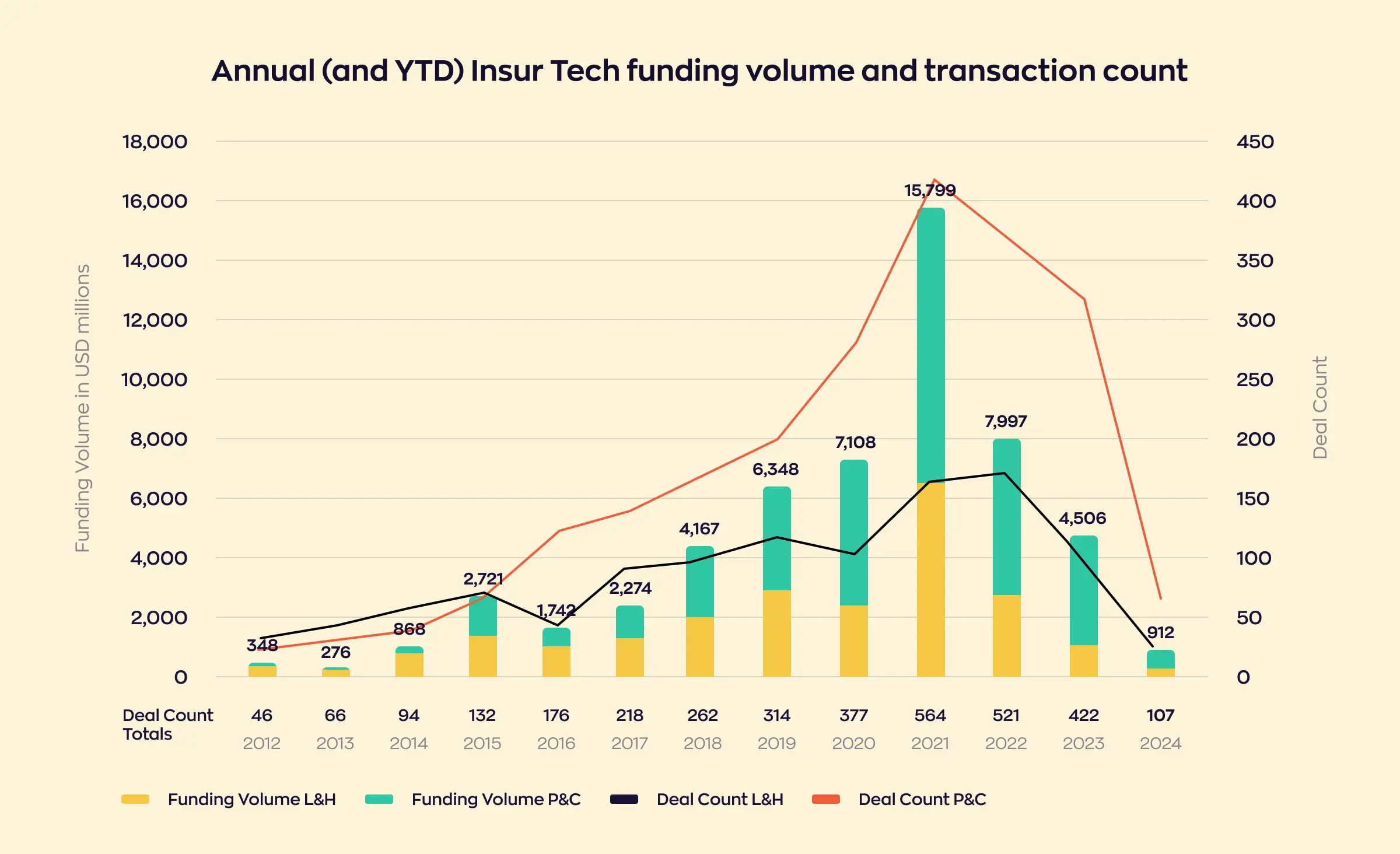
Insurance mobile apps now handle what once meant paperwork and office visits: buying a policy, filing a claim, and tracking payouts. InsurTech funding dropped sharply after its 2021 peak, but the technology kept maturing. As NTT Data reports, the cooldown looks more like a reset before the next wave of growth, this time driven by AI and generative technologies.
Customers now judge insurers partly on the app, which makes it competitive ground rather than a side project. Satisfaction with insurance apps in the US already scores well: in Statista's 2022–2023 figures, mobile apps rated 83 and 84 points out of 100 for property and casualty insurances and health insurances, respectively.
What follows covers the app types you can build, the features that matter, the tech choices, and what the build costs in money and months. Our own experience here is adjacent rather than insurance-specific: as a fintech software development team we have shipped trading platforms, payment and anti-fraud systems, and neobank products, where KYC, payment rails, audit trails and regional data law drive the architecture the same way they do in insurance.



What an insurance company needs a mobile app for
Almost every reason to build an insurance app comes back to user experience: when customers can self-serve quickly, retention and cross-sell follow. Here are the concrete jobs an app does for an insurer.
Claims processing automation
While in distress, the last thing you want to do is handwrite a claim and carry it to the insurance company. With today's technology, users can file claims, share documents, and track progress from anywhere.
Digital self-service
Many insurers now run with few or no branch offices, which cuts staffing and real-estate costs. An app lets customers do in minutes what used to mean a trip to an office.
Customer support
An in-app knowledge base handles common questions and cuts support load, so a phone call becomes the last resort rather than the first. When a customer does need a person, an in-app chat with a specialist should be one tap away.
Instant payments
Users should have an opportunity to make in-app premium payments and set up automatic prolongation. To implement it, you need third-party integrations, which we'll discuss further. Having an automated payment system in the app where customers can sign documents and pay makes the sales process smoother.
Cross-selling and up-selling
When a company's offerings are accessible on an app, customers are more likely to explore and buy more insurances, for example, pay attention to both automotive and health policies. While in other contexts, customers might hesitate to buy or even not know about certain services.
Market analysis
An app turns customer behavior into data an insurer can act on: which policies get viewed, where users drop off, which offers convert. Pricing and product decisions then rest on real usage rather than guesswork.
Insurance mobile app types
Since most agencies sell several lines (vehicle, property, life, travel, business, health) through one product, the useful split is by who uses the app rather than by what it covers. Which line you lead with matters too, but it shapes the extra features rather than the app type, so we come back to it further down.
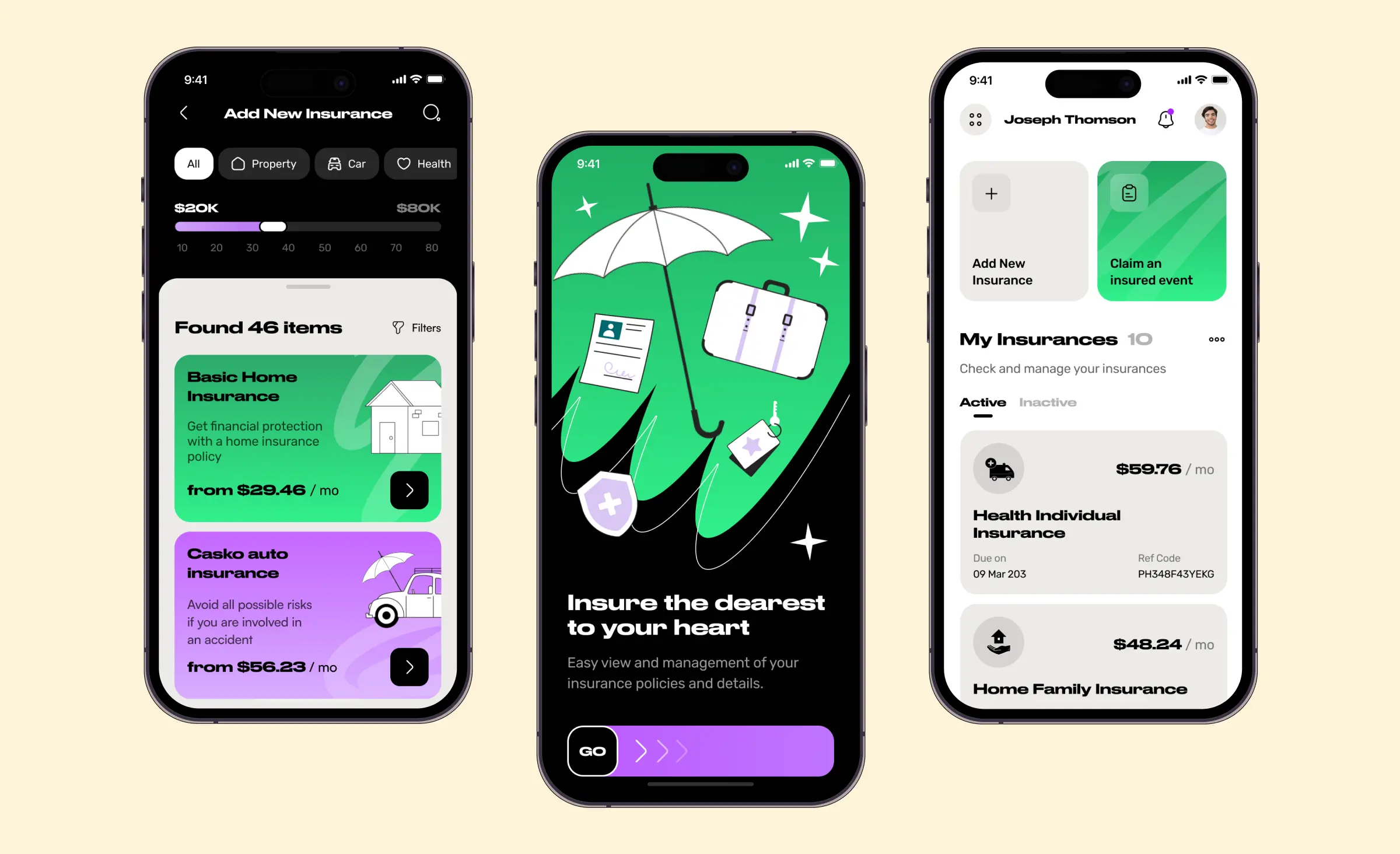
That gives three products for a single agency: a customer app, a paired agent app, and an admin panel behind both. Each has a different feature set.
Customer application
A customer app has four essentials (secure accounts, policy information, in-app payments, and claims submission), with everything else built around them. The fuller feature set for customers includes:
- Registration and log-in. Personal accounts with two-factor authentication, since a policy record is financial and often medical data.
- Comprehensive dashboard. Active policies, payments due and open claims visible at a glance on the home screen.
- Policy search. Keyword search with filters, so customers find a policy without scrolling the full catalog.
- Policy information. Each policy profile carries benefits, pricing, terms and conditions in full.
- Quote engine. The sales entry point for a direct insurer: the customer answers a short set of questions about the vehicle, property or person, and gets a price and coverage options back without a call. This is the feature most tied to your own underwriting rules, so it is rarely a drop-in component.
- E-signature. Binding a policy needs a signature, and collecting it in the app keeps the purchase from falling back to email and print. What counts as a valid signature depends on the jurisdiction, so this usually runs through a provider instead of a canvas the user draws on.
- Document upload. Photographing a document in the app removes the paper trip from a claim.
- Claims processing. Filing a claim, attaching documents and tracking its status through to payout.
- Payment gateway. Secure in-app premium payments with several payment methods and automatic renewal.
- Push notifications. Reminders about expiry, due dates and renewals keep policies from lapsing and open a channel for relevant offers.
- Feedback and support. A chatbot for common questions plus a direct line to a manager when a case needs a person.
Agent application
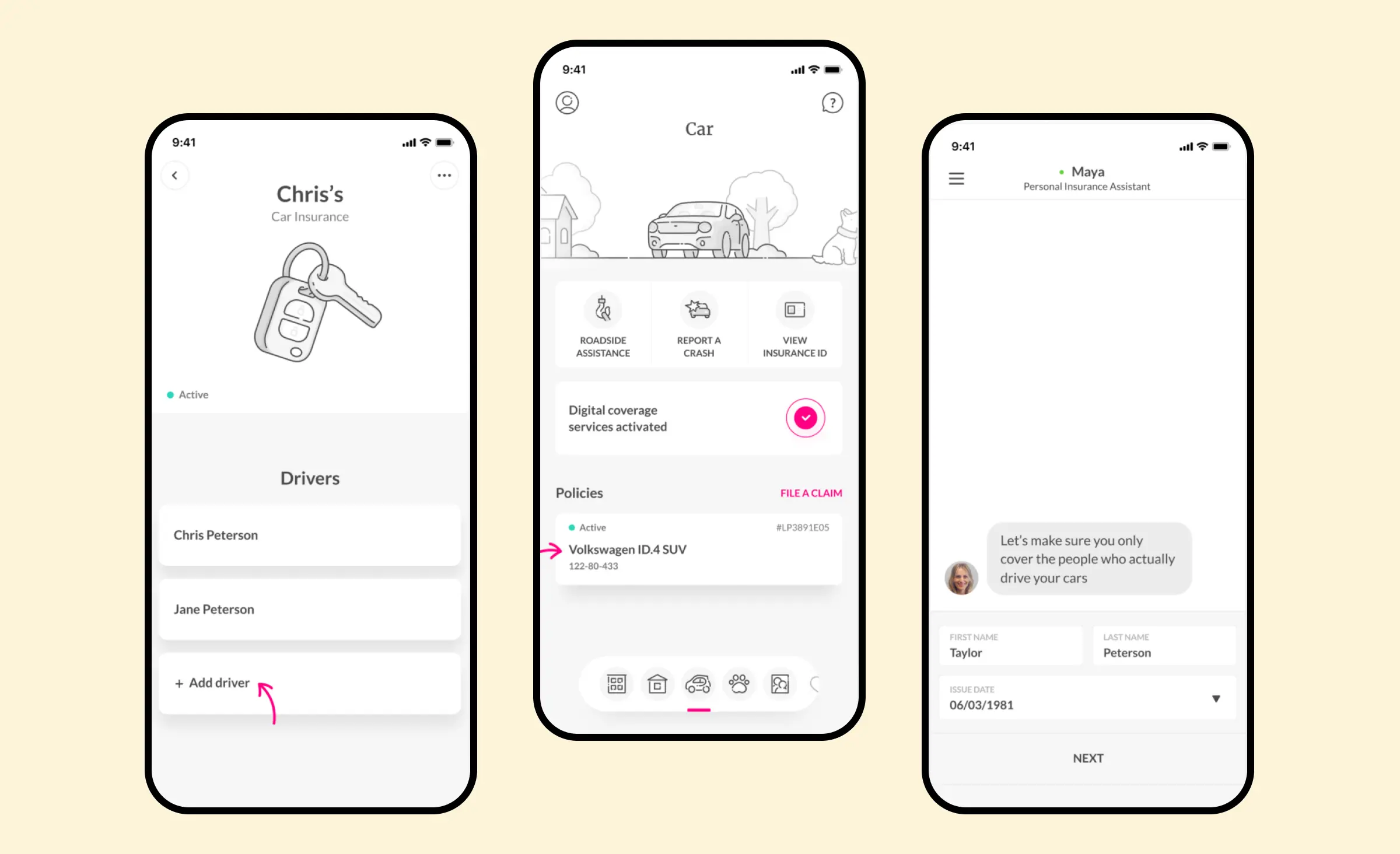
An agent app helps staff respond quickly to claims and support requests. It usually includes:
- Customer database. Immediate access to premiums, purchase history and contact details, usually through an integrated CRM rather than a second data store.
- Policy information. The same policy details customers see, so advice on a call matches what is in the app.
- Commission tracking. Commission earned on each policy sold, visible to the agent without asking finance.
- Appointment manager. For insurers that keep client offices, a task tool for booking and tracking appointments.
- Claims handling. Working a claim on the customer's behalf and keeping its status current.
Admin panel
An insurer can skip the agent app, but not the admin panel: it is where policies, claims and payments are managed. It is a web back office rather than a mobile app, and it usually covers:
- Customer management. Accounts and claim history, assigning customers to agents, and resolving complaints.
- Agent management. Agent profiles, assigned clients and access rights.
- Policy management. Adding, updating and withdrawing policies, including the pricing and terms attached to each.
- Payment and claim processing. Overseeing claim approvals and denials alongside payment runs.
- Analytics. Reporting on policies, claims and payments, usually through a third-party BI integration rather than charts built from scratch.
- Escalated support. The queue that receives questions the chatbot and the agent could not close.
Those three roles assume one agency owning the whole stack. Two other models digitize insurance without that.
Peer-to-peer app
Peer-to-peer (P2P) insurance is a decentralized model: members pool their premiums to cover each other's claims, which lowers claims costs and spreads risk across the group. It looks like a model that only benefits members, but the operator has several revenue options:
- Membership fees. The most direct route, charged for access to the pool.
- Business partnerships. Commission or referral fees from insurers behind the pool.
- Value-added services. Expedited claims, consulting or access to closed groups.
- Advertising. Viable once the user base is large, though ads placed inside a claims flow tend to annoy the people you most need to keep.
Platform for multiple agencies
The other model is an aggregator: users compare offers from several agencies in one place and pick one. The operator charges agencies for listing and can add a user subscription on top, so revenue comes from both sides of the marketplace instead of from underwriting. It needs the widest catalog and the comparison logic to match, which is a different engineering problem from a single insurer's app.
Features that matter for each insurance type
If your agency leads with one line, that narrows which extras are worth building. For each type below, three features that tend to set an app apart, plus an example of how a working insurer handles it.
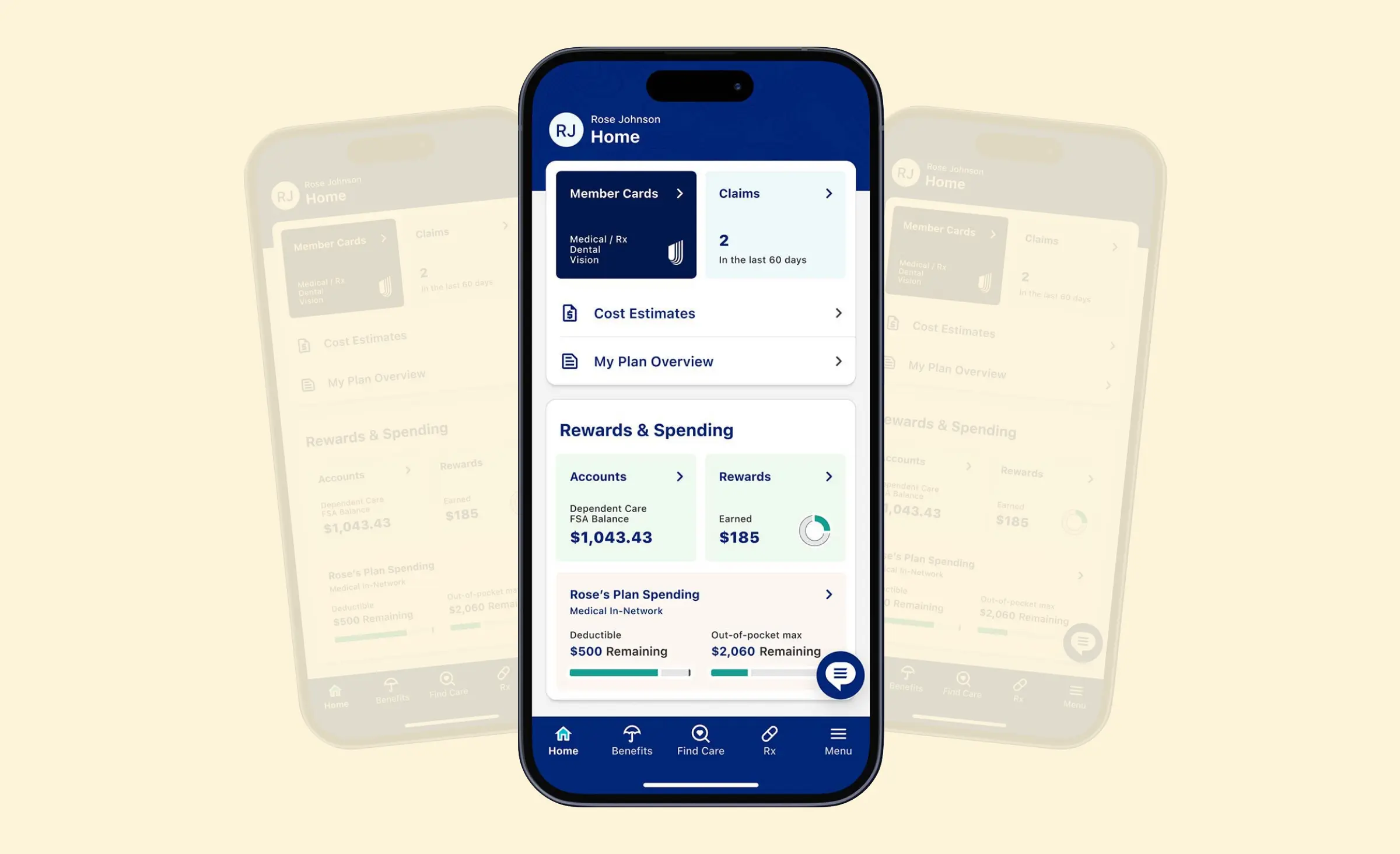
Health insurance application
This type of app typically involves three stakeholders: healthcare policy providers, hospitals, and individuals. An application may focus strictly on managing policies, or it may integrate with a healthcare application, enabling users to track claims as well as schedule GP appointments.
Features:
- Appointment management
- Real-time insurance verification
- Prescription management
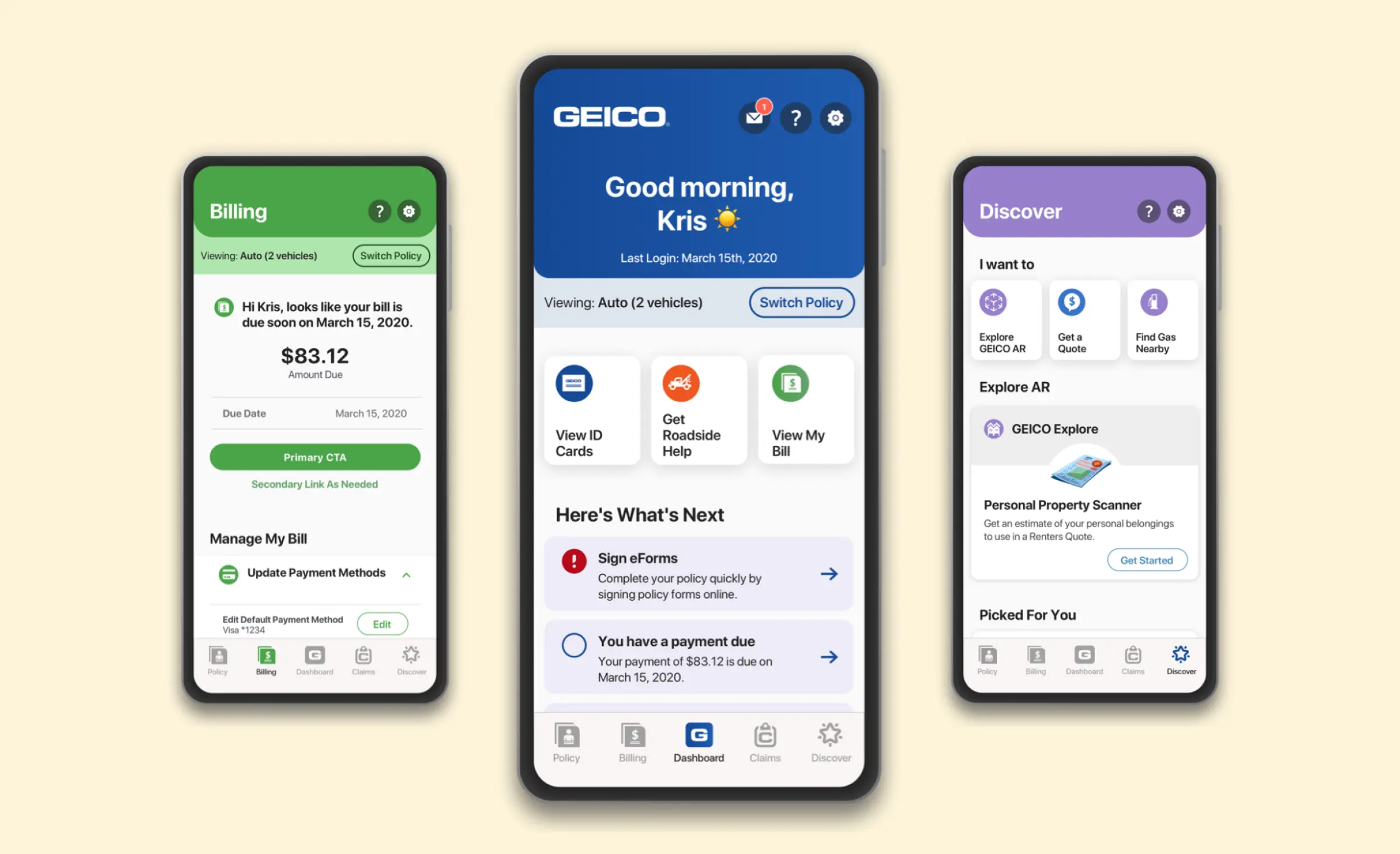
Car insurance application
These apps assist drivers in protecting their vehicles and submitting claims in the event of an accident. Insurance companies seeking to add complexity to an app could consider integrating Internet of Things (IoT) devices. These gadgets connect to a car insurance app and report data based on user behavior.
Features:
- Repair estimates
- Car services map
- Predictive maintenance
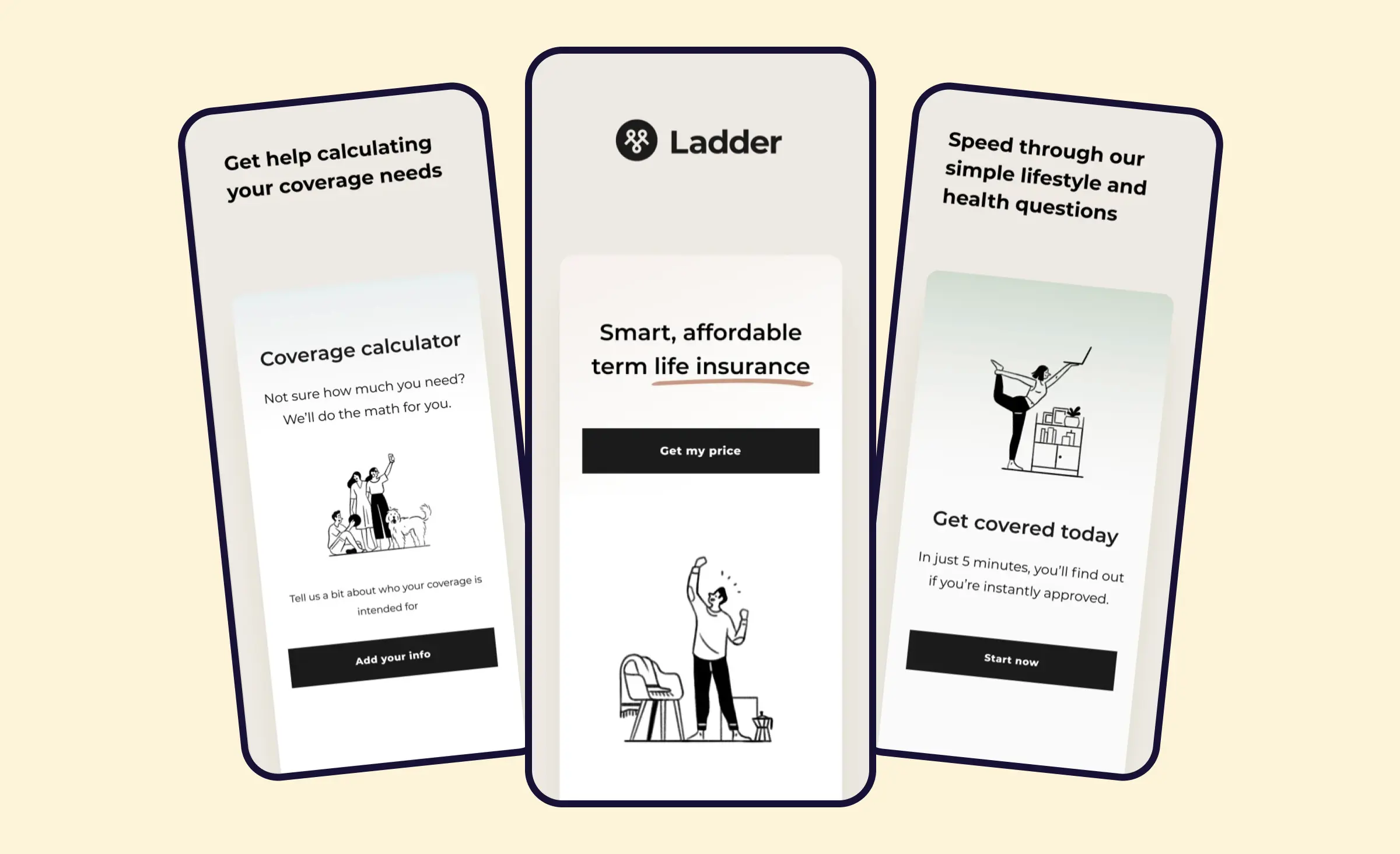
Life insurance application
Life insurance applications aim to provide payments in emergency situations such as terminal illness, disability, or death. These apps don't necessitate extensive communication between policyholders and insurance providers but they might still include specific features.
Features:
- Personalized amounts of coverage
- Beneficiary designations
- Expedited approval
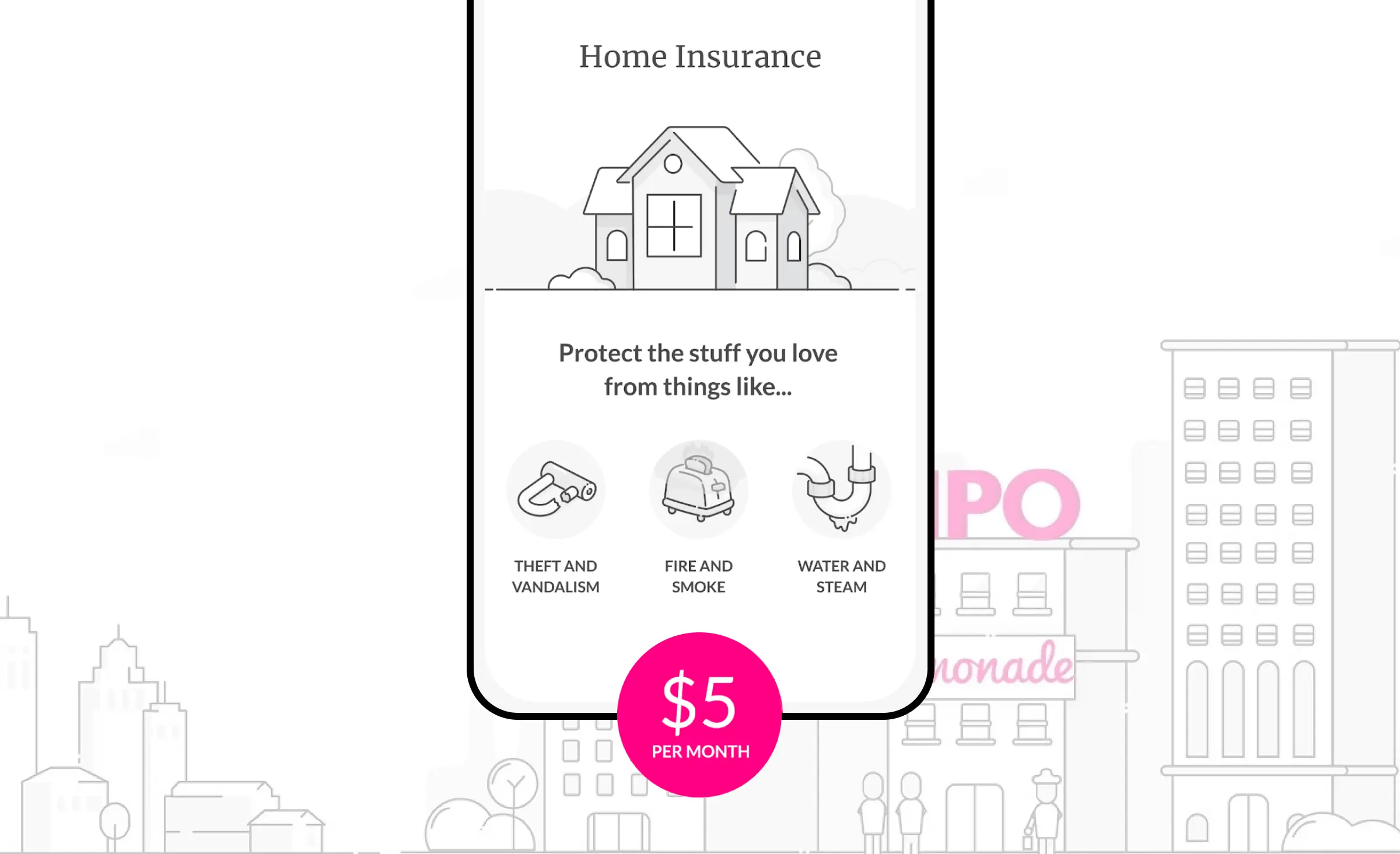
Home insurance application
These insurance apps protect properties in case of damage and can integrate with smart home devices such as door, water, and fire sensors.
Features:
- Smart device alerts
- Damage prevention tips
- Emergency assistance
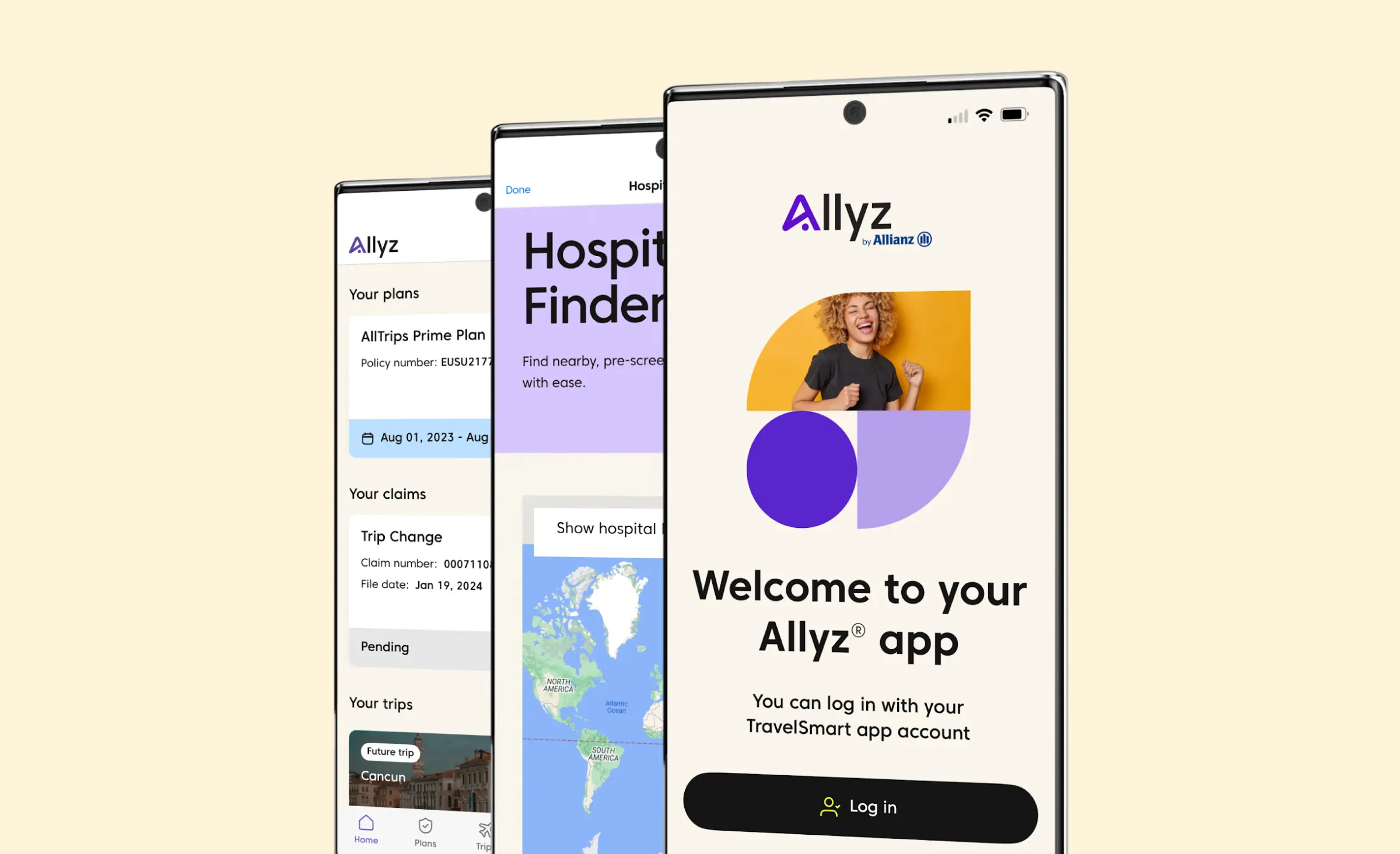
Travel insurance application
Travel insurance apps assist travelers in emergency situations such as sickness, baggage loss, and flight cancellation. Traveling can already be stressful, and so travel insurance aims to mitigate consequences should anything go wrong.
Features:
- Medical directory
- Travel tips
- Health and safety advice
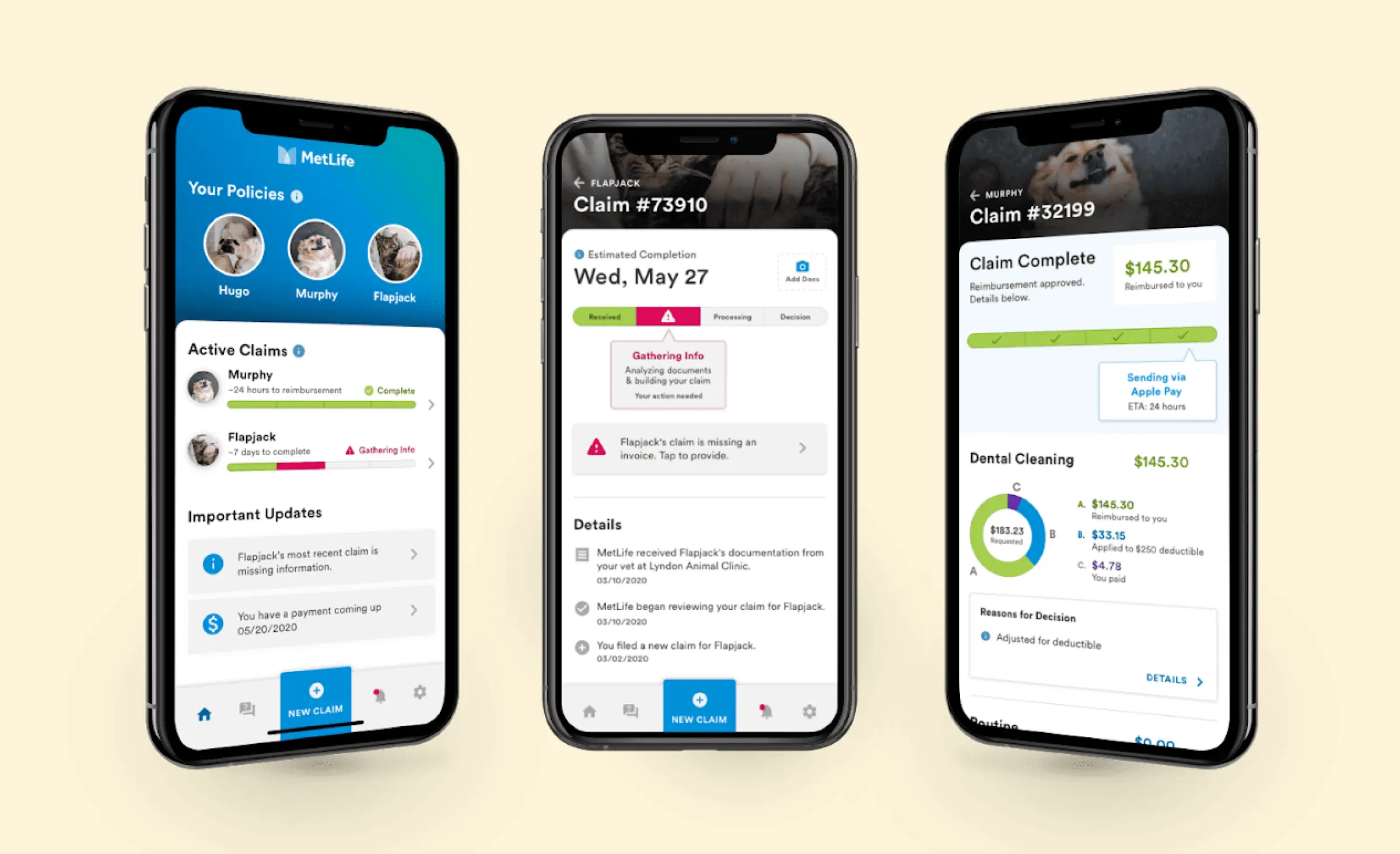
Pet insurance application
These insurance apps cover veterinary expenses if a pet becomes ill or injured. An application can integrate with any services related to pet care.
Features:
- Customizable coverage for your pet
- Integration with pet care services
- Map of veterinary clinics
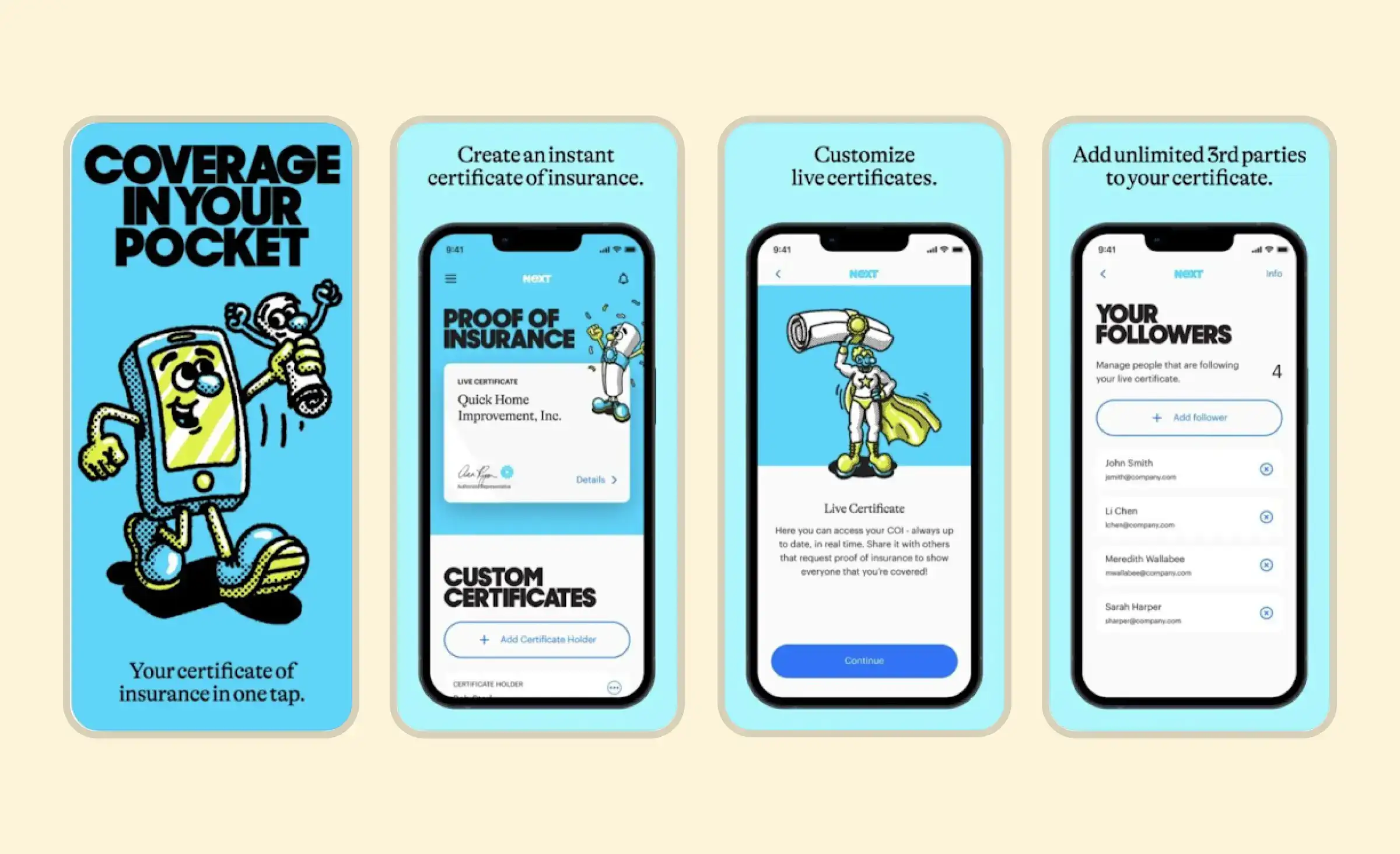
Business insurance application
Business insurance covers company losses associated with unexpected events such as property damage, business interruption due to strikes and other circumstances, the defense of lawsuits, libel, and more.
Features:
- Policies tailored to a business's specific needs
- Cybersecurity offers
- Reports of incidents in the area
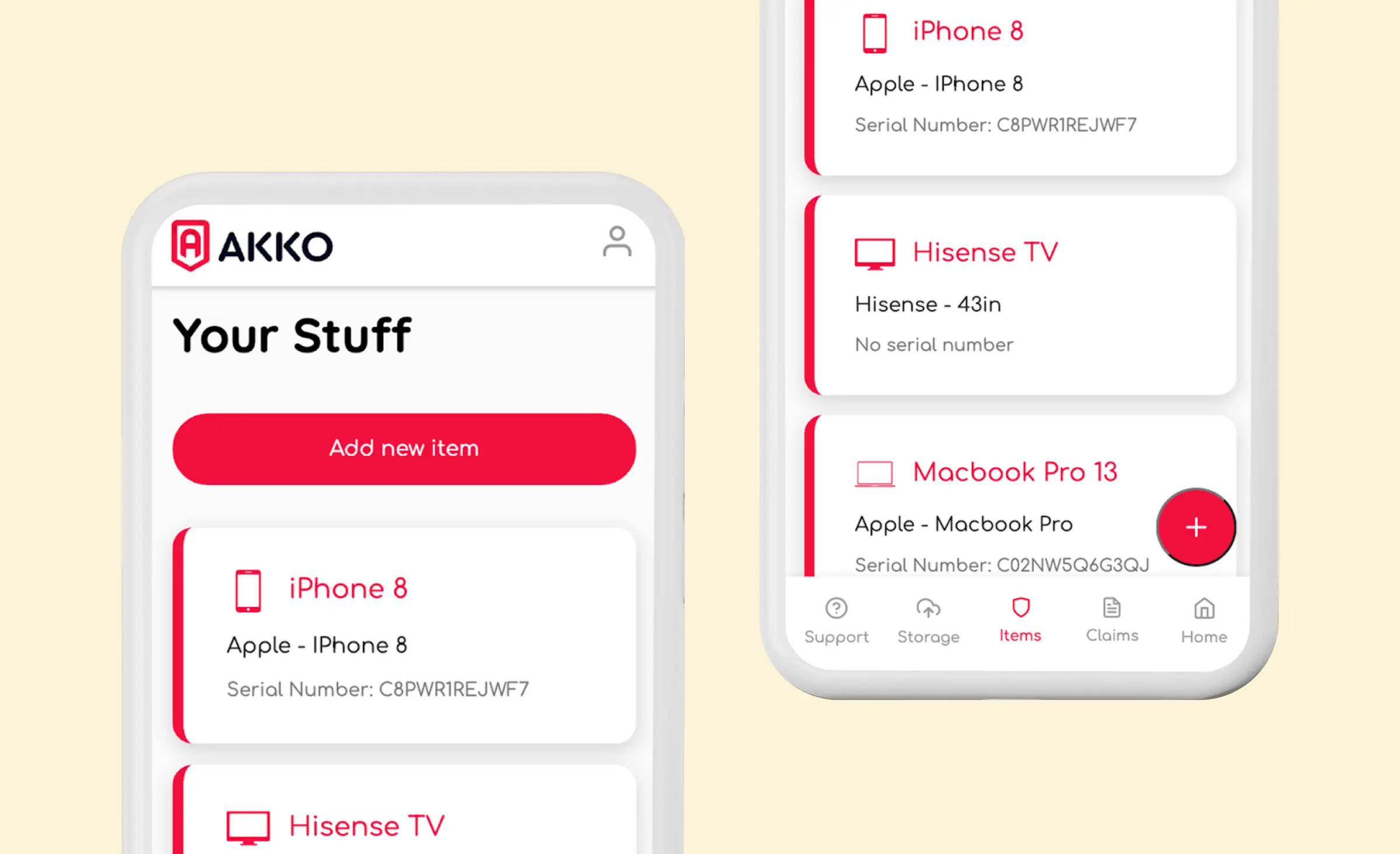
Device insurance application
These apps cover phones, laptops and other gadgets against theft, damage or loss. As device prices climb, coverage per item becomes an easier sell, and the app has to track each insured item separately.
Features:
- Device lock and data wipe
- Lost phone tracking
- Map of repairment points
The list is not exhaustive: any line can carry an app, and the pattern above holds. Identify the two or three extras your line needs, then keep the rest of the build standard.
Features that make an insurance app stand out
Core features make an app usable. The ones below are what customers notice when they compare one insurer's app against another.
Better security
Insurance mobile apps handle sensitive data and money transfers, so they need strong security features, especially in the case of health insurance app development. This should involve biometric and multi-factor authentication, and end-to-end encryption.
AI chatbot
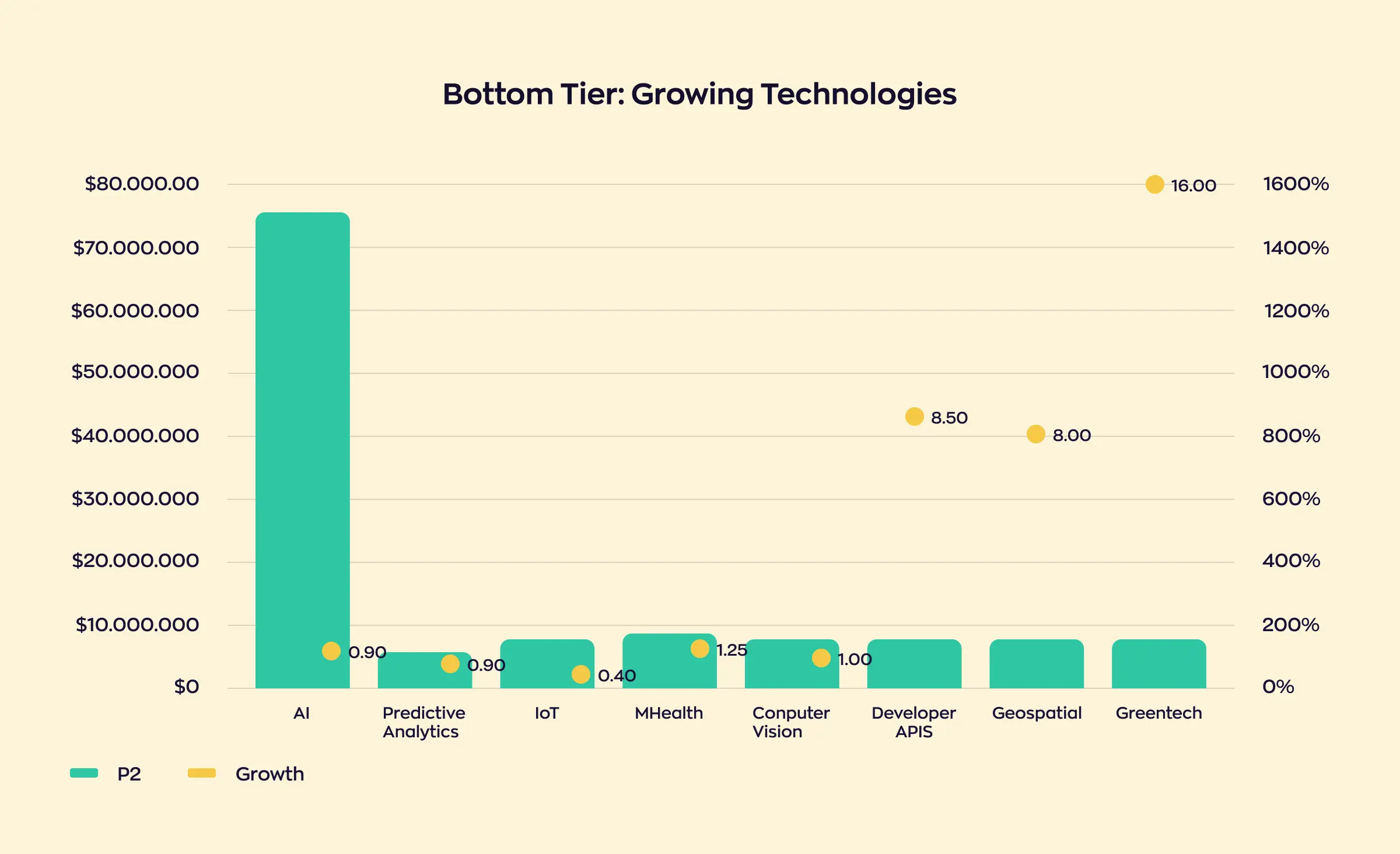
An in-app AI chatbot is the feature users notice first. It answers questions without making them dig through an FAQ, recommends suitable policies, and reminds them about upcoming premiums. Among the emerging technologies insurers were funding in 2024, AI drew more investment than all the others put together.
Real-time tracking
While a claim is being processed, the user should be able to track its progress in real time and get notified of any status change, instead of calling in to ask where it stands.
Side-by-side policy comparison
A single insurer quotes its own products, which the quote engine above already covers. An aggregator has a harder job: normalizing coverage terms from several agencies so they can sit side by side honestly, since two policies at the same price often exclude different things. Users come to an aggregator specifically for that comparison, so the normalization logic carries the whole product.
Steps in insurance mobile app development
These are the steps of a full-cycle insurance app build as we usually run it at Ronas IT.
Step 1. Gathering information
The first job is agreeing what the first version does and what it deliberately leaves out. Insurers often arrive wanting all three roles and every integration at once, which prices the project out before it starts. We map the scope against the budget, keep version one to the features that carry the core journey, and add the rest once real usage says which ones matter. This can stay a conversation and a rough estimate, or become a paid analysis phase that documents the scope, architecture and plan as a deliverable you own.
Step 2. UI/UX design
Once the requirements have been gathered, designers begin creating the user interface. At Ronas IT, designers use Figma, which makes it easy to share progress with clients and maintain transparency. First, they create mockups with the main functionality, and after getting approval, they start designing interface screens. Designers create a user flow map encompassing all app logic, working on each role of the application on separate pages. For example, in an insurance application, they would create an agent app flow and a client app flow. To hand out the design to developers, designers make a UI kit, which is a collection of reusable elements of the application such as buttons, icons, indicators, tags, and so on.
Step 3. Mobile app development
After the design is compiled in a Figma file, it is passed on to the software development team. The development teams typically work in 2–3 week sprints, showing the results to the client at the end of each sprint. However, if you prefer, a team can provide reports more frequently. A reliable insurance app is more than clickable screens: the parts that matter are scalable infrastructure and clean, maintainable code that a later team can extend without rewriting.
Step 4. Release to the stores
Insurance app deployment has to follow App Store and Google Play guidelines closely, and financial apps draw extra scrutiny during review. A reliable vendor handles publishing and shepherds the app through that review process.
Step 5. Post-release support and maintenance
Release is the point where regulated apps start generating work rather than stopping: new features, bug fixes, dependency and OS updates, and monitoring. We cover this on a subscription starting at $1,000 per month for bug fixes, infrastructure support and updates, with larger support tiers for products that need guaranteed response times.
InsurTech trends to watch out for in 2026-2027
Four shifts are changing what an insurance app is expected to do: live device data, open APIs, insurance sold inside someone else's checkout, and AI in pricing and claims. Each one adds an integration you have to plan for from the start.
IoT and connected devices
Internet of Things (IoT) devices are sensors and trackers that report data on their own. In insurance they turn pricing from a yearly form into a continuous feed, and the app is where the customer sees what that data did to their premium.
Car insurance
Car insurance apps increasingly rely on telematics, small devices that track driving behavior such as speed, braking habits, and time spent on the road. Insurers use this real-time data to calculate risk more accurately and offer discounts to safe drivers. Usage-based insurance can lower premiums for careful drivers, which encourages safer driving and makes pricing more transparent.
Health insurance
Wearable devices like fitness bands and smartwatches are becoming standard in healthcare. These apps can now sync heart rate, step count, and sleep patterns directly from a user's device. Health data helps insurance companies reward healthy habits or early intervention in case of risk. For example, a person with a steady heart rate and regular activity can get a lower premium, sometimes with a personalized offer generated within seconds of receiving new data.
Property insurance
Smart sensors in homes can alert owners and insurers to water leaks, smoke, or a door left open. Partnerships like ADT and Hippo show how professionally monitored smart-home devices earn homeowners premium discounts. In case of an incident, sensors give insurers immediate proof, helping to reduce fraud and cut down the time for claim approvals.
With IoT data flowing in almost in real time, insurers can price risk and process claims on fresher information than a static application form ever provided. For the user, that can mean a status update or a revised quote within seconds of submitting a claim or connecting a device.
Open API and integrations
In 2026–2027, open APIs are becoming the main architecture for insurance apps, letting companies connect quickly with banking apps, healthcare providers, and e-commerce platforms. For users, this means they can manage policies, make instant payments, schedule medical appointments, verify coverage, and file claims inside one connected app instead of jumping between systems.
Analysts at Walnut expect API-driven integration to power more than 30% of insurance transactions by 2028. Major brands already show what that looks like in practice: Amazon offers small-business insurance through Next Insurance (now ERGO NEXT) with instant policy binding, and IKEA has sold home insurance alongside furniture in markets like Switzerland. For a development team, this shifts the hard part from the UI to the integration layer, secure authentication, data mapping, and error handling across partners you don't control.
Embedded insurance
One of the strongest trends in 2026–2027 is embedded insurance. Instead of purchasing insurance separately, customers get the chance to add protection directly at the point of purchasing another product or service. For example, travel insurance may be offered during flight booking, or home insurance bundled with the sale of a new property or smart device. This approach is made possible by flexible, API-powered integrations, which let users customize coverage with a single tap.
The embedded insurance market is growing fast. Valuates Reports projects it will reach $296.85 billion by 2029 at a 24.12% compound annual growth rate. In practice, most people will meet insurance during a key life event, buying a car or booking a holiday, with the insurer present right in the transaction. Instant quotes and low-touch policies reduce paperwork and shorten the path from interest to coverage.
AI integration
In 2026, artificial intelligence is changing every stage of the insurance process, making insurance apps smarter and more helpful than ever.
Personalized rates and products
AI helps insurers build personalized policies in real time. It weighs many signals together, IoT feeds, claims history, and behavior patterns, to price risk at the individual level rather than by broad actuarial class. As new data arrives, the model can reprice or surface a better-matched product without a manual review step.
Predictive risk and automated claims
AI allows insurers to predict risks by analyzing real-time data from telematics and wearables. On the claims side, AI now handles much of the routine work. According to Vantage Point's 2026 InsurTech report, insurers using AI-powered claims automation resolve claims 75% faster than traditional methods, dropping the cost per standard claim from $40–60 down to $25–36. The same report notes that insurance fraud costs the US industry roughly $80 billion a year, and AI pattern analysis is one of the main tools carriers use to catch it earlier.
Smarter customer support
Today's AI chatbots are more like virtual assistants. They help users compare policies, complete complex claims, or get advice inside the app, without waiting for human support. Lemonade and Oscar Health both lean on AI for quick resolutions. Across the industry, automation is pushing straight-through processing rates on routine claims from the old 10–15% baseline up toward 70–90% at carriers that have deployed it well.
We have built this pattern outside insurance. On a marketplace for the UAE market, we shipped an AI layer for recommendations plus an in-app chat assistant, under local data rules. An insurance app swaps product catalogs for policies and claims, but the engineering underneath is the same: prompt design, data handling, and keeping the model away from records it has no reason to read.
Compliance and security for insurance apps
Security and compliance sit at the core of any insurance app, which handles sensitive financial and personal data. The rules differ by market and tighten most years, so it pays to map them before you build rather than after.
Global regulations
There is no single insurance regime to build against. Licensing, data privacy and AI rules each come from a different authority, and they change per market.
USA
Across the US, insurance is regulated primarily at the state level. That structure comes from the federal McCarran-Ferguson Act, which leaves insurance regulation to the states, so intermediaries and brokers need state-specific licenses. HIPAA applies when an app operator is a covered entity, such as a health plan, or handles protected health information (PHI) on behalf of a covered entity as its business associate. A standalone broker, aggregator, or direct-to-consumer app may fall outside HIPAA, depending on its role and data relationships. Those apps still need to assess applicable state privacy laws and FTC requirements, including the Health Breach Notification Rule where applicable. On the AI side, Colorado's SB21-169 requires insurers to build a governance and risk-management framework and test predictive models for unfair discrimination. It applied to life insurers first, with the framework extended to auto and health insurers in late 2025 and the detailed testing rules for those lines still in rulemaking. Some states also restrict genetic data in underwriting, and California's AB 2013 adds transparency demands on AI training data from 2026.
European countries
In Europe, the GDPR remains the foundation for data privacy, with tough requirements on consent and profiling, and insurance intermediaries passport across the EU under the Insurance Distribution Directive (IDD). Insurers also sit under Solvency II for capital and risk management. DORA, in force since January 2025, adds stricter ICT risk management, regular resilience testing, and third-party risk controls for all financial organizations, including insurance. Under GDPR Article 83, fines for breaches can reach up to €20 million or 4% of total worldwide annual turnover, whichever is higher.
We have hit this set of rules on an educational web platform for the European market, where privacy by design meant data minimization, explicit consent flows and parental consent for minors. An insurance app answers the same GDPR questions, on data that is both medical and financial.
Canada
Canada still operates under PIPEDA. A planned overhaul (Bill C-27, which would have replaced PIPEDA with the Consumer Privacy Protection Act) died in Parliament in early 2025, so no successor law is in force yet. Insurers should comply with PIPEDA today and build toward privacy-by-design and consent management in anticipation of a future bill. OSFI is raising its oversight of digital insurers, while regulatory sandboxes in provinces like Ontario and British Columbia allow new insurance products to operate under controlled risks.
Australia
Australia relies on AFSL licenses, APRA supervision, and its own regulatory sandboxes for insurtech innovation, so not every service needs full compliance during a test phase. For insurers covered by the Privacy Act 1988, the Australian Privacy Principles (APPs) govern personal information handling. The Consumer Data Right (CDR) is relevant when an app receives data through CDR from a designated sector, such as banking or energy. Insurance is not itself a designated CDR sector.
On a payment solution for an Australian travel platform, the same privacy laws applied to card payments and fraud. Relying on PCI DSS-compliant providers, device fingerprinting and strict data minimization kept card data out of our scope entirely, and 3DS2 handled the authentication step. The same payment and fraud stack maps directly onto insurance premium collection and payouts.
MENA countries
Middle Eastern markets have introduced specific rules for licensing digital platforms, consumer protection, Takaful compliance, and quarterly reporting. In Saudi Arabia, insurance oversight moved to the new Insurance Authority in 2024; in the UAE, the Central Bank of the UAE (CBUAE) regulates the sector.
| Region | Licensing | Data privacy | AI/Tech focus | Sandboxes |
|---|---|---|---|---|
| USA | State-based licenses | State privacy laws; HIPAA/FTC rules where applicable | AI governance (CO SB21-169) | Limited |
| Europe | IDD + Solvency II | GDPR/DORA | Profiling limits (GDPR) | Yes |
| Canada | OSFI/provincial | PIPEDA (reform stalled) | Data governance | Yes (BC/Ontario) |
| Australia | ASIC AFSL/APRA | Privacy Act 1988/APPs | Claims handling (ASIC) | Yes |
| MENA (KSA/UAE) | Insurance Authority (KSA), CBUAE | PDPL (KSA), UAE data protection law | Quarterly reports | Emerging |
Leading security standards: SOC 2 and ISO 27001
Demonstrating trust requires more than technical controls. Global B2B partners expect clear proof that sensitive data is protected. Security certifications such as SOC 2 and ISO 27001 are quickly becoming mandatory, showing that a company meets international expectations for data privacy, auditability, and incident response.
SOC 2 reviews how data is managed, protected, and monitored; ISO 27001 covers information security management across the whole business. Enterprise clients often require these certifications before integration or partnership.
How Ronas IT ensures compliance
We map which rules apply to your market and product before writing code, because the answer changes the data model. Privacy by design then follows from that map: collect the minimum, make consent explicit and revocable, and build export and deletion paths in from the start rather than retrofitting them when the first subject-access request arrives.
Our team builds secure apps on proven platforms: AWS, Google Cloud, Auth0, and GitLab. We store sensitive data encrypted and use project VPNs. All access to internal tools and data follows a “least privilege” approach: only team members who actually need access get it, controlled by RBAC.
“To secure user data, it's not enough to just use a secure database for this. It's also necessary to build a flexible and reliable infrastructure so that in case of troubles we can always take a step back. To be able to quickly revert the system to a previous version, we create backups and use an approach called ‘Infrastructure as Code’. We configure all the infrastructure and use scripts to make the system able to deploy automatically, even from the ground. In case of a security breach or data center outage, our client won't lose data or reputation”
Roman Surikov, CEO at Ronas IT
Microservice architecture allows us to quickly update or replace parts of your app as security standards evolve, without risk to the whole platform. We cover key modules with automated tests and add real-time monitoring and audit logs to track all important actions.
To keep your system secure over time, we offer ongoing support, including regular security audits and adaptation to new requirements. We also help you set up workflows to handle data subject requests and keep records of all user data processing activities.
Insurance mobile app tech solutions
There are several approaches to insurance app development. One option is to use native languages for iOS and Android, while another is to use cross-platform solutions. Let's examine both approaches, exploring their advantages and disadvantages.
Native development
Native development means using a language designed for a specific operating system, like iOS or Android. For instance, if you want to make an Android app and release it on the Google Play Store, you'd use Kotlin or Java. Conversely, for iOS applications released to the App Store, developers may use Swift or Objective-C.
Advantages of writing applications with native languages include the fact that they swiftly receive all the updates to correspond with the latest OS updates. As a result, building with them provides an enhanced user experience. Additionally, being supported by operating system vendors, native languages offer strong long-term stability.
Disadvantages of native development are associated with the fact that engineers build apps for different operating systems with different programming languages. Therefore, if a client decides to cover users of both platforms, development will cost more because it requires building two separate codebases. The latter introduces another challenge, which is maintenance. When an app needs an update, developers have to do it for each platform independently, which does not save resources at all.
Cross-platform
Cross-platform development involves using a single codebase for both iOS and Android. There are several cross-platform frameworks, including Flutter, React Native, Xamarin, Ionic, NativeScript, and others. At Ronas IT, we prefer React Native, which Facebook (now Meta) launched in 2015. React Native has a large community of technical specialists and focuses on creating a native-like UI experience.
Advantages of cross-platform development include economy of all resources as it allows for developing for two platforms at once. It makes it easier to maintain and update apps for both OSs. Due to the shared codebase, cross-platform development provides consistency to user experience across platforms.
Disadvantages of cross-platform frameworks include dependency on third-party libraries and, as a result, performance limitations as they don't have direct access to platform APIs. Nevertheless, we've built multiple platforms with the React Native cross-platform framework and never faced complaints on performance of the apps.
The choice between the two technologies depends on business needs: whether a company wants to invest in native insurance app development and its high performance, or save resources and simplify maintenance with cross-platform development.
“For most insurance apps, the hard part isn't the screens, it's everything behind them: payment providers, KYC checks, document flows, and partner APIs that all have to stay consistent under strict data rules. We default to React Native with a Laravel backend because it lets one team own both the customer and agent apps and move fast without a second codebase. Across the apps we've shipped this way, performance has never been the thing that held a project back.”
Evgeny Leonov, CTO at Ronas IT
Insurance mobile app development cost and timeframe
Insurance app cost depends on scope: how many user roles you build, which integrations you need, and how strict your compliance requirements are. At Ronas IT, cross-platform mobile app development starts from $20,000 and a native iOS app from $25,000, while a full regulated build lands in our fintech tier from $75,000. You can see current rates on our pricing page. Those figures sit below a lot of the quotes you will collect for an insurance build, and that comes down to how the work is structured. One React Native codebase covers iOS and Android, so you are not funding two mobile teams. The regulated pieces (payments, KYC, telematics feeds) go through providers that already hold the licensing and certification, so no part of your budget goes to rebuilding infrastructure that already exists. That leaves the integration layer and your own business rules, and those are the expensive part: a quote engine wired to your underwriting, or claims automation spanning several partner APIs, will cost what it costs. The floor is low because the standard pieces are genuinely standard, not because the regulated ones get skipped.
Cost
A customer-facing app with core features, accounts, policy browsing, document upload, and claims submission, starts around the cross-platform and native entry prices above. Adding real-time claims management, an AI assistant, agent and admin apps, or IoT integrations raises the budget, since each is a separate module with its own logic and third-party connections.
Beyond complexity, the biggest cost variable is where the team sits. North American rates run well above Eastern European or Asian ones for the same seniority. Glassdoor puts the average US Kotlin developer salary at about $117,500, with the middle of the range between $94,000 and $148,000. That gap is why the same scope can carry very different price tags.
To make the scope-to-budget relationship concrete, here is how insurance app cost and timeframe usually scale at Ronas IT.
| Scope | Starting cost | Timeframe |
|---|---|---|
| Core customer app (accounts, policies, payments, claims) | from $20,000 (cross-platform) / $25,000 (native iOS) | 2–3 months |
| + Real-time claims automation and AI assistant | above the entry price, per module | 4–5 months |
| + Paired agent app and admin panel | higher again, per extra role | 5–6 months |
| + IoT and integrations (full regulated build) | from $75,000 (fintech tier) | 6 months or more |
The middle rows show direction rather than a figure on purpose: each added module carries its own logic and third-party connections, so the number only gets reliable as the scope gets specific. Our estimates tighten in steps: a free rough estimate from your initial brief, a paid analysis phase if you want the scope and plan documented before committing, and a firmer figure once the interface is complete and the functionality is settled.
Time
Timeframe follows the same logic as cost. A first version with core customer features can ship in roughly 2 to 3 months, while an app with claims automation, paired agent and admin tools, and several integrations often runs 6 months or more. The design stage sets the real schedule, which is why we estimate again once the interface is finalized.
Other factors stretch the timeline: design complexity (animations or 3D graphics take longer), third-party integrations, and the extra testing that complex, regulated features require.
At Ronas IT, we offer different plans for custom mobile app development so clients can pick a timeframe without trading away quality. We have enough specialists to scale the project team up when a deadline is tight. For plan details, see our mobile app development services.
Common pitfalls in insurance app projects
A few patterns show up often enough that they are worth naming before you start. Each one costs weeks if you hit it mid-build rather than planning for it.
- Building agent and admin apps too early. Teams often scope all three roles at once. A lean customer app validated with real users first keeps the initial budget near the entry price and tells you which agent features are actually needed.
- Underestimating third-party dependencies. Payment providers, KYC services, and IoT partners each have their own auth, data formats, and downtime. In our projects the integration layer, not the screens, is usually where schedule risk lives.
- Treating compliance as a final step. GDPR, PCI DSS, or state insurance rules shape data storage and consent flows. Mapping them after development means rework, which is why we map requirements during discovery.
What to do next
If you're planning an insurance mobile app, a practical order of decisions looks like this:
- Decide the model first, single agency, peer-to-peer, or an aggregator, because it drives the roles and revenue logic.
- Scope the customer app around the four features people actually use: accounts, policy info, payments, and claims. If you sell direct, the quote engine and e-signature join that list. Add agent and admin tools only if the business needs them.
- Map your compliance requirements (GDPR, PCI DSS, regional rules) before development, not after, since they shape the architecture.
- Pick the tech stack against your budget and performance needs, then plan for the integration layer, which is usually where the real work lives.
Get those four right and the rest, generative AI, real-time claim tracking, IoT, becomes an addition rather than a rescue.
Frequently Asked Questions (FAQs)
How much does it cost to develop an insurance mobile app?
How long does it take to build an insurance app?
What features should an insurance mobile app have?
What technologies are used to build insurance apps?
How do you keep an insurance app secure and compliant?
Should I build a native or cross-platform insurance app?
How is AI used in insurance apps in 2026?
Related posts



Related Services
React Native App Development Services
Save time and costs with Ronas IT's React Native app development, allowing cross-platform capabilities for iOS and Android. Our team has built 20+ React Native apps since 2020, ensuring rapid development, flexible maintenance, and cost-effective solutions.
AI Software Development Services
We deliver custom AI solutions, including generative AI, chatbots, predictive analytics, and recommendation systems. From strategy to integration and ongoing support, our expert team ensures secure, scalable, and value-driven AI applications tailored to your needs, so you can innovate faster and stay ahead of the competition.
Fintech Software Development Services
We build secure, scalable fintech solutions like neobanks, trading, and investment platforms — tailored to your market and regulatory needs. Our team ensures robust KYC, compliance, and data privacy, delivering modern, user-friendly interfaces and flexible microservice architectures. From code audits to full-cycle development and ongoing support, we help you launch and manage high-performing fintech apps with confidence.