Explainable AI (XAI): Building trust and transparency in AI-driven decisions


Artificial intelligence plays a growing role in how we shop, manage our health, and make business choices. Yet, with more AI applications in our daily routines, many companies and users question how these smart systems reach their decisions. Thаis has made AI decision-making and transparency more important than ever.
That's where explainable AI (XAI) comes in. XAI means using techniques that make artificial intelligence systems more understandable to humans. Instead of keeping answers behind a complex wall, XAI breaks them down so people can see why an AI made a specific recommendation or prediction. When people understand how AI decision-making works, it helps build AI trust and unlock AI benefits for businesses.
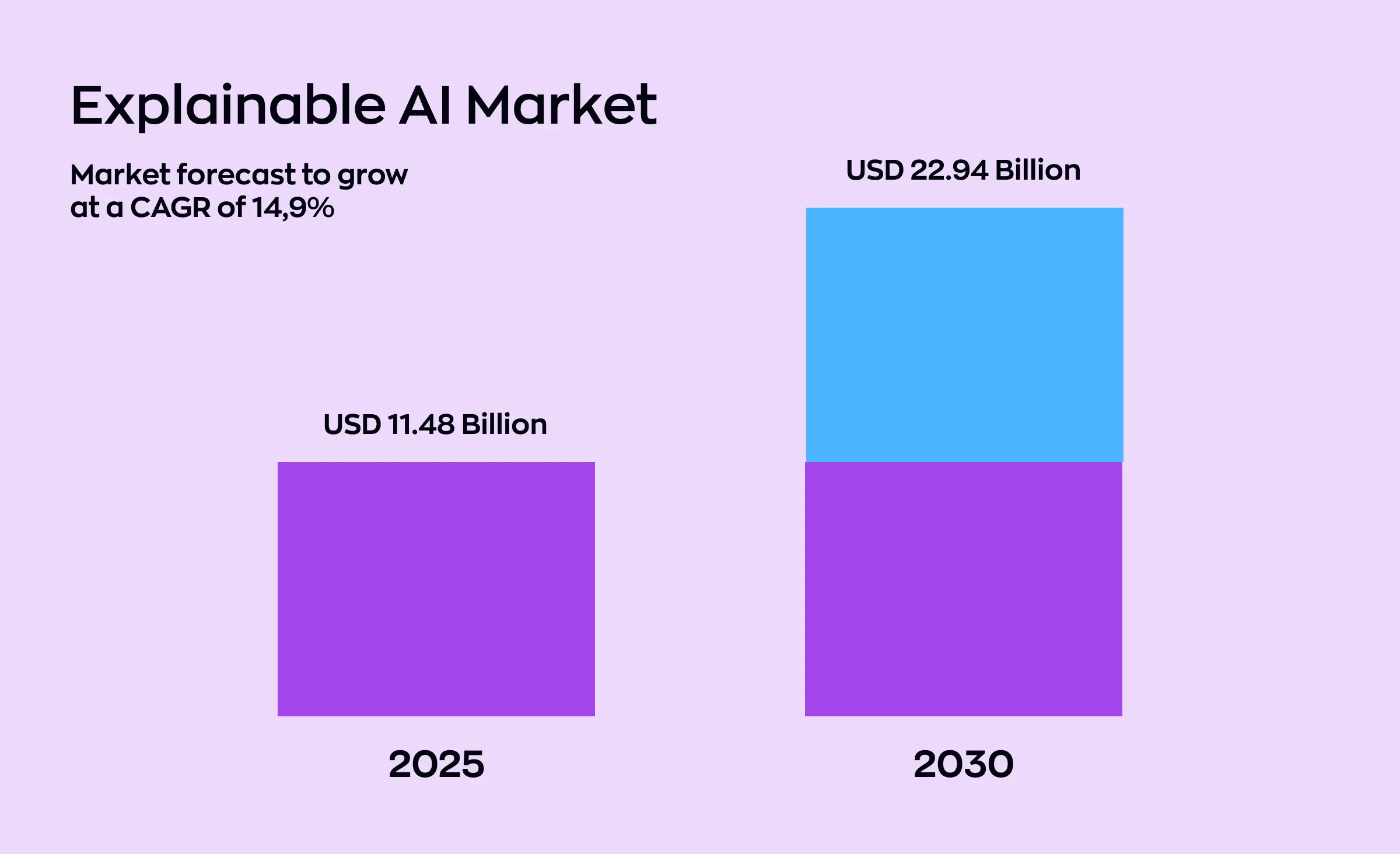
As more organizations see the value of clear, transparent AI business integration, investment in XAI is rising fast. Experts believe the global value of explainable AI solutions could nearly double within five years, rising from around $11.5 billion in 2025 to almost $23 billion by 2030, growing at an annual pace of about 15%.
While the AI benefits are clear, it's also important to keep in mind the potential AI risks that come with these rapidly advancing tools. In the next section, we'll look at why explainability is becoming such a vital part of responsible artificial intelligence.
The importance of explainability in AI solutions
Artificial intelligence is, without a doubt, at the core of major digital changes today. From personalized marketing to fraud detection, AI applications now power daily operations, big decisions, and even customer experiences. Yet as these smart tools shape our lives, questions about trust and ethics rise to the surface more than ever. How do we know if we can rely on the answers AI gives us? That's where the need for explainable AI (XAI) comes in.
What is explainability?
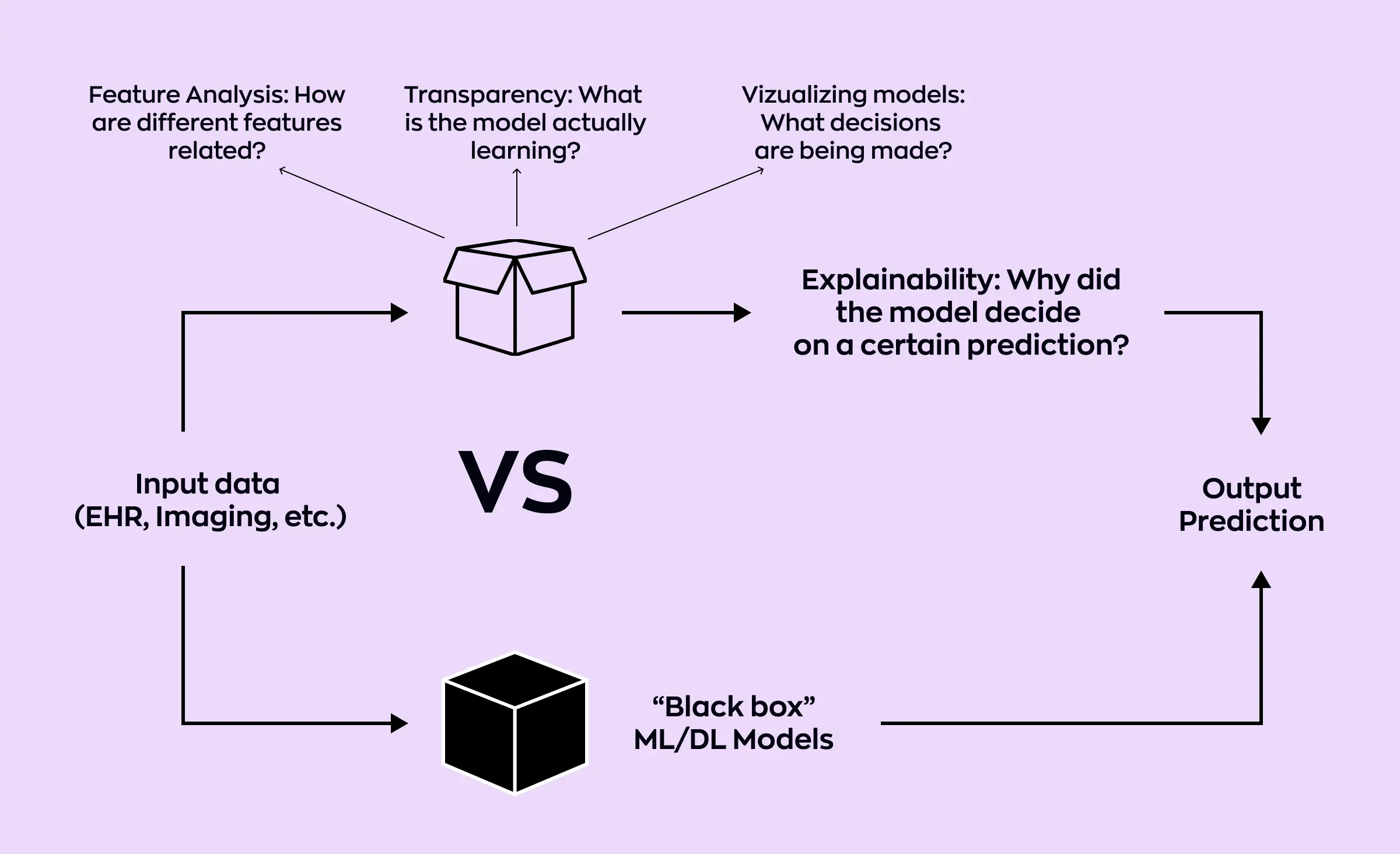
Explainability in the context of AI means making the reasoning of algorithms clear and accessible to everyone involved. When a company uses new machine learning models, leaders, customers, and regulators all want to see how the technology reaches its results. With strong AI transparency, teams can confidently trace the path from data inputs to a final decision. This process lifts the veil on what's usually unreveiled, making AI decision-making more understandable.
Machine learning interpretability is what brings this transparency to life. Interpretable AI models show step-by-step how the technology processes information. This helps both developers and non-technical managers see why an AI made a certain choice. It's not just for experts — clear explanations can mean the difference between winning or losing a customer's AI trust.
Why is explainability critical for AI business integration?
Clear AI transparency is not just a technical bonus — it's a business advantage. When stakeholders and users see how AI works, they are more likely to trust the system and embrace new AI business integration. A customer who knows why a loan application is approved or rejected is more likely to accept the result, while managers can spot and address underlying problems faster.
Explainability is also central to AI accountability. If an automated system makes a mistake, transparent processes let teams track down the error and fix it. This is an important part of responsible AI development. Companies with high standards for transparency are better positioned to manage AI risks — from unintended bias to costly compliance failures.
Reaching success with explainable AI
When explainability forms the foundation of your AI applications, the benefits multiply:
- Teams can spot issues early, reducing the chances that small mistakes snowball out of control.
- Leaders and regulators get insights they need to approve, validate, and scale new AI solutions.
- Employees gain confidence and clarity, which boosts wider AI adoption.
- Customers feel assured, knowing their interests and data privacy are protected.


At the same time, a lack of machine learning interpretability can block progress or lead to missed business opportunities. Teams may hesitate to launch products if they cannot explain how decisions are made, which slows AI development.
Explainable AI, with its focus on transparency and understanding, is one of the best ways to unlock the true AI benefits while staying vigilant about new and emerging risks. But what happens when AI systems operate as “black boxes,” leaving their logic hidden from view? In the next section, we'll explore why the black box problem remains such a challenge for organizations and how it threatens effective and ethical AI adoption.
The “black box” problem in AI system validation
As artificial intelligence becomes more advanced, many organizations rely on machine learning models to make decisions in real-time. These models often deliver impressive AI insights in areas like healthcare, finance, and customer service. However, as businesses adopt more AI applications, a major challenge emerges: the AI “black box” problem.
What is the “black box” problem?
The AI “black box” problem describes how many machine learning models make decisions that are difficult — even impossible — for humans to understand. Even when a model produces accurate results, the process it uses might remain hidden. This lack of AI transparency can turn everyday choices into mysteries for users, managers, and even the data science teams who built the models.
Why does it matter for AI regulation?
When companies use AI decision-making tools without insight into their logic, they invite a range of AI risks. A model could use incomplete or biased data, make errors, or treat similar cases differently without clear reasons. If a customer's loan is denied or a medical alert is missed, no one outside the system will know why it happened.
Without interpretable AI models or machine learning interpretability, there's no way to check if a model works fairly or as intended. This raises issues around data science ethics. Organizations are responsible not just for the resulting AI insights, but for understanding and explaining how those results are reached.
AI business integration and ethical impact
For businesses, the “black box” problem erodes trust and can even create legal challenges. If a company cannot explain its AI insights, teams risk making the wrong decisions or losing customer confidence. A lack of transparency in mission-critical AI applications can also lead to fines or ruined reputations, especially when regulations demand fairness and explainability.
Focusing on AI transparency and building interpretable AI into every project allows organizations to spot problems early. It protects their reputation and help them use artificial intelligence responsibly.
AI teams now face growing pressure to open up their models and create systems that everyone can understand. In the next section, we'll unpack the core concepts of interpretability, transparency, and accountability, which help move AI insights from a mysterious “black box” to a trusted business tool.
Key AI regulation concepts: Interpretability, transparency, and accountability
AI technology is changing how organizations create value, but to harness its full potential, teams must focus on three core ideas: interpretability, transparency, and accountability. These concepts form the foundation of responsible AI development and help build trust in both the technology and the organizations that use it.
Interpretability: Understanding AI insights
Interpretability means being able to explain how artificial intelligence systems reach their conclusions. Interpretable AI models allow users to see which factors a system considers most important when making decisions. For example, in a loan approval scenario, a bank can use machine learning interpretability tools to show which data points — such as credit score, income, or past repayment history — played the biggest role in the final answer. When stakeholders can follow this logic, they gain vital AI insights into the system's strengths and weaknesses.
Transparency: Opening the “AI black box”
Strong AI transparency makes it easier for teams to investigate how AI applications work under the hood. This openness is key to building and maintaining AI trust. By sharing details about the data sources, algorithms, and potential biases, organizations show that they are not hiding anything. Transparency also supports the wider use of AI solutions across the business.
Accountability: Who is responsible?
AI accountability answers the critical question of who is responsible for the system's decisions and outcomes. In transparent AI business integration, roles are clear, and there are processes in place for correcting errors and addressing ethical AI concerns. Emphasizing accountability helps AI applications align with company values and legal requirements. When something goes wrong, teams can quickly identify what happened and put solutions in place to fix the problem.
The path forward
Together, interpretability, transparency, and accountability drive responsible AI development. Organizations that embed these ideas into their AI business integration strategy help protect themselves from costly mistakes and public mistrust. With clear track records and well-defined standards, AI-ready businesses can pursue new opportunities with confidence.
Next, let's look at the practical XAI techniques and tools companies can use to make their AI systems more understandable and trustworthy.
Unlocking AI transparency: Feature importance rankings, decision trees, LIME, and SHAP
As organizations rely increasingly on machine learning models to drive AI applications and achieve core AI benefits, the demand for clear, actionable explanations grows. Explainable AI is no longer optional — it's central to any effective AI strategy and trustworthy AI deployment. Let's break down some of the most valuable XAI techniques empowering businesses today: feature importance rankings, decision trees, and model-agnostic tools such as LIME and SHAP.
Feature importance rankings: Quantifying what matters
Feature importance rankings are foundational XAI techniques providing direct insight into which features most influence machine learning models' outcomes. In practical AI applications, these rankings might reveal, for example, that income and credit history weigh most heavily in a mortgage approval model. These interpretable AI models help business users focus improvement efforts where they matter most and give transparency to stakeholders about how AI decision-making works. By highlighting top factors, organizations can fine-tune their AI solutions for fairness and efficiency, advancing machine learning interpretability and supporting both data science ethics and compliance with data privacy mandates.
Decision trees: Transparent by design
Decision trees are among the most interpretable AI models, making the logic of machine learning models visually and conceptually clear. Each decision path can be followed from root to leaf, explaining each outcome of AI solutions step-by-step. This direct structure is unique among AI solutions — stakeholders can immediately see what led to any decision in AI applications, facilitating explanation, trust, and quick debugging. Businesses embedding decision trees into their AI strategy can respond rapidly to regulatory requests for explanations, strengthening AI transparency and, as a result, their overall position in AI business integration.
Model-agnostic tools: LIME and SHAP
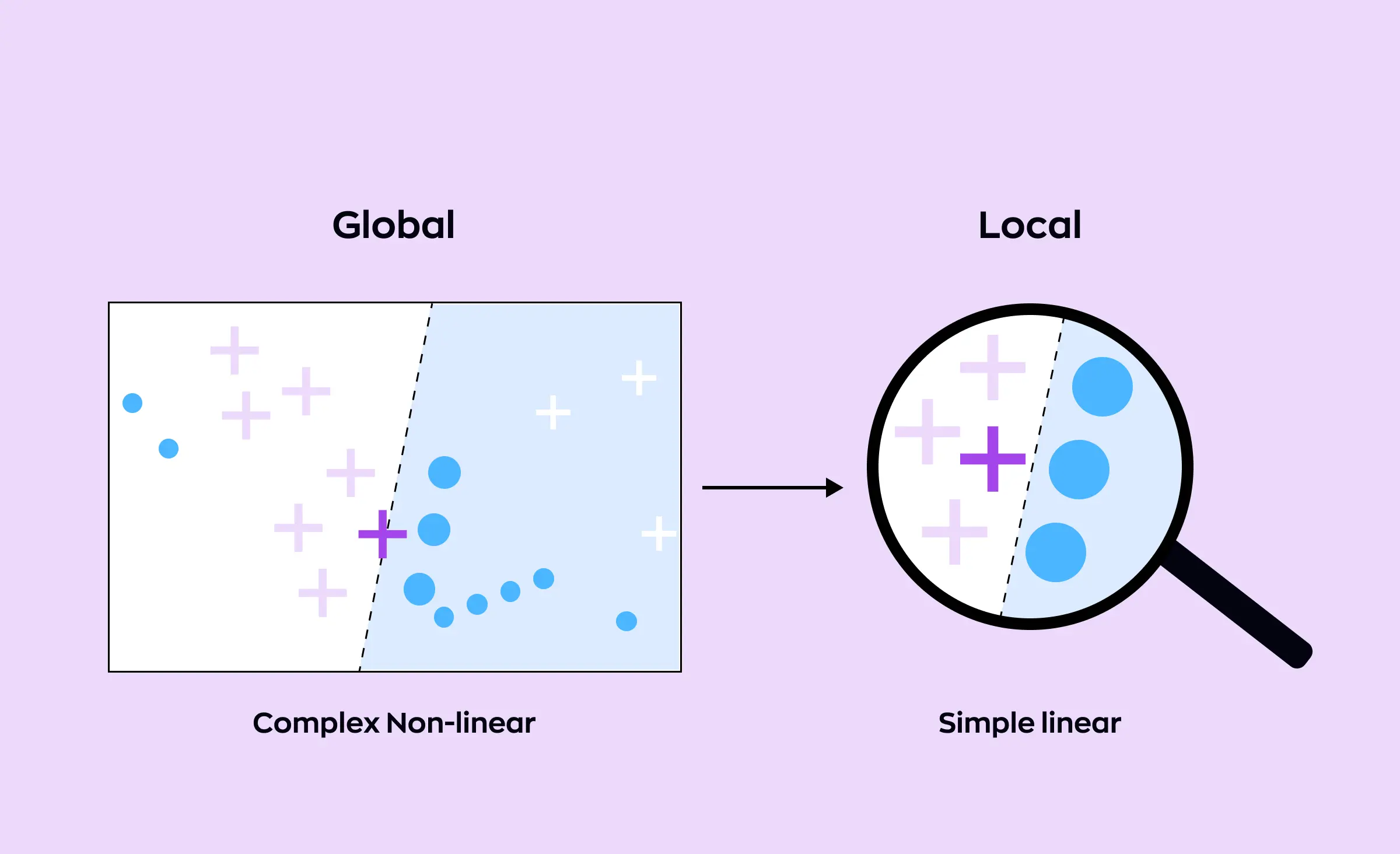
Because many modern machine learning models — such as random forests, deep neural networks, or ensemble methods — don't possess inherent interpretability, model-agnostic XAI techniques are vital. LIME (Local Interpretable Model-agnostic Explanations) and SHAP (SHapley Additive exPlanations) allow companies to open up any “black box” model. LIME approximates local prediction logic by building a simple, interpretable model around each prediction, identifying which inputs altered the outcome in a specific case. SHAP, on the other hand, leverages principles from cooperative game theory to assign each feature a value indicating its contribution to any given outcome — crucial for auditing complex AI decision-making across high-impact AI applications.
Integrating LIME and SHAP into day-to-day workflows not only advances machine learning interpretability but also helps organizations generate actionable AI insights, improve their AI strategy, and unlock new AI benefits through deeper, evidence-based understanding of their AI solutions' decision rationales.
Bringing it all together
Organizations that combine feature importance rankings, decision trees, and model-agnostic XAI techniques such as LIME and SHAP are far better positioned for responsible, effective AI business integration. These tools make it possible to build trustworthy AI, gain stakeholder buy-in, minimize risk, and demonstrate the real AI benefits of their AI applications — all while advancing machine learning interpretability and supporting compliant, ethical data-driven decision-making at scale.
Explainable AI benefits in key industries: Healthcare, finance, and business
Artificial intelligence is rapidly reshaping industries that depend on precision and trust. Yet as algorithms influence patient outcomes, credit decisions, and enterprise efficiency, the call for explainable AI (XAI) has become more urgent. Explainability isn't just about transparency; it's also about regulatory compliance and sustained trust in machine-led insights.
AI in healthcare ethics: Making clinical AI actionable and safe
In healthcare, explainability now underpins digital diagnostics and clinical decision support. When radiology algorithms highlight lesions or predictive models assess patient deterioration risk, clinicians must understand why AI flagged those cases. Regulatory bodies — from the EU MDR to the FDA's forthcoming AI/ML SaMD framework — increasingly demand traceable reasoning and reproducible performance from AI tools.
Top institutions are adopting human-in-the-loop systems, ensuring clinicians not only see outputs but also AI rationale, for example, heatmaps or feature-weight explanations. A 2025 study on transparent AI diagnostics showed that enhancing transparency and confidence calibration reduced clinician override rates from 87.64% to 33.29%, indicating much higher acceptance of AI recommendations. In short, XAI bridges the gap between algorithmic efficiency and medical ethics.
AI in finance ethics: Explainability as a compliance imperative
In finance, explainable AI has shifted from an ethical preference to a regulatory expectation. Credit scoring models built on opaque deep learning face scrutiny under the EU AI Act and US CFPB fair lending regulations, both requiring explainable decision outputs for consumers. Advanced XAI techniques — SHAP and LIME — are now used not only for debugging but for auditing and bias detection.
Banks that implement explainability pipelines report better regulator relationships and reduced model validation cycles. For instance, lenders incorporating SHAP-based audit trails can demonstrate individualized reasoning for credit approvals, leading to measurable gains in customer trust and reduced non-compliance risk.
AI business integration: Scaling AI without losing oversight
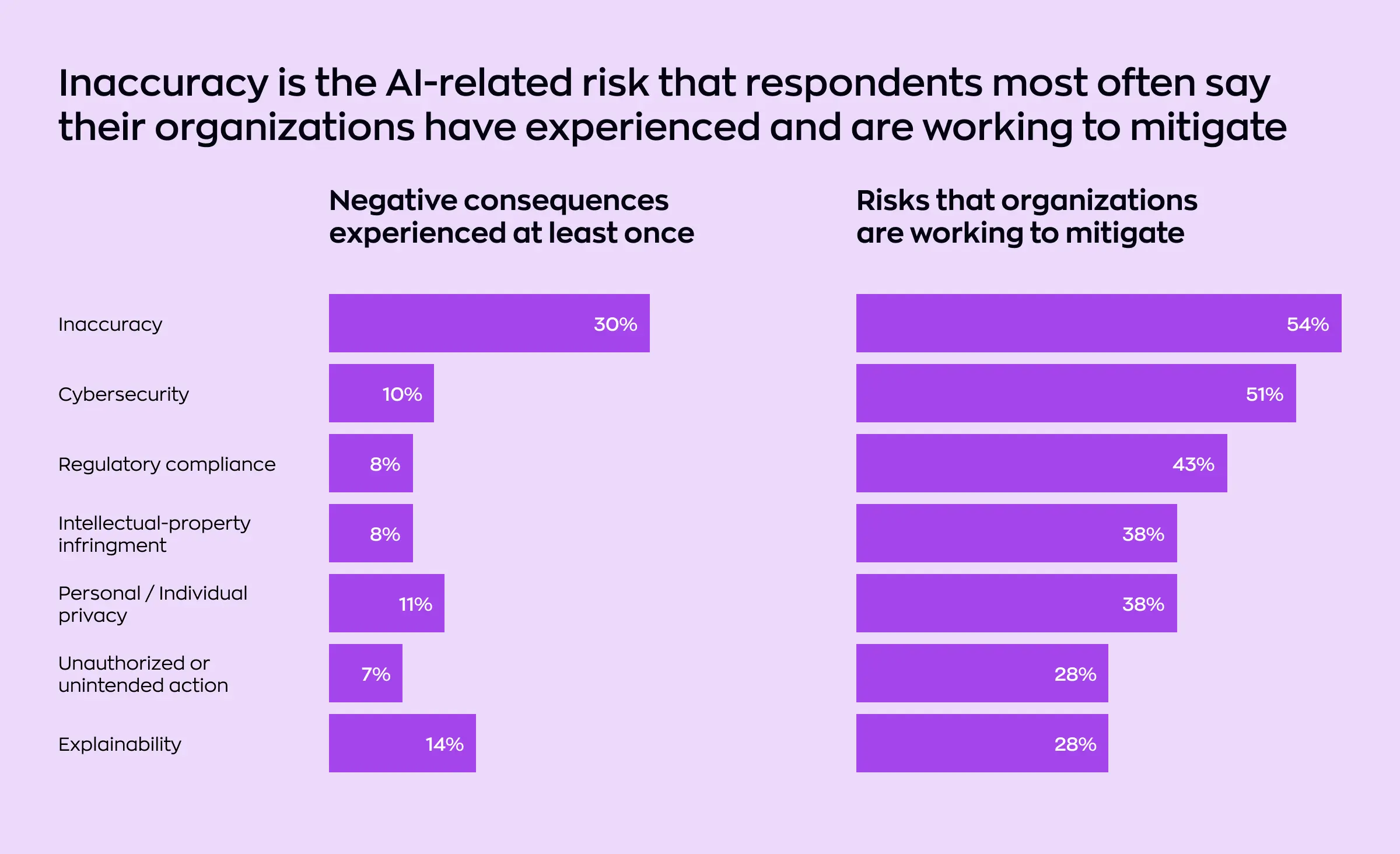
Enterprises adopting AI for demand forecasting, customer analytics, or HR automation face the twin challenge of speed and accountability. Explainability tools embedded into MLOps workflows — from model monitoring dashboards to bias alerts — help businesses maintain visibility across models at scale. However, despite being one of the top AI-related risks, explainability does not receive as much attention as it should within organizations — an issue that warrants closer examination.
Leaders that operationalize explainability early can accelerate innovation, reduce deployment friction, and build responsible AI brand equity. It's becoming a key differentiator for B2B clients evaluating automation vendors.
Overcoming challenges: Managing AI risks, compliance, and regulation
As artificial intelligence becomes embedded in everyday decision-making, organizations must mature from experimentation to disciplined AI risk management. The challenge isn't merely to innovate with speed — it's to innovate responsibly, within a rapidly tightening web of global regulation and ethical expectations.
Meeting regulatory and governance standards
AI compliance now ranks alongside cybersecurity as a board-level concern. The EU AI Act, NIST's AI Risk Management Framework, and the emerging ISO/IEC 42001 AI management standard all demand transparent, auditable AI operations. Under these frameworks, companies must track model lineage, document data sources, and demonstrate human oversight throughout the AI lifecycle.
This shift is pushing businesses to build AI governance programs that blend policy, technology, and ethics. Forward-leaning organizations treat governance not as a cost but as a foundation for trusted innovation — reducing rework, accelerating audits, and preventing compliance failures before they happen.
Safeguarding privacy and organizational trust
Data privacy and explainability are now intertwined. With generative and predictive systems ingesting sensitive information, safeguarding data requires more than anonymization — it means privacy-by-design architecture, secure model training, for example, federated learning, and post-deployment monitoring to prevent data leakage or model inversion attacks.
A single breach or opaque model decision can undo years of trust-building. Organizations therefore validate all machine learning models against privacy, bias, and fairness criteria prior to deployment — and continuously after. This fosters accountability across technical and non-technical teams alike.
Overcoming AI challenges is not a one-time compliance exercise. It's a continuous alignment of technology, ethics, and regulation — a discipline that defines the most resilient and trusted AI-driven organizations.
Best practices for implementing explainable AI
For organizations to get the most from artificial intelligence, they need practical steps that turn complex technology into real, everyday value. The journey to explainable AI is not just about technical features — it's about building habits and processes that ensure transparency, trust, and responsible growth.
Make responsible AI development a priority
Responsible AI development means putting ethical standards and clear documentation at the center of every project. Teams should outline expectations for fairness and clarity from the start, using frameworks that reflect data science ethics. This approach lays the groundwork for trustworthy AI systems that can adapt as business needs and regulations change.
Put AI transparency into every stage
AI transparency should begin with early planning and continue through deployment and updates. By using tools that explain machine learning models and share insights with stakeholders, companies help non-technical teams and end-users understand AI decision-making. This openness leads to more confident AI adoption and faster buy-in across the company.
Choose AI solutions designed for clarity
Seek out AI solutions with built-in methods for generating explanations and visual reports. Solutions that highlight key features or factors in AI applications make it easier to validate results and maintain consistency as systems evolve.
Build AI strategy around value and trust
A strong AI strategy supports both innovation and risk management. It includes regular reviews of results, ongoing learning for team members, and checks for unintentional bias. These reviews help the business to earn genuine AI benefits, not just quick wins.
Integrate explainable AI into the business
Connecting explainable AI directly with AI business integration leads to workflows where everyone receives timely, understandable AI insights. This is crucial for industries dealing with fast decisions or strict oversight and helps shape solutions that work for real people.
Monitor and improve data science ethics
Make space for regular conversations about ethics, especially where artificial intelligence interacts with sensitive data or personal information. Ongoing review, testing, and open communication help catch issues early and keep your AI decision-making process aligned with best practices and company values.
By following these steps, organizations boost trust and speed up the integration of explainable AI. The result is smarter AI applications — delivering benefits that support both business goals and the needs of end-users.
The future of explainable AI: Trends and opportunities
Explainable AI (XAI) is quickly becoming a standard part of artificial intelligence, not just an added feature. As organizations shape their AI strategy for long-term success, they are seeing new trends in explainability transform the landscape.
Key drivers for future AI development
Widespread AI adoption puts a spotlight on the need for greater AI transparency. Businesses want to understand not just what machine learning models decide, but how and why. As a result, future AI development will focus even more on interpretability tools, visualizations, and explanations that are easy for everyone to grasp. Companies investing in responsible AI development will have an edge, as regulators and consumers push for clearer answers and ethical practices.
Unlocking new business value
One of the biggest opportunities is the deeper AI insights that explainable systems deliver. Whether fine-tuning AI applications or rolling out new products, teams can use transparent AI solutions to quickly learn from mistakes, spot trends, and capture more value for their customers. These practices help build trustworthy AI and strengthen relationships with partners and end-users.
Expanding use cases and industries
AI business integration is spreading beyond early adopters, moving into fields like law, insurance, manufacturing, and logistics. As new machine learning models are tested in these areas, explainability will be key to ensuring smooth AI decision-making and preventing costly errors. Transparent, explainable AI encourages faster, safer AI adoption as businesses gain confidence in these tools.
Building for privacy and security
Looking ahead, companies must also address data privacy AI concerns. Building explainability features into the development process means teams can spot and remove hidden biases or risks before going to market. This not only strengthens compliance, but also protects customers' data and trust.
The bottom line
As artificial intelligence continues to evolve, the future belongs to organizations with a clear, explainable approach. Teams that make explainable AI part of their AI development and strategy will enjoy more sustainable growth, better partnerships, and enduring AI benefits.
In the final section, we'll summarize why explainability is essential and how your organization can start building a more transparent and trustworthy AI future right now.
Conclusion
Explainable AI (XAI) is no longer just a specialized tool — it is a foundational step toward building AI trust and ensuring responsible AI development in every industry. As artificial intelligence takes on a growing role in critical AI applications, organizations must demand more from their machine learning models than just high accuracy. They need systems that offer real AI transparency and ethical AI practices from the start.
When businesses invest in trustworthy AI, they gain more than regulatory compliance. They open the door to stronger partnerships, faster innovation, and lasting AI benefits. Leaders who prioritize clear AI decision-making, transparent reports, and actionable AI insights set the stage for success in both the near and long term.
At the same time, explainability helps teams honor data science ethics and ensure every stage of AI development reflects those values. By making the logic behind each prediction accessible, companies boost user confidence and prove they are committed to fairness, safety, and quality.
As your organization explores or expands its use of artificial intelligence, set explainability as a central goal. Ronas IT team provides a clear approach to building and deploying machine learning models, responsible AI development, and open communication. Fill out the short form below to implement reliable AI solutions in your business.
Related posts













Related Services


Development
React Native App Development Services


Development
MVP Development Services


Development