Achieving product-market fit with a strong tech foundation: A startup guide


Product-market fit is the moment your product matches a real market need well enough that people keep using it and tell others. For most startups it is the milestone that separates a growing business from a slow fade. In its 2026 CB Insights review of failed startups, poor product-market fit was one of the leading root causes at 43%, second only to running out of capital.
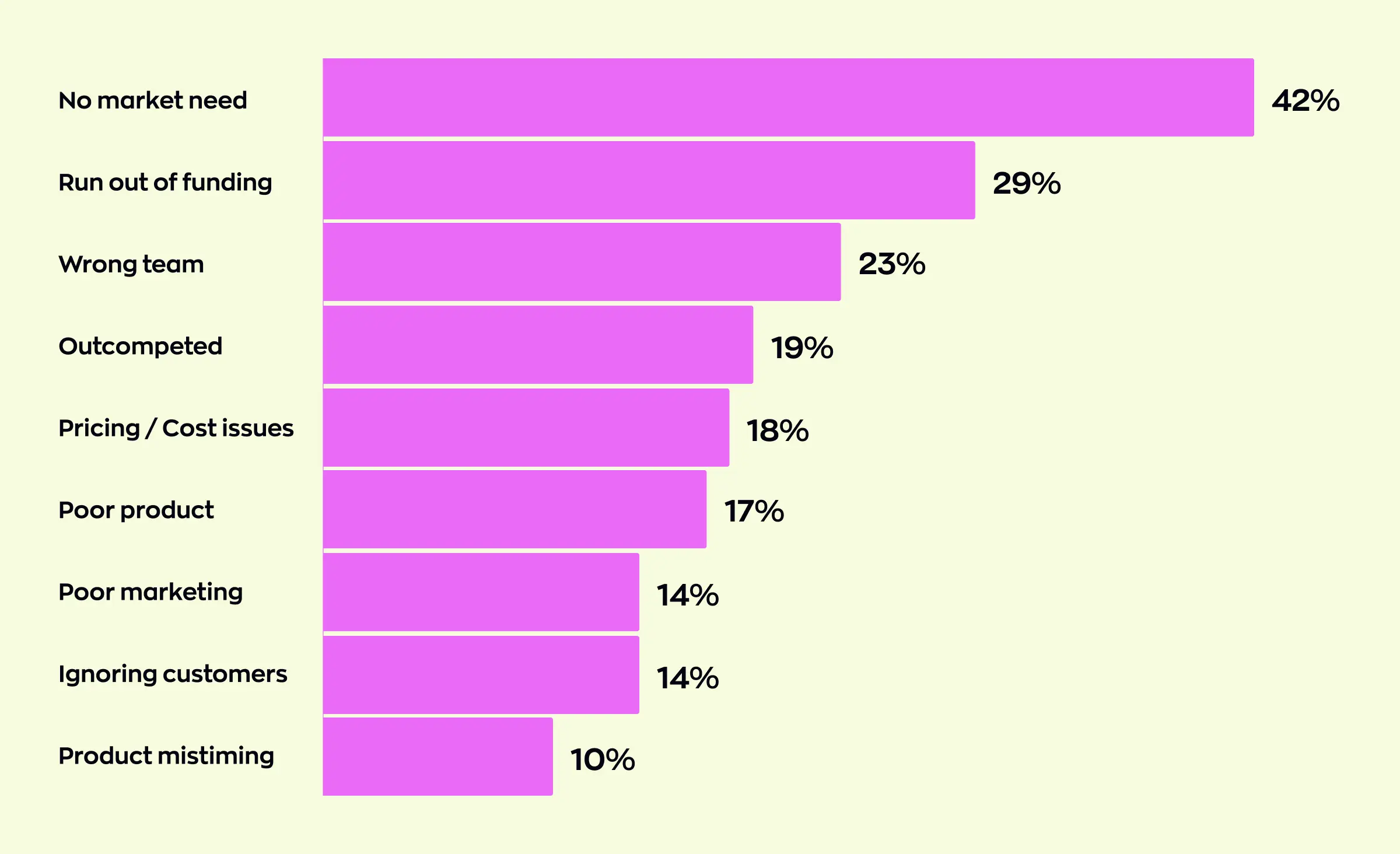
Technology does not create that fit. The market does. What a strong tech foundation gives you is speed: faster experiments, cleaner data, and a shorter loop between a hypothesis and a validated answer. This guide is the product-market fit tech strategy we use at Ronas IT for startup MVPs: how to validate demand, measure fit, and build a foundation that carries you past launch.
AI coding agents have made building a prototype much cheaper and faster. In 2026 you can put a working version in front of users within days. That speed helps you test ideas, but a cheap build is not a validated one: shipping fast tells you nothing until real users react. The market still decides, and it does not care how little the prototype cost to make.
“A founder does not pay us for code. They pay us to reach a clear yes-or-no answer about their idea as cheaply as possible. Our job is to make each validation loop short, so the budget buys learning, not features nobody asked for.”
Roman Surikov, CEO at Ronas IT
Defining PMF: where market needs meet your solution
Product-market fit (PMF) is the point where enough people in your target market prefer your solution over the alternatives and keep coming back. It sits on top of two things you do not fully control (a real problem and a market that wants it solved) and one thing you do: the product you build to serve them.
Why product-market fit matters
Without fit, a product struggles to attract and keep customers no matter how much you spend on marketing. Even well-funded products fail without it: Google Glass had strong engineering behind it but no clear everyday use, and it never reached a mainstream market. Founders often invest months building features, but unless those features solve an urgent problem, usage rarely sticks. Fit validates your assumptions and proves there is real demand. Reaching it lets you shift from hunting for traction to scaling on proven demand.
The five elements of product-market fit
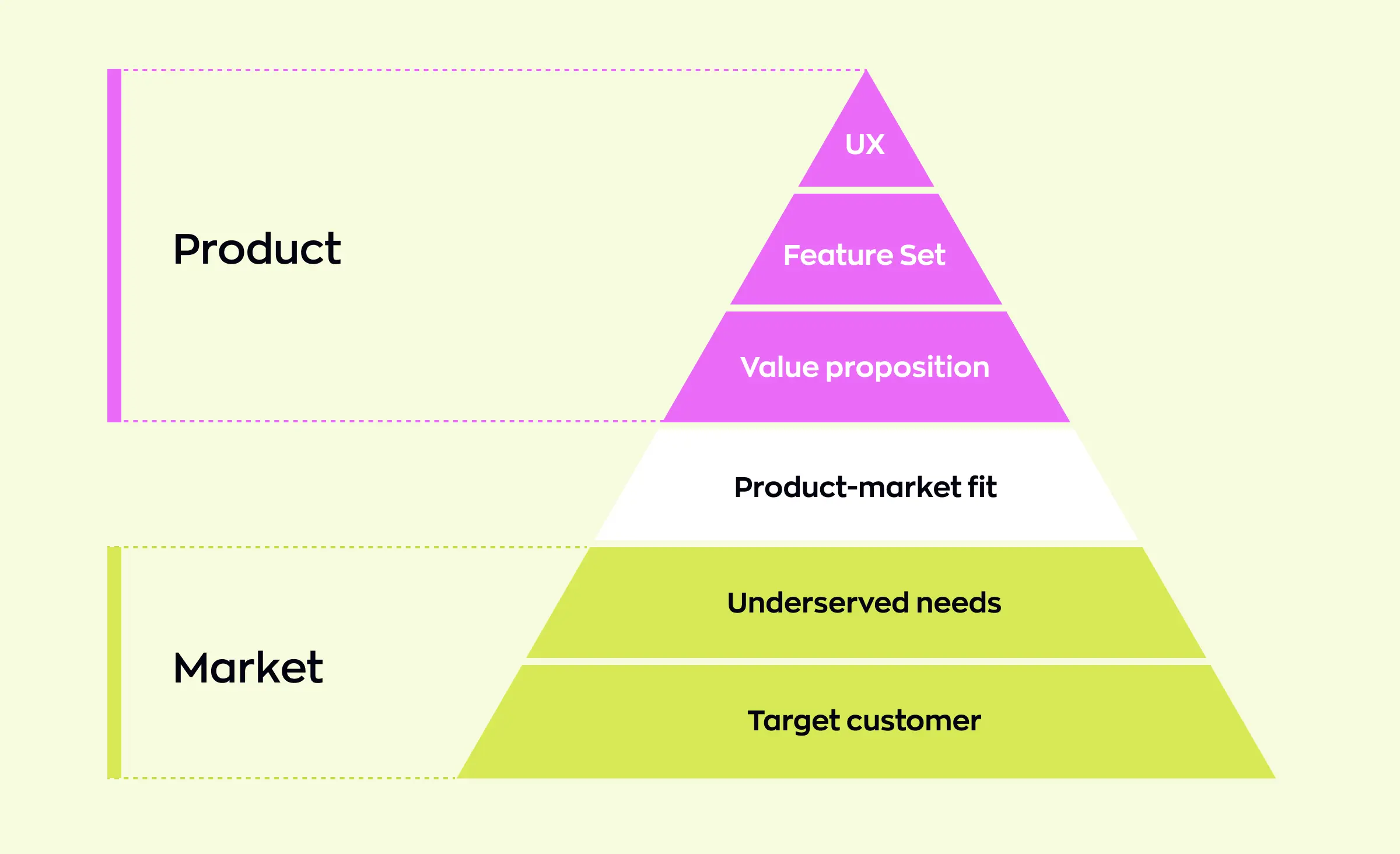
Fit is not a single on/off state. Marc Andreessen, who coined the term in 2007, framed it as a good market plus a product that can satisfy that market, and argued the market matters most: a weak product can still sell in a strong market, but no product wins in a market that is not there. Dan Olsen's product-market fit pyramid breaks that idea into five elements across two halves.
The market, which you research but do not control:
- Target customer: the specific user whose problem you choose to solve.
- Underserved needs: the high-priority needs that current options do not meet well for that customer.
The product, which you build and control:
- Value proposition: how your product meets those needs better than the alternatives.
- Feature set: the functionality that delivers the value proposition.
- User experience: how the customer interacts with that functionality.
Product-market fit is how well your decisions in the top three product layers match the market in the bottom two. Get the market wrong and no amount of features or polish saves the product.
How technology moves you toward fit
A strong tech foundation helps you reach fit faster. When your stack lets the team ship, measure, and iterate on real usage signals, you learn something from each release. Product decisions guided by analytics let you test assumptions fast and drop what does not work. Because the market layers of the pyramid sit outside your control, the product layers above are where your tech and design choices earn fit.
The Ronas IT PMF-validation checklist
Most PMF advice tells you what fit is, not how to test for it in a real build. This is the sequence we run on startup engagements. Each gate has to pass before we spend budget on the next one, which keeps the cost of being wrong low.
- Confirm problem-solution fit first. Before writing code, we pressure-test the problem with the founder: who has it, how often, and what they do today instead. If the problem is not urgent, no product fixes that.
- Define one core assumption to test. We reduce the idea to the single riskiest belief. The MVP exists to prove or kill that one thing, not to be a small version of the whole roadmap.
- Ship the smallest product that produces a real signal. A basic MVP with us starts from 4 weeks, so founders get usage data in weeks, not quarters.
- Instrument before launch. Analytics, cohort tracking, and feedback capture go in from day one. You cannot measure fit you did not set up to see.
- Measure with the Sean Ellis 40% test and retention. Ask active users one question: “How would you feel if you could no longer use the product?” If at least 40% answer “very disappointed,” you have a strong fit signal. Cross-check it against a retention curve that flattens rather than dropping to zero.
- Iterate or pivot on the data, then scale the foundation. If the signal is weak, change the product before spending on growth. If it is strong, the same stack scales up instead of forcing a rewrite.
Sean Ellis, who coined the term “growth hacking,” popularized the 40% benchmark after studying roughly 100 startups: those above the line tended to grow sustainably, and those below it usually stalled. It is one of the most widely used single measures of product-market fit.
Strategic tech development: from MVP to validated product
Early technology decisions set the ceiling for how fast you can learn later. Fit rarely comes from building a feature-heavy product up front. It comes from a focused build, real usage data, and steady refinement as you learn what your customers actually need. Four choices matter most.
1. Start with a minimum viable product
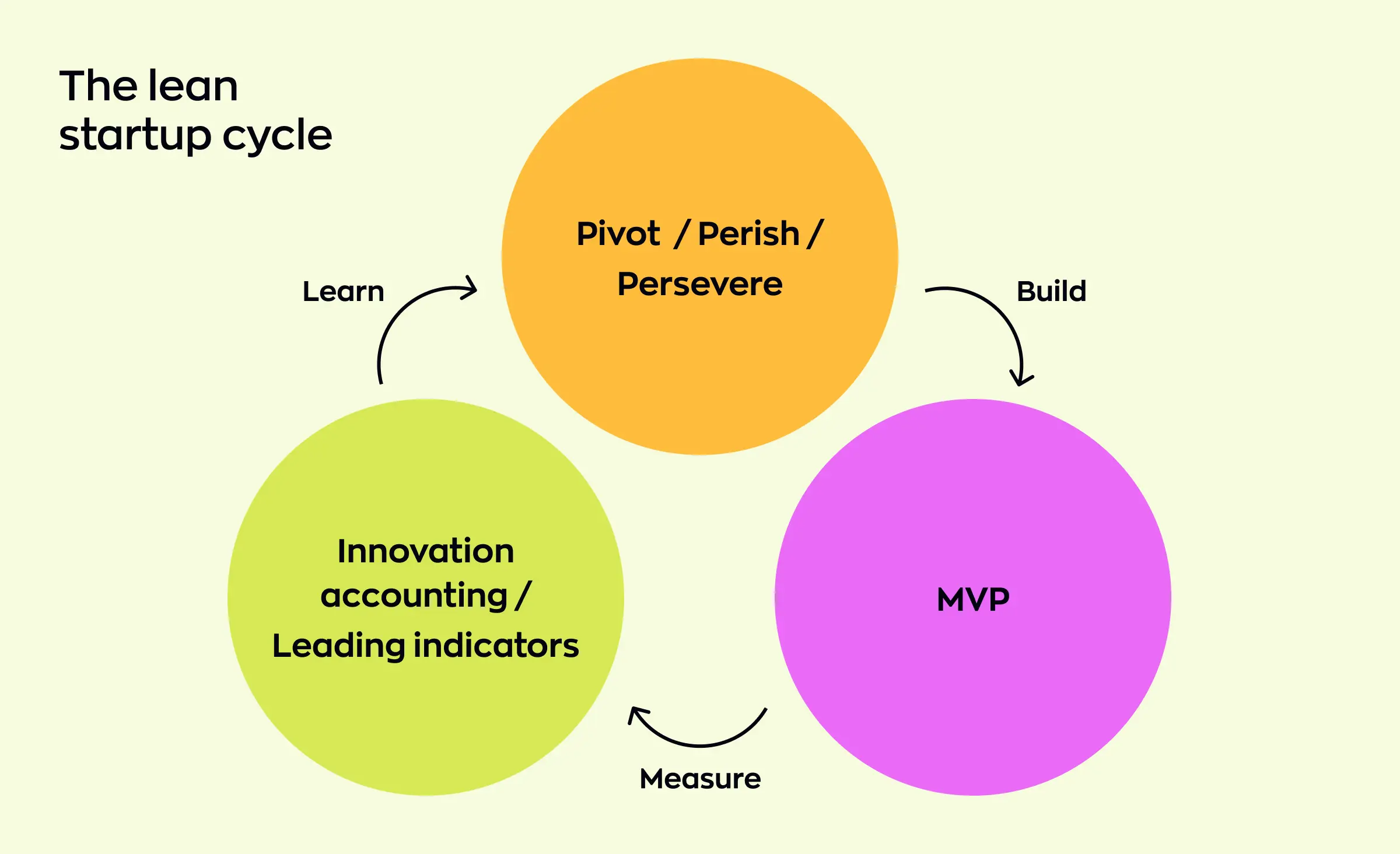
The lean startup approach, defined by Eric Ries, recommends building a minimum viable product that meets only the essential need of your target customer.
- It reduces risk and forces a real test of demand instead of a guess.
- MVP development lets you deploy fast, gather feedback, and adapt before the budget runs out.
2. Build features toward fit, not away from it
Every development cycle is a chance to test an assumption. Instead of adding extras, concentrate on the few features that move the product closer to fit.
- Ship one feature per cycle tied to a clear hypothesis, then check whether it moved activation or retention before you build the next one.
- Cut features that do not move a metric, even the ones already on the roadmap.
- Let usage data, not the loudest opinion in the room, set the order of the backlog.
3. Choose a stack that scales with you
Every infrastructure choice shapes how easily the product can grow and adapt later.
- Pick well-supported frameworks such as React, React Native, Laravel, and PostgreSQL, so the same codebase carries you from a 4-week MVP to scale without a rewrite.
- Avoid trend-driven picks that lock you into a small hiring pool or a costly migration once you have paying users.
4. Sharpen the user experience and keep iterating
Steady updates based on user signals build momentum.
- Fix the friction users hit most often, spotted in your analytics, before you add anything new.
- A product manager owns the metrics and decides which improvement ships in the next release.
Effective product development is iterative. By focusing on the target market, building an adaptable foundation, and learning from feedback, startups improve their odds of reaching durable product-market fit.
How to measure product-market fit
You can only improve what you track, so instrument the product before you launch it. The Sean Ellis 40% survey is the primary signal, but pair it with four quantitative metrics that show whether usage is deepening or leaking:
- Cohort retention: track how many users from each weekly or monthly cohort stay active 30 days after sign-up. A curve that flattens instead of decaying to zero is the strongest sign of fit.
- Churn rate: users lost in a period divided by users at its start. Falling churn across cohorts confirms the Sean Ellis signal from the other direction.
- LTV to CAC ratio: lifetime value against customer acquisition cost. As a rule of thumb, a ratio above 3:1 means the product is worth paying to acquire users for.
- Net Promoter Score: the share of promoters (a 9 or 10 out of 10) minus the share of detractors (0 to 6), useful as a trend line between the deeper Sean Ellis surveys.
Match the metrics to your business model. A two-sided marketplace like the Noah project below has to measure retention on both sides at once, because supply and demand can reach fit at different speeds: producers may stay while consumers churn, or the reverse. A single blended curve would hide that gap.
Signs you have reached product-market fit
Beyond the numbers, fit shows up in behavior you did not have to pay for. Watch for four signals:
- Users come back on their own, and word of mouth brings new ones without paid acquisition.
- People ask to pay, upgrade, or expand their usage before you push them.
- Support and sales start hearing “I could not go back to the old way of doing this.”
- Organic sign-ups and referrals begin to outpace your paid channels.
These signals map onto a phased progression the industry knows well: problem-solution fit comes first, then product-market fit, then the room to scale. Dan Olsen's Lean Product Process names the same ladder, which is why the Ronas IT checklist follows it rather than jumping straight to building features.
Common tech pitfalls that hinder PMF
The same tech choices that speed up your search for fit can also stall it. Five traps show up most often on early-stage builds.
Over-engineering the MVP
Packing the first version with extras nobody asked for wastes money and delays real feedback. Cut the MVP back to the one assumption you most need to prove, and add the rest only once usage justifies it.
Neglecting technical debt
Skipping refactoring feels harmless until the debt compounds into slower releases, more bugs, and a codebase that gets harder to change. Small, regular cleanups cost far less than one big rewrite later.
Choosing the wrong tech stack
Picking frameworks by trend instead of fit can lock you into a costly migration once you have paying users. Well-supported choices like React, Next.js, TypeScript, and Laravel for the backend keep hiring easy and the codebase maintainable as you scale.
Lacking analytics and customer insight
Without event tracking and user feedback in place, you are guessing where users engage and where they drop off. Instrument the product before launch, not after you already need the answers.
Ignoring security concerns
Weak data protection and identity management erode trust and get expensive to fix later. Proven building blocks like Auth0 for authentication and managed infrastructure on AWS, Google Cloud, or Cloudflare cover the basics from day one.



How Ronas IT builds toward product-market fit: the Noah case
Founders navigating the path to fit often need an experienced partner who knows how to build for real users in a specific market. At Ronas IT, we combine technical depth, a tested product process, and a strong focus on UI/UX design to help teams iterate faster and adapt to what the market tells them.
Take our work on the Noah project. In 2019, a startup founder from Sweden approached us to build a farmer marketplace connecting local food producers with everyday consumers, with the goal of making the region less dependent on foreign suppliers. Facing a tight window before the harvest season, our team designed and developed three apps in 4 months: iOS and Android apps for consumers, a separate mobile app for producers, and a web admin panel. We used native stacks for mobile and Angular with Laravel on the web, choices that supported fast iteration and clean scaling from launch.
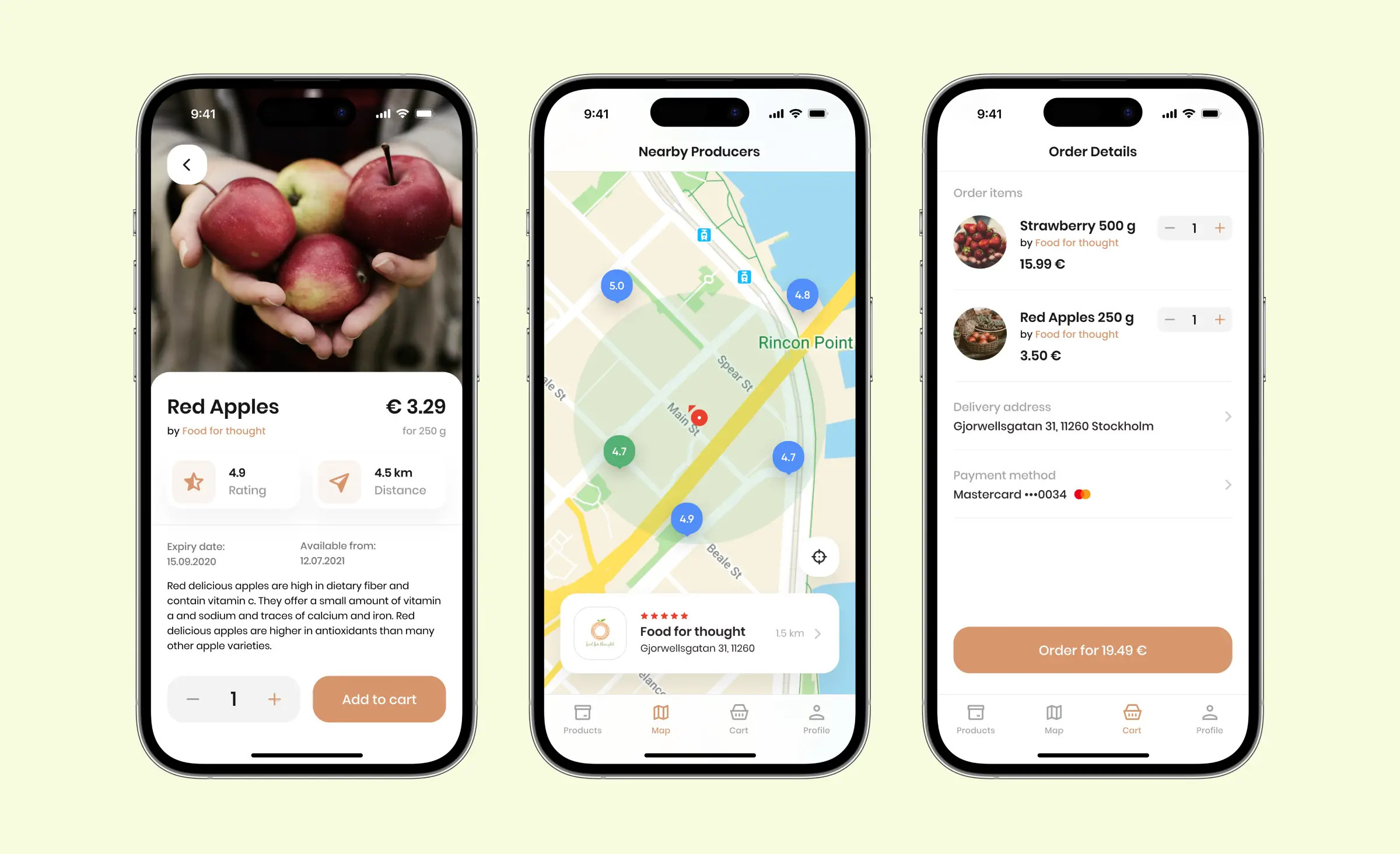
We wired in analytics with Firebase from the start so the team could measure real user flows, and integrated the Stripe SDK for in-app payments and the Google Maps SDK for producer search. Security was built into the Laravel backend, which stores producer and buyer data. That instrumentation is what turns a launch into a learning loop: the founder could test the marketplace with real producers and buyers in a pilot market instead of guessing.
The founder was satisfied enough with the pilot to keep working with us: after the first release we continued adding features and providing post-release support rather than delivering once and walking away. That is the payoff of a foundation built for iteration. When the early signals are worth acting on, the same stack carries the next round of work instead of forcing a rebuild.
The core lesson maps to every PMF journey. A focused MVP built for early learning, tight feedback loops, and quick iteration let a startup find its footing before it commits to a full roadmap. Ronas IT works with founders at different stages, and while every product journey is unique, a foundation tuned to your market puts you in a better position to adapt and move forward.
Conclusion: what to do next
Reaching product-market fit is hard for any founder. A focused tech strategy, honest user feedback, and a clear read of your target market let you learn, iterate, and close the gap between your product and real demand. Technology is not a guarantee of success, but it is a powerful ally for listening to your audience and adjusting fast.
If you are working toward fit, here is a concrete way to start this week:
- Write down the single riskiest assumption your business depends on.
- Define the smallest product that could prove or disprove it, then scope it as a minimum lovable product rather than a feature list.
- Set up analytics and cohort tracking before launch, not after.
- Run the Sean Ellis 40% survey once you have a base of active users, and watch your retention curve.
Once the signal is strong, a flattening retention curve and real usage data are exactly what investors want to see before they fund your next stage, and the foundation you built scales up instead of forcing a rewrite.
Frequently Asked Questions (FAQs)
How do you know when you have reached product-market fit?
How much does it cost to build an MVP to test product-market fit?
Why do startups fail to reach product-market fit?
What metrics should a startup track before product-market fit?
What is the biggest tech mistake startups make chasing product-market fit?
Can you switch the tech stack after finding product-market fit?
How long does it take to reach product-market fit?
Who owns product-market fit at a startup?
Related posts






Related Services
React Native App Development Services
Save time and costs with Ronas IT's React Native app development, allowing cross-platform capabilities for iOS and Android. Our team has built 20+ React Native apps since 2020, ensuring rapid development, flexible maintenance, and cost-effective solutions.
MVP Development Services
Need to launch your startup quickly? Ronas IT offers urgent MVP development services, allowing you to get a fully-functional app in 4 to 12 weeks, depending on scope. Ideal for testing business ideas, presenting to investors, or entering the market swiftly. Benefit from our extensive experience and accelerated development process.
Custom Web App Development Services
Build secure, scalable web applications with Ronas IT’s custom web app development services. Our team covers the full cycle — from concept and UI/UX design to development, testing, and ongoing support — using leading tech like React and Laravel. With 200+ custom apps delivered across various industries, we ensure intuitive interfaces, smooth integration, and solutions tailored to your business goals.