How disaster recovery and business continuity in the cloud helps companies protect data


Every business must protect its information from new risks and fast-moving threats. Using a disaster recovery and business continuity cloud approach gives you more options to keep your services safe. With cloud disaster recovery, your IT infrastructure is easier to fix if something goes wrong. Choosing trusted cloud platforms and well-designed cloud infrastructure helps your company build strong cloud resilience from day one.
As a CTO, I've seen that a good business continuity plan also means your team can keep working even if part of your system fails. By focusing on data protection in cloud environments and always keeping secure data as a top priority, you can support your company's growth and stay ready for anything. In this article, I'll show you the tools and steps you need to build secure apps in the cloud.
Key thoughts of the article:
- Cloud disaster recovery and business continuity cloud solutions protect your data and keep your business running — even during outages or cyberattacks.
- A strong business continuity plan and modern cloud architecture let you quickly restore systems and prevent data loss, using automated data backup and recovery.
- Cloud platforms with high availability and resilience features spread services across multiple zones, so downtime and disruptions are rare and short.
- With the right IT infrastructure and cloud security best practices, your company can safely scale, serve users, and handle any challenge.
Why disaster recovery matters for businesses
Many businesses depend on round-the-clock access to their systems and data. When outages, cyberattacks, or hardware failures happen, the results can be costly. This is why a solid disaster recovery and business continuity cloud approach helps you handle these risks and stay ready. A clear business continuity plan helps companies prepare for emergencies. When unexpected events occur, such a plan keeps operations going with minimal disruption. It also helps protect valuable digital assets, so you don't lose important data or face compliance problems.
Cloud disaster recovery offers better flexibility and speed compared to traditional methods like manual replication or backups. With cloud infrastructure, your business can recover quickly — even after major incidents. Building in high availability cloud features ensures your services stay up and running, which is the foundation of enterprise resilience.
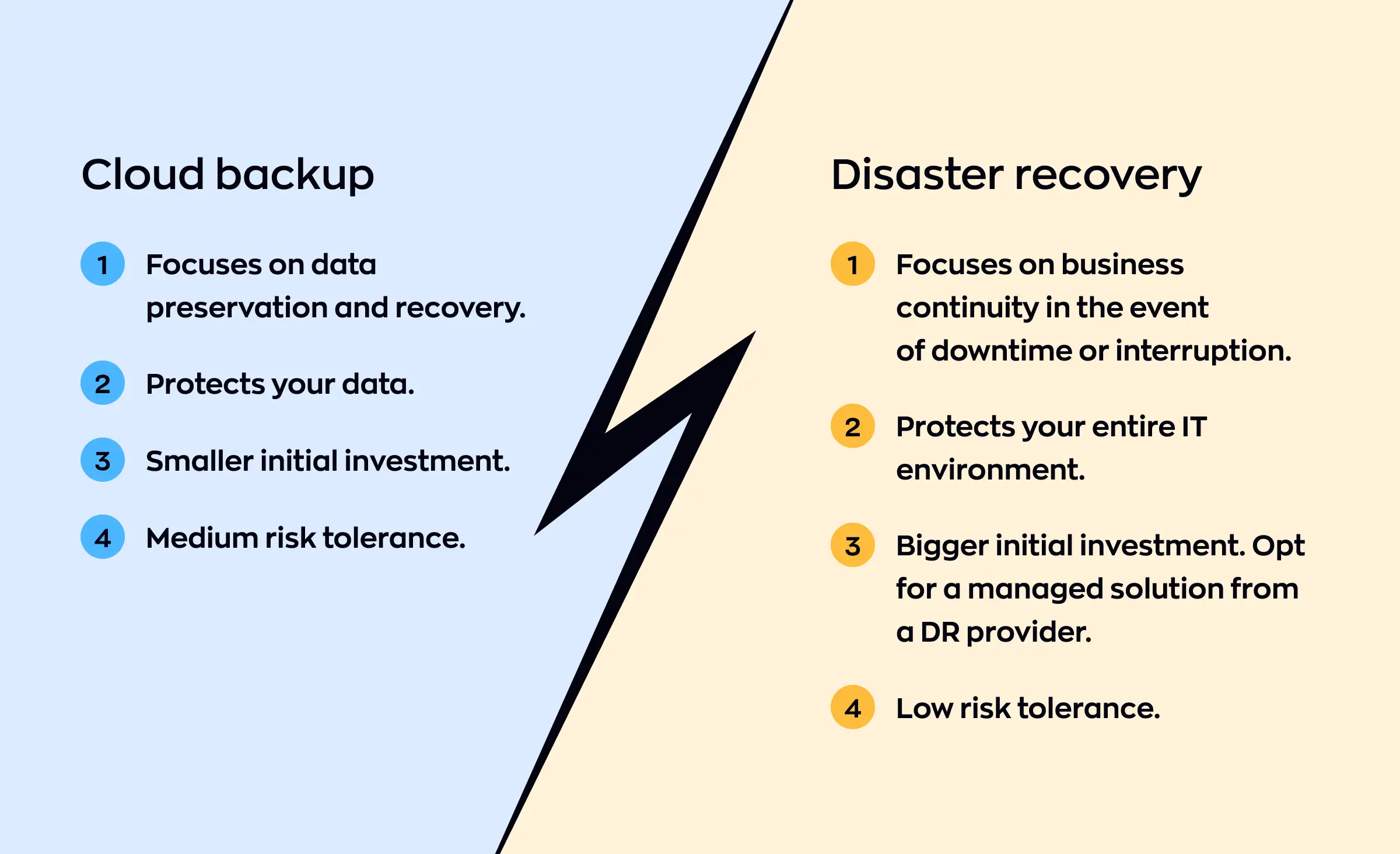
Enterprise resilience comes from quick action and smart planning, so operations bounce back from trouble. Cloud resilience means your services keep running, even if parts of your system fail. With high availability cloud tools, downtime becomes rare and short. A good IT resilience strategy also includes digital assets protection, making sure your information and key files are secure and recoverable.
By combining solid cloud tools with careful preparation, you keep your business strong, confident, and ready for anything.
Core elements of a cloud-based disaster recovery and business continuity plan
A strong business continuity plan helps every company protect digital services. In the cloud, you need to use several main tools and strategies. Here are the basics:
Data backup and recovery
Good data backup and recovery form the base of your disaster recovery plan. Backups should happen automatically and on schedule. With cloud backup solutions, your important data stays safe from hardware failure or cyberattacks. Organized data storage means you can restore systems quickly when needed.
Data protection and security
Data protection in cloud environments does more than just save copies. Encrypt your files and make sure secure data transfers happen every time. Update security controls often and make use of data integrity cloud features. This way, you know your information has not been changed by mistake or attack.
Check out how we developed a travel platform that features adaptive 3D Secure 2 verification, anti-fraud device fingerprinting, all while ensuring PCI DSS and Australian Privacy Act compliance.
Continuous availability and resilience
Customers want systems that never go offline. High availability cloud features spread services over many servers, so if one fails, others keep working. Using a smart cloud architecture for DR brings redundancy and keeps your services up, backing up your business continuity plan.
Setting RTO and RPO goals
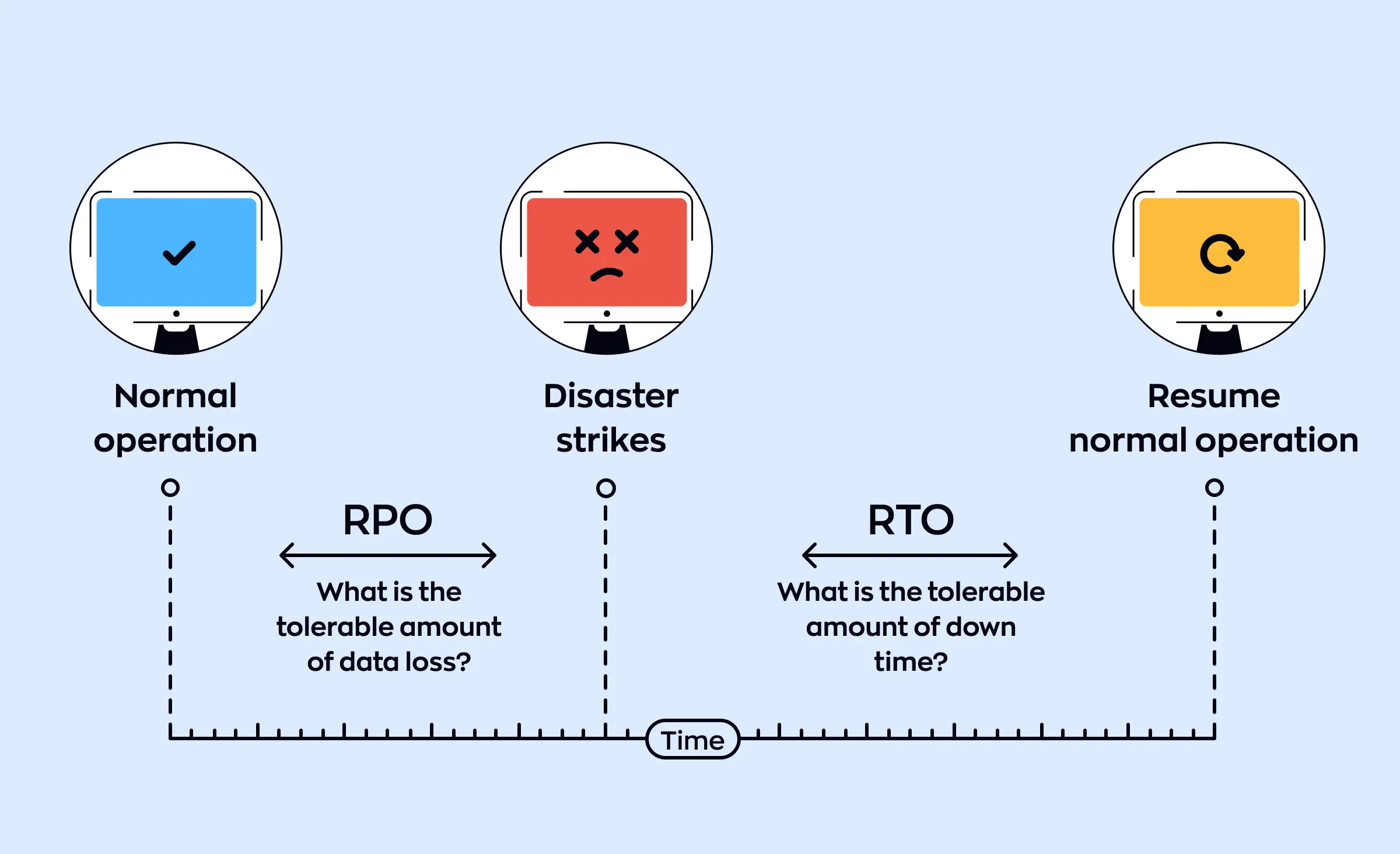
Set clear RTO (Recovery Time Objective) and RPO (Recovery Point Objective) goals. RTO is how fast you bring services back. RPO is how much data you can lose. These targets keep your cloud disaster recovery work focused on what matters most.
Incident response and data management
If something goes wrong, a good incident response cloud process helps fix issues fast. Assign clear roles and steps to your team. Strong data management means you always know where your data is and who can use it.
Securing your data and planning ahead
Protect your secure data with regular disaster tests, employee training, and cloud-based security tools. When you cover all these core parts, your company's data protection in cloud grows stronger and you boost resilience for any situation.
Designing cloud architecture for disaster recovery
A smart disaster recovery strategy begins with thoughtful cloud architecture. The right foundation helps you avoid downtime and protect your business, no matter the challenge. Let's look at core design principles and technology choices.
Building reliable cloud architecture
Modern cloud architecture focuses on scalability and flexibility. It should adapt to growing needs and handle multiple workloads at the same time. Strong cloud infrastructure supports disaster recovery by allowing systems to shift seamlessly between resources when needed.
Elements of cloud architecture for DR
Cloud architecture for DR adds extra protection. This design uses backup servers, multi-region replication, and automation to restore services quickly. Effective planning with cloud architecture for DR prepares your company for both small outages and major incidents.
Cloud disaster recovery approaches
Cloud disaster recovery gives you new ways to restore operations. With a high availability cloud setup, your applications run across several zones, so a single failure does not bring everything down. Cloud disaster recovery can use automated failover, reducing manual work and helping you meet recovery goals.
Hybrid and alternative models
For some businesses, a hybrid cloud DR approach offers the best of both worlds. It combines private and public cloud environments and adds flexibility without sacrificing control. Hybrid setups are often chosen as data center alternatives, allowing critical data storage offsite while keeping sensitive systems more secure.
Planning for migration and ongoing operations
Cloud migration disaster recovery strategies help companies move legacy systems to the cloud safely. They map out how to transfer workloads and data storage while minimizing interruptions. When choosing cloud platforms, consider how well they support migration, scaling, and integration with your existing IT infrastructure. Cloud operations play a key role too. Monitoring, regular testing, and strict access controls help maintain high availability cloud standards.
By focusing on strong design, careful planning, and the right technology, you can build a cloud disaster recovery solution that lasts.



Best practices for cloud security and data protection
Protecting your cloud environment requires a practical and holistic approach. Here's how to build a secure foundation, ensure business continuity, and safeguard your digital assets.
Develop a business continuity plan
A thorough business continuity plan outlines how your company will react to disruptions, from minor outages to major disasters. Identify all critical cloud operations and IT infrastructure components, then map out clear recovery procedures. Define contact lists, roles, escalation paths, and communication guidelines. Make this plan a living document — update it after every incident and during major changes in cloud infrastructure or processes.
Build a secure infrastructure
Always choose cloud platforms that offer high availability cloud capabilities and advanced cloud computing security tools. Build your workloads on well-architected cloud infrastructure, taking advantage of automatic backups, traffic encryption, and built-in DDoS protection. Evaluate vendors for compliance certifications and their ability to deliver digital assets protection at scale.
Enforce data protection in cloud environments
Ensuring data protection includes encrypting data in transit and at rest, securing APIs, and using granular access controls. Regularly audit who has access to what and apply least-privilege principles. Enable versioning and data integrity cloud checks to detect and roll back unauthorized changes, keeping secure data safe and reliable.
Implement cloud security
Cloud security best practices defend against common vulnerabilities. Use strong, unique passwords, enable multi-factor authentication, and segment your networks. Set up firewalls and access control lists. Schedule regular security reviews and penetration tests to uncover gaps before attackers do. Combine automated monitoring with manual audits for full visibility into cloud operations and data management.
“Within our company, we use approaches like the least privilege principle and fine-grained access. This means that even team members do not have full access to all parts of the project, which helps us better protect data and minimize risks.”
Maintain cloud backups
Set up cloud backup solutions for frequent, automated snapshots of your critical workloads and data storage. Store copies in multiple geographic regions to limit risk of loss from localized events. Test restore processes regularly: confirm that you can recover secure data and maintain business as usual. Integrate backup testing into your disaster prevention program to catch issues early.
Ensure data management and integrity
Implement a clear data management policy covering collection, storage, labeling, retention, and deletion. Monitor data continuously with integrity checks, hash comparisons, and alerting for anomalies. Choose scalable storage systems within your cloud architecture to handle growth and guarantee you can restore clean copies if needed.
Embed cybersecurity in all phases
Prioritize cybersecurity for digital products from development through deployment. Use secure coding standards, conduct security reviews for new releases, and automate dependency checks for libraries and frameworks. Secure APIs, production data, CI/CD pipelines, and integrate real-time scanning for vulnerabilities.
Prepare clear incident response cloud protocols
Establish a formal incident response cloud protocol that defines detection, containment, eradication, and recovery steps for different threat scenarios. Assign clear roles during a cyber event. Use automated alerting and response tools to speed up remediation. Review and rehearse your plan as your cloud operations grow or your IT infrastructure changes.
Real-world use cases
Learning from real incidents helps organizations improve their cloud disaster recovery approach and make the most of modern cloud platforms. Here are some lessons from different sectors and situations.
A EU company case
A European company once ran its site from a Paris data center. A fire destroyed their servers and customer data. Without a business continuity plan or cloud disaster recovery setup, they lost customers and revenue. Afterward, they built new IT infrastructure on Azure with geo-redundant storage between the US and UK. This modern cloud architecture for DR gave them low downtime and strong digital assets protection — even when facing another crisis.
Revolut and Coinbase
Big names like Revolut and Coinbase have faced heavy service disruptions. In 2017, a server outage at Revolut exposed gaps in backup systems, causing transactions to fail when demand spiked. In another case, Coinbase and other platforms were knocked offline for 16 hours during an AWS us-east-1 outage in 2025. Even with big DR budgets, companies relying on just one AWS region were unable to recover quickly, showing that backups alone or limited cloud infrastructure are not enough for high resilience or fast recovery.
Netflix and Shopify
Netflix experienced serious AWS region outages in 2012, which exposed weaknesses in their old backup approach. Instead of just backing up data, Netflix built an IT resilience strategy based on active-active, multi-region AWS cloud disaster recovery. They invested in redundant cloud infrastructure across multiple regions and developed tools like Chaos Monkey and Chaos Kong to regularly run failure tests. When another AWS regional outage occurred, this approach kept streaming nearly uninterrupted, proving that a solid cloud architecture for DR combined with live testing can protect even huge digital businesses.
Shopify has seen major outages due to dependencies on third-party edge networks like Cloudflare. In May 2024, a routing incident at Cloudflare led to widespread traffic loss and automatic scaling down of Shopify's systems. When Cloudflare rolled back the changes, Shopify's own platform stayed scaled down, causing even more downtime. To improve enterprise resilience, Shopify revised its business continuity plan, boosting automated alerting and scaling, and worked to isolate core applications from such external incidents. After a major Cyber Monday outage, many merchants moved to multi-cloud and multi-backend architecture, ensuring that even if Shopify is down, they can keep stores running.
Key patterns for success
Analyzing these stories, experts advise:
- Go beyond basic backups: use automation to recreate cloud infrastructure in new regions.
- Regularly disaster-test your cloud migration disaster recovery plan.
- Design for multi-region, hybrid, or multi-cloud operations.
- Use cloud computing security and digital assets protection at every layer.
These examples prove resilient disaster recovery and business continuity in the cloud require smart planning, robust cloud platforms, and an IT resilience strategy that's tested, not just documented.
How Ronas IT can help with secure disaster recovery and business continuity in cloud
At Ronas IT, we guide our clients through every stage of disaster recovery and business continuity cloud implementation. Our approach combines certified technology, latest security standards, and hands-on expertise to protect your business from data loss and downtime.
Trusted cloud infrastructure
We select cloud infrastructure based on reliability, availability, and cost-efficiency. For most projects, we rely on Google Cloud and Amazon Web Services. These platforms allow us to set up high availability cloud storage using solutions like Google Cloud Storage or Amazon S3, as well as robust managed databases such as Cloud SQL, Amazon RDS, or MongoDB Atlas. With this setup, your data storage is always scalable and protected, aligning with your business continuity plan.
Data protection
Data protection in cloud is a priority in every solution we build. We follow cloud security best practices such as the principle of least privilege, granular access controls with IAM, and automated encryption both in transit and at rest. Cloud backup and automated failover mechanisms ensure that secure data remains intact, even during unexpected events. We use built-in tools for auditing and fine-grained access, keeping sensitive information safe from unauthorized access.
Automation, monitoring, and continuous availability
Our DevOps services support fully automated provisioning and monitoring for your cloud disaster recovery setup. We use Infrastructure as Code with tools like Terraform, managed environments with Kubernetes, and continuous monitoring using Prometheus and Grafana. This guarantees continuous availability and fast recovery in case of incidents, while our support team responds within 24 hours to any operational problem.
Microservices and cloud operations
We design cloud architecture for DR using a microservice approach, which improves reliability and simplifies updates or integrations. Our cloud operations include proactive monitoring and auto-scaling to handle spikes in demand without risking application downtime, driving enterprise resilience. We proactively monitor system health, log security events, and optimize performance so your digital assets protection is always up to date.
Enterprise-ready development
We use only enterprise-ready, certified technology stacks. We automate tests on key modules and ensure every step meets rigorous compliance requirements. When you need it, we can audit existing systems or develop instructions to help your team adapt to new services and maintain cloud computing security protocols. Our secure enterprise application development supports clients who require fine-tuned, custom software that meets strict industry standards. We also provide a ready-to-use infrastructure solution based on Google Cloud Platform to help you start faster.
Solutions for any business size
Whether you need custom software development solutions or ongoing managed services, Ronas IT builds disaster recovery and business continuity cloud infrastructures tailored to your needs. From small startups to large companies, we scale our tools and processes to match your IT infrastructure, business goals, and budget.
US neobank app case study
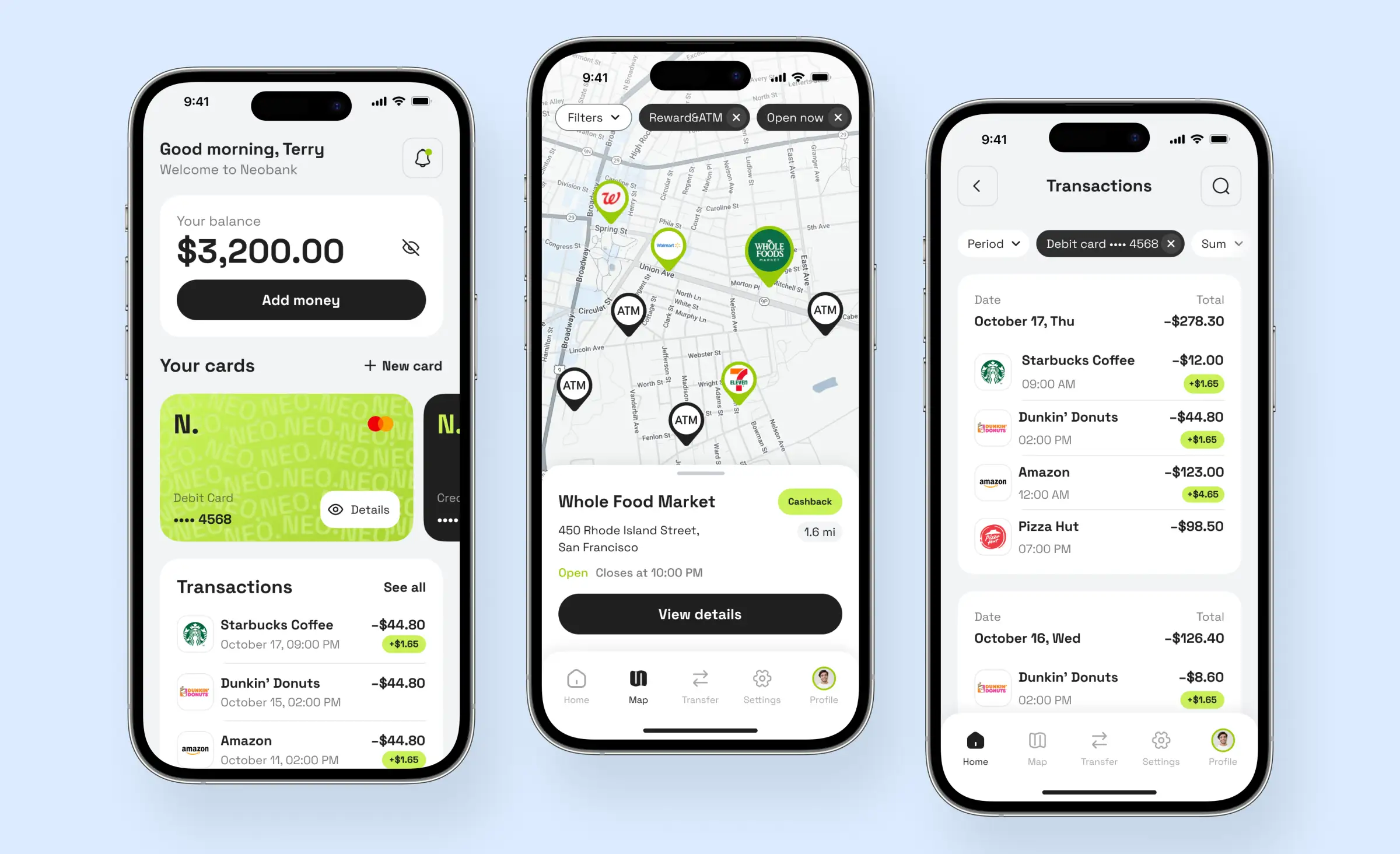
For this project, our task was to build a stable, secure mobile platform that helps users boost their credit scores and manage their finances safely. We implemented a microservice architecture and followed a robust business continuity plan. Our team set up cloud disaster recovery by using Cloud SQL replication and automatic backups to ensure no financial data would be lost during outages or system failures. Each service was isolated, with separate databases and access restrictions, which improved digital assets protection and reduced risks during potential incidents.
With continuous monitoring and strict data management practices, we created a resilient IT infrastructure that maintains high availability and keeps sensitive user data protected at every step. As a result, when the Neobank app went live, it met strict security and regulatory requirements, handled growing user numbers smoothly, and enabled ongoing updates with minimal risk.
To conclude
Disaster recovery and business continuity cloud solutions are essential for any company that wants to protect data and minimize downtime. By creating a strong business continuity plan, adopting modern cloud architecture, and using secure cloud platforms, organizations ensure reliable data backup and recovery as well as resilient data storage. Cloud disaster recovery allows businesses to recover swiftly from disruptions, while robust IT infrastructure and cloud resilience strategies keep operations steady even during unexpected events.
With automated data protection in cloud environments and continuous monitoring, your business gains a secure data environment and stays prepared for any challenge. Ultimately, investing in advanced cloud infrastructure and proven disaster recovery practices makes sure your organization is safe, agile, and able to grow with confidence.
Related posts




Related Services
DevOps Services
Accelerate your software delivery with Ronas IT's DevOps services. We streamline development and deployment through CI/CD automation, proactive monitoring, and secure cloud infrastructure. Enjoy faster releases, minimal downtime, and scalable solutions — letting you focus on growth while we handle seamless operations.
AI Software Development Services
We deliver custom AI solutions, including generative AI, chatbots, predictive analytics, and recommendation systems. From strategy to integration and ongoing support, our expert team ensures secure, scalable, and value-driven AI applications tailored to your needs, so you can innovate faster and stay ahead of the competition.
Enterprise Software Development Services
We create scalable, secure solutions like CRMs, HR systems, and workflow automation tools — tailored to your company’s specific needs. Our team handles everything from research and UI/UX design to seamless integration and ongoing support, ensuring improved productivity, unified communication, and full data ownership for your enterprise.
Custom software development solutions
Build secure, scalable software tailored to your business. We develop custom web, mobile, and enterprise solutions designed to fit your workflows, streamline operations, and support growth. From MVPs to large-scale products, we handle the full development cycle so you can launch faster and scale with confidence.